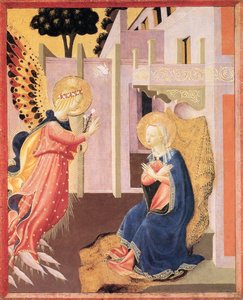
Zanobi Strozzi, 1412 – 1468

Zanobi Strozzi: De 25 mest berømte malerier

Madonna and Child with Angels (1434) er det mest berømte maleri af Zanobi Strozzi, som er i Convent of San Marcos samling i Firenze. Camaldolese Friars in Choir (1450) og The Annunciation (1442) er de næste to værker, som verden kender bedst. Udvalgt fra de 26 værker af Zanobi Strozzi i vores katalog er her de 25, som samlere og museumsgæster oftest opsøger, inklusiv årstal, museum og historien bag hvert værk.

Rangordnet efter vores popularitetsscore, som kombinerer søgninger, besøg og ordrer for hvert værk. Opdateret oktober 2026. Hvert mesterværk på denne side kan bestilles som en håndmalet oliereproduktion i museumskvalitet eller som et kunsttryk i den størrelse, du vælger.

Portræt af Zanobi Strozzi
Zanobi Strozzi · 1412 – 1468
Født · død
1412 – 1468, Firenze
Bevægelse
Early renaissance
Værker i vores katalog
26
Mest kendte
Madonna and Child with Angels (1434)
Flest værker hos
National Gallery

Top 10: Zanobi Strozzis mest kendte malerier

Madonna and Child with Angels (1434) af Zanobi Strozzi
1

Madonna and Child with Angels

1434 · Oil On Canvas · Convent of San Marco, Firenze

A Vision of Divine Grace: Zanobi Strozzi's Madonna and Child with Angels To gaze upon this masterpiece by Zanobi Strozzi is to step directly into the luminous heart of the Early Renaissance. The scene unfolds with an almost palpable sense of sacred tranquility, centering on the Virgin Mary cradling the divine presence of the Christ Child. It is more than a mere portrait; it is a profound meditation on motherhood,…

Hand-painted oil reproduction from $181 30 × 34 cm Same size as the original $680 127 × 138 cm Order at original size →
Camaldolese Friars in Choir (1450) af Zanobi Strozzi
2

Camaldolese Friars in Choir

1450 · Tempera On Panel

In this 1450 composition, we find ourselves drawn into a quiet, sacred space where time seems to have slowed. A group of Camaldolese friars is gathered in a choir, their figures arranged with a sense of rhythmic unity. Some monks stand at the forefront, while others recede into the background, creating a subtle depth within the square format. They are dressed in heavy robes that signal their religious devotion, their…

Hand-painted oil reproduction from $181 32 × 32 cm
The Annunciation (1442) af Zanobi Strozzi
3

The Annunciation

1442 · Tempera On Panel · National Gallery, London

The Annunciation by Zanobi Strozzi captures a suspended moment of divine interruption. Created about 1440-5, the painting depicts the Archangel Gabriel arriving to deliver a celestial message to the Virgin Mary. A single dove, representing the Holy Ghost, descends with a gilded halo above the angel's head. The scene is framed by the quiet weight of classical columns, separating the celestial messenger from the woman receiving the news.

Hand-painted oil reproduction from $206 37 × 27 cm Same size as the original $624 142 × 105 cm Order at original size →
Virgin and Child with Four Angels and the Redeemer (1450) af Zanobi Strozzi
4

Virgin and Child with Four Angels and the Redeemer

1450 · Tempera On Panel · Brooklyn Museum, Brooklyn

The air within the sacred space feels heavy with the scent of old wood and the silent weight of devotion. At the center of this celestial assembly, the Virgin Mary sits with a quiet, solemn grace, her presence anchoring the entire composition. She holds the Christ Child, whose small form is framed by the deep, ultramarine blue of her mantle and the rich crimson of her tunic. Around them, four…

Hand-painted oil reproduction from $331 25 × 40 cm Same size as the original $424 51 × 79 cm Order at original size →
Scenes from the Story of Susanna: Susanna and the Elders (1450) af Zanobi Strozzi
5

Scenes from the Story of Susanna: Susanna and the Elders

1450 · Tempera On Panel · Musée du Petit Palais, Avignon

The panel stretches wide, a long horizontal sequence of moments captured in tempera. It unfolds like a silent play, divided into three distinct stages of a biblical drama. On the far left, the heavy lines of an interior architectural setting frame the beginning of the tension. The center shifts to an outdoor garden, where a circular structure anchors the composition. Finally, the eye moves to the right, toward a landscape…

Hand-painted oil reproduction from $756 55 × 18 cm Same size as the original $948 170 × 43 cm Order at original size →
Saints Zenobius, Francis and Anthony of Padua (1450) af Zanobi Strozzi
6

Saints Zenobius, Francis and Anthony of Padua

1450 · Tempera On Panel · Yale University Art Gallery, New Haven

This Renaissance-era religious panel painting presents three saints arranged side-by-side in a vertical, frontal composition. The figures occupy a shallow space against a background of patterned gold leaf, which creates a flat, celestial setting. On the left, a figure is dressed in episcopal regalia, including a mitre, and holds a book. The central figure is depicted in a brown monastic habit with hands clasped in prayer. To the right, the…

Hand-painted oil reproduction from $231 25 × 40 cm Same size as the original $310 47 × 77 cm Order at original size →
Altarpiece of Saint Jerome (1460) af Zanobi Strozzi
7

Altarpiece of Saint Jerome

1460 · Tempera On Panel · Musée du Petit Palais, Avignon

The Altarpiece of Saint Jerome is a significant work by the Florentine painter Zanobi Strozzi. Created about 1460, this large-scale panel was originally commissioned for the convent of San Girolamo in Fiesole. The commission for this religious work was awarded by the Medici, reflecting the close ties between the artist and the influential family during the Quattrocento.

Hand-painted oil reproduction from $506 34 × 29 cm Same size as the original $1492 217 × 156 cm Order at original size →
The Last Judgement (1456) af Zanobi Strozzi
8

The Last Judgement

1456 · Tempera On Panel · Gemäldegalerie, Berlin

The Last Judgement, also known as Das Jüngste Gericht, is a work by Zanobi Strozzi. Created in 1456, the painting emerged from the hands of Zanobi di Benedetto di Caroccio degli Strozzi. This Florentine artist, born in Florence, Italy, brought a specific precision to the panel. The wood of the support is poplar.

Hand-painted oil reproduction from $1506 37 × 27 cm
The Annunciation (1453) af Zanobi Strozzi
9

The Annunciation

1453 · Tempera On Panel · Philadelphia Museum of Art, Philadelphia

The artwork depicts the Annunciation scene, a sacred moment of divine communication. The composition centers on two figures: an angel presenting lilies to Mary, who is seated in a state of prayer and sudden awareness. The angel's pink gown features the gold-lettered greeting "Ave Maria" within its folds. Mary is characterized by the deep blue of her mantle and a posture of stillness. A single dove, representing the Holy Spirit,…

Hand-painted oil reproduction from $206 28 × 35 cm Same size as the original $209 30 × 37 cm Order at original size →
The Nativity (1436) af Zanobi Strozzi
10

The Nativity

1436 · Tempera On Panel · Metropolitan Museum of Art, New York

The Nativity is a painting by Zanobi Strozzi, an artist born in 1412 in Florence, Italy. He remained in Florence until his death in 1468. This specific work is attributed to Strozzi and is also identified by the alternative title, Adoration of the Child.

Hand-painted oil reproduction from $231 27 × 36 cm

Resten af Zanobi Strozzi-ranglisten, fra 11 til 25

Vallombrosan Gradual (1437) af Zanobi Strozzi
#11

Vallombrosan Gradual

1437 · Calouste Gulbenkian Foundation

In this 1437 work, we find ourselves drawn into a celestial assembly that feels both intimate and vast. The composition centers on Jesus, who is surrounded by a…

Tag den med hjem from $181 →
St Agnes (1448) af Zanobi Strozzi
#17

St Agnes

1448 · Convent of San Marco

The tempera panel painting, “St Agnes,” attributed to Zanobi Strozzi and completed in 1448, is more than simply a depiction of a saint; it's a meticulously crafted window…

Tag den med hjem from $181 →
The Nativity (1433) af Zanobi Strozzi
#22

The Nativity

1433 · Metropolitan Museum of Art

Although long ascribed to Fra Angelico, this enchanting Nativity is probably by his pupil Zanobi Strozzi, who is especially known for his manuscript illuminations. The scene is from…

Bestil en reproduktion from $181 →

Zanobi Strozzis malerier efter periode

De motiver Zanobi Strozzi malede mest

De fire motiver, der optræder hyppigst blandt disse mesterværker, med det fineste eksempel på hvert enkelt.

Hvor kan man se Zanobi Strozzi's malerier

De 8 museer, der rummer flest af malerierne på denne side.

Museum By Værker af Zanobi Strozzi Malerier fra denne liste
National Gallery, LondonNational Gallery London 3 The Annunciation, The Adoration of the Magi, The Abduction of Helen
Metropolitan Museum of Art, New YorkMetropolitan Museum of Art New York 3 The Nativity, Initial B with David in Prayer, The Nativity
Convent of San Marco, FirenzeConvent of San Marco Firenze 2 Madonna and Child with Angels, St Agnes
Musée du Petit Palais, AvignonMusée du Petit Palais Avignon 2 Scenes from the Story of Susanna: Susanna and the Elders, Altarpiece of Saint Jerome
Walters Art Museum, BaltimoreWalters Art Museum Baltimore 2 Book of Hours for the Use of Rome (Folios 169v-170r), Book of Hours for the Use of Rome (Folios 14v-15r)
Brooklyn Museum, BrooklynBrooklyn Museum Brooklyn 1 Virgin and Child with Four Angels and the Redeemer
Yale University Art Gallery, New HavenYale University Art Gallery New Haven 1 Saints Zenobius, Francis and Anthony of Padua
Gemäldegalerie, BerlinGemäldegalerie Berlin 1 The Last Judgement

Zanobi Strozzi gennem årtierne: et mesterværk for hvert årti

  1. 1430s
    Madonna and Child with Angels (1434) af Zanobi Strozzi
    Nr. 1 ud af 25

    Madonna and Child with Angels

    Alder 18 – 27 · Convent of San Marco

    A Vision of Divine Grace: Zanobi Strozzi's Madonna and Child with Angels To gaze upon this masterpiece by Zanobi Strozzi is to step directly into the luminous heart…

  2. 1440s
    The Annunciation (1442) af Zanobi Strozzi
    Nr. 3 ud af 25

    The Annunciation

    Alder 28 – 37 · National Gallery

    The Annunciation by Zanobi Strozzi captures a suspended moment of divine interruption. Created about 1440-5, the painting depicts the Archangel Gabriel arriving to deliver a celestial message to…

  3. 1450s
    Camaldolese Friars in Choir (1450) af Zanobi Strozzi
    Rang 2 ud af 25

    Camaldolese Friars in Choir

    Alder 38 – 47

    In this 1450 composition, we find ourselves drawn into a quiet, sacred space where time seems to have slowed. A group of Camaldolese friars is gathered in a…

  4. 1460s
    Altarpiece of Saint Jerome (1460) af Zanobi Strozzi
    #7 ud af 25

    Altarpiece of Saint Jerome

    Alder 48 – 56 · Musée du Petit Palais

    The Altarpiece of Saint Jerome is a significant work by the Florentine painter Zanobi Strozzi. Created about 1460, this large-scale panel was originally commissioned for the convent of…

Zanobi Strozzis malerier: ofte stillede spørgsmål

Hvad er det mest berømte maleri af Zanobi Strozzi?Vis svaret

Madonna and Child with Angels (1434), Convent of San Marco, Firenze. Derefter følger Camaldolese Friars in Choir (1450) og The Annunciation (1442).

Hvilken alder havde Zanobi Strozzi, da Madonna and Child with Angels blev malet?Vis svaret

22 år gammel: Madonna and Child with Angels er fra 1434, og Zanobi Strozzi blev født i 1412.

Hvilke er de 10 mest berømte Zanobi Strozzi malerier?Vis svaret

Madonna and Child with Angels, Camaldolese Friars in Choir, The Annunciation, Virgin and Child with Four Angels and the Redeemer, Scenes from the Story of Susanna: Susanna and the Elders, Saints Zenobius, Francis and Anthony of Padua, Altarpiece of Saint Jerome, The Last Judgement, The Annunciation og The Nativity. Ranglisten ovenfor angiver årstallet og museet for hver af dem.

Hvor mange malerier af Zanobi Strozzi er der?Vis svaret

Vores katalog indeholder 26 værker af Zanobi Strozzi, dateret fra 1433 til 1463.

Hvor kan jeg se de mest berømte Zanobi Strozzi malerier?Vis svaret

De fleste af dem findes i National Gallery (London), Metropolitan Museum of Art (New York) og Convent of San Marco (Firenze). Tabellen ovenfor lister museerne enkeltvis.

I hvilken periode malede Zanobi Strozzi sine mest kendte værker?Vis svaret

I 1450s: 9 af de 25 værker på denne side stammer fra denne periode, herunder Camaldolese Friars in Choir.

Hvad er det tidligste berømte maleri af Zanobi Strozzi, og hvad er det nyeste?Vis svaret

Det tidligste på denne side er The Nativity (1433), det seneste Book of Hours for the Use of Rome (1463).

Hvilke motiver malede Zanobi Strozzi?Vis svaret

Angels (4), Woman (3) og Child (3), blandt de 25 værker på denne side.

Hvad malede Zanobi Strozzi på, og med hvad?Vis svaret

Tempera On Panel: 11 ud af de 25 værker på denne side.

Hvilken stilart tilhører Zanobi Strozzis kunst?Vis svaret

Early renaissance, som malerierne på denne side viser.

Hvilke malerier af Zanobi Strozzi har National Gallery i sin samling?Vis svaret

The Annunciation, The Adoration of the Magi og The Abduction of Helen er blandt de 3 værker på denne side, som er i National Gallery, London's samling.

Hvor kan jeg købe en Zanobi Strozzi reproduktion?Vis svaret

Ja. Hvert maleri på denne side kan bestilles som en håndmalet oliereproduktion i museums kvalitet eller som et kunstprint i den størrelse, du ønsker, direkte fra maleriets egen side.

Zanobi Strozzi: biografi

Den florentinske visionær: Livet og eftermælet efter Zanobi Strozzi

I den florentinske renæssances guldalder, hvor lys og skygge begyndte at danse med en nyfundet humanistisk dybde, trådte navnet Zanobi Strozzi frem som en livsvigtig tråd i byens kunstneriske gobelin. Zanobi blev født i 1412 ind i den illustre Strozzi-familie, og hans tidlige liv blev formet af de dybe politiske omvæltninger i Firenze. Selvom hans herkomst forbandt ham med adelen, drev sin fars tidlige død, da Zanobi kun var femten år gammel, ham mod en anden skæbne. Denne periode med personligt tab førte ham ind i det transformative lærlingeforhold under Battista di Biagio Sanguigni, et mentorskab, der med tiden ville forfine hans hånd og indgyde ham den tekniske præcision, der var nødvendig for at mestre den delikate kunst inden for manuskriptillumination og panelmaleri.

Strozzis kunstneriske udvikling var dybt sammenvævet med sin tids åndelige og æstetiske strømninger. Hans mest betydningsfulde forbindelse var dog hans relation til den ærede Fra Angelico. Som elev i denne indflydelsesrige kreds efterlignede Strozzi ikke blot mesteren; han opsugede en dyb følelse af hengivenhed og en lysende tilgang til farver, som skulle blive kendetegn for hans egen stil. Dette forhold muliggjorde en smuk stilistisk sammensmeltning, hvor det æteriske, guddommelige lys, der er karakteristisk for Fra Angelico, mødte Strozzi’s omhyggelige sans for detaljen. Hans arbejde byggede ofte bro mellem de intime, miniatureagtige verdener i illuminerede manuskripter og den storslåede, følelsesladede tilstedeværelse i religiøse altertavler.

Mestring af detaljen og den hengivne skønhed

Omfanget af Strozzi’s talent er mest tydeligt i hans evne til at navigere i forskellige medier med samme ynde. Han var en mester i tempera på panel, et medie der krævede enorm tålmodethed og en rolig hånd for at opnå de levende, juvelagtige toner, man ser i hans religiøse værker. Hans repertoire omfattede flere betydningsfulde altertavler og rørende skildringer af Jomfru og Barn, værker designet til at vække dyb spirituel refleksion hos beskueren. I disse værker benyttede Strozzi den florentinske tidlige renæssancestil til at væve fortællinger om tro, hvor han brugte bløde overgange og indviklede mønstre til at puste liv i de hellige figurer.

Udover de større paneler opnåede Strozzi legendarisk status gennem sine bidrag til manuskriptillumination. Hans evne til at beherske små rum gjorde det muligt for ham at skabe miniatureverdener af en åndeløs kompleksitet. Nogle af hans mest bemærkelsesværdige kunstneriske bedrifter inkluderer:

  • Skt. Cosmas og Damian reddet fra drukning: Et mesterværk fra 1435, der indfanger et rørende øjeblik af guddommelig indgriben og fremviser hans evne til at skildre fælles tro og dramatisk bevægelse.
  • Skt. Agnes: Skabt i 1448, dette værk eksemplificerer hans evne til at fremstille serene profilportrætter mod svungne, dekorative mønstre, der fremhæver periodens elegance.
  • Tidebog til brug i Rom: Et vidnesbyrd om hans dygtighed som illuminator, hvor hvert folio fungerer som et vindue ind i det minutiøse håndværk i det florentinske scriptorium.

Et varigt indtryk på renæssancen

Den historiske betydning af Zanobi Strozzi ligger i hans rolle som en bro mellem den middelalderlige tradition for dekorativ illumination og renæssancens spirende fokus på menneskelig følelse og naturalisme. Selvom meget af hans arbejde var bestemt til privat andagt i Firenzes storslåede residenser, gav hans indflydelse genlyd i byens værksteder. Han var med til at sprede en specifik form for florentinsk skønhed – en der var både intellektuelt stringent og følelsesmæssigt tilgængelig. Gennem hans hænder blev de hellige fortællinger om helgenerne og Jomfru Maria fremstillet med en klarhed og vitalitet, der indfangede selve essensen af Quattrocento-ånden.

Selvom han gik bort i 1468 og efterlod sig en arv præget af bladguld og tempera, forbliver Strozzi et symbol på kunstnerens evne til at finde dyb mening i det mikroskopiske. Hans liv, der var markeret af overgangen fra en adelig forældreløs til en fejret mester, spejler selve transformationen af Firenze: en rejse fra fortidens strukturerede traditioner mod renæssancens lysende, menneskecentrerede genialitet.