Théodore Géricault, 1791 – 1824

The 100 Most Famous Paintings by Théodore Géricault

The painting that made Théodore Géricault famous is Raftet af Médusa (1818); it hangs in the Louvre, Paris. Nymph and Satyr (Jupiter and Antiope) (1820) and The Oath of Brutus after the Death of Lucretia (1815) follow it in the hearts of collectors and museum visitors. Of the 183 works by Théodore Géricault in our catalogue, these 100 are the most admired, each presented with its date, its museum and what sets it apart.

Rangordnet efter vores popularitetsscore, som kombinerer søgninger, besøg og ordrer for hvert værk. Opdateret oktober 2026. Every masterpiece on this page can be ordered as a museum-quality, hand-painted oil reproduction or a fine art print, at the size you choose.

Portræt af Théodore Géricault
Théodore Géricault · 1791 – 1824
Født · død
1791 – 1824, Rouen
Bevægelse
Romanticisme dramatique
Værker i vores katalog
183
Mest kendte
Raftet af Médusa (1818)
Flest værker hos
Louvre

Théodore Géricault: the ten masterpieces

Raftet af Médusa (1818) af Théodore Géricault
1

Raftet af Médusa

1818 · Olie på lærred · Louvre, Paris

Jean-Louis André Théodore Géricaults monumentale mesterværk er mere end blot en gengivelse af en søkatastrofe; det er en visceral udforskning af menneskelig desperation, politisk skandale og naturens sublime styrke. Dette over-livsstørrelse lærred (491 x 716 cm), som blev færdiggjort i 1819, foreviger de rædselsvækkende eftervirkninger af det franske fregatskib Méduses forlis i 1816 – en tragedie født af inkompetence og korruption, der chokerede Frankrig.

Nymph and Satyr (Jupiter and Antiope) (1820) af Théodore Géricault
2

Nymph and Satyr (Jupiter and Antiope)

1820 · Acrylic On Canvas · Musée des Beaux-Arts et de la Céramique, Rouen

The Allure of the Divine Encounter: Géricault’s *Nymph and Satyr* Jean-Louis André Théodore Géricault's *Nymph and Satyr*, painted in 1819, isn’t merely a depiction of a mythological scene; it’s a profound exploration of desire, transgression, and the inherent tension between innocence and primal instinct. Born amidst the tumultuous backdrop of post-revolutionary France, Géricault, already recognized for his dramatic intensity, sought to capture not just a narrative but an emotional truth—a…

Lions in a Mountainous Landscape (1818) af Théodore Géricault
4

Lions in a Mountainous Landscape

1818 · Acrylic On Canvas · Metropolitan Museum of Art, New York

This vigorous painting of six lions in a remote, spectrally illuminated lair—possibly intended to evoke the Atlas Mountains of Morocco—is an extraordinary example of Gericault’s spontaneous handling of paint. Rather than applying finishing touches to make a polished cabinet picture, the artist left the painting in a state known as an esquisse, or sketch, a work prized by fellow artists for its strength of directly capturing a subject or effect.…

The Kiss (1822) af Théodore Géricault
5

The Kiss

1822 · Acrylic On Canvas · Thyssen-Bornemisza Museum, Madrid

Théodore Géricault's "The Kiss," painted in 1816, isn’t merely a depiction of lovers entwined; it’s a visceral embodiment of the burgeoning Romantic movement’s fascination with raw emotion, dramatic intensity, and the sublime. This arresting work, housed within the Thyssen-Bornemisza Museum in Madrid, transcends simple representation to become a profound meditation on passion, vulnerability, and the very essence of human connection. Géricault, already a figure known for his unflinching portrayals of…

Wounded Soldiers Retrating from Russia (1814) af Théodore Géricault
6

Wounded Soldiers Retrating from Russia

1814 · Acrylic On Canvas · Musée des Beaux-Arts, Rouen

A Symphony of Suffering: Géricault’s “Wounded Soldiers Retrating from Russia” Jean-Louis André Théodore Géricault's "Wounded Soldiers Retrating from Russia" is not merely a painting; it’s a visceral embodiment of the horrors and human cost of war, rendered with an unprecedented level of realism and emotional intensity for its time. Completed in 1814, this monumental canvas—measuring a commanding 250 x 206 cm—captures a pivotal moment during Napoleon's disastrous invasion of Russia,…

Study of Feet and Hands (1818) af Théodore Géricault
7

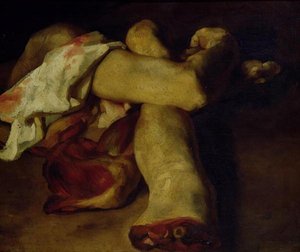
Study of Feet and Hands

1818 · Oil On Canvas · Musée Fabre, Montpellier

Jean-Louis André Théodore Géricault's "Study of Feet and Hands," painted in 1818, isn’t a grand statement of Romantic drama like his monumental “The Raft of the Medusa.” Instead, it offers a profoundly intimate glimpse into the artist’s meticulous process and a poignant meditation on the human form. This unassuming oil painting—measuring a modest 52 x 64 cm—is far more than just a preparatory sketch; it's a concentrated distillation of Géricault’s…

The Raft of the Medusa (detail) (1818) af Théodore Géricault
8

The Raft of the Medusa (detail)

1818 · Oil On Canvas · Louvre, Paris

Jean-Louis André Théodore Géricault's "The Raft of the Medusa," a monumental detail from his 1818 painting, isn’t merely a depiction of shipwreck; it’s a visceral plunge into the depths of human suffering and political indictment. The scene, rendered with a dramatic intensity characteristic of Romanticism, captures the harrowing aftermath of the French frigate *Medusa*'s wreck off the coast of Mauritania in 1816. This disaster, largely attributed to the incompetence and…

The Wreck (1821) af Théodore Géricault
10

The Wreck

1821 · Oil On Canvas · Louvre, Paris

Théodore Géricault's "The Wreck," painted in 1821, isn’t merely a seascape; it’s a visceral confrontation with the sublime—a raw depiction of humanity’s vulnerability against the overwhelming force of nature. Born amidst the turbulent currents of post-revolutionary France, Géricault, a figure both lauded and controversial within the burgeoning Romantic movement, channeled his own anxieties and the era's fascination with dramatic events into this monumental canvas. The painting immediately commands attention not…

More Théodore Géricault masterpieces, 11 to 100

The Horse Race (1816) af Théodore Géricault
#11

The Horse Race

1816 · Thyssen-Bornemisza Museum

Jean-Louis André Théodore Géricault's "The Horse Race," painted in 1816, isn’t merely a depiction of a sporting event; it’s a visceral embodiment of Romanticism’s core tenets – passion,…

Bring it home →
Swiss Guard and Wounded Veteran (1819) af Théodore Géricault
#12

Swiss Guard and Wounded Veteran

1819 · Louvre

Jean-Louis André Théodore Géricault's "Swiss Guard and Wounded Veteran," painted in 1819, is not merely a historical depiction; it’s a profound meditation on duty, sacrifice, and the lingering…

Order a reproduction →
Mazeppa (1823) af Théodore Géricault
#13

Mazeppa

1823 · Château de Chantilly

Théodore Géricault's "Mazeppa," painted in 1823, isn’t merely a depiction of a dramatic legend; it’s a visceral embodiment of Romantic turmoil—a raw exploration of suffering, resilience, and the…

Bring it home →
Two Horses (1809) af Théodore Géricault
#14

Two Horses

1809 · The Phillips Collection

Jean-Louis André Théodore Géricault's "Two Horses," painted in 1808-1809, isn’t merely a depiction of two magnificent animals; it’s a visceral exploration of movement, power, and the fleeting nature…

Bring it home →
A Turk (Mustapha) (1820) af Théodore Géricault
#15

A Turk (Mustapha)

1820 · Louvre

Jean-Louis André Théodore Géricault's "A Turk (Mustapha)," painted in 1820, is not merely a portrait; it’s a carefully constructed tableau of exoticism, melancholy, and the burgeoning Romantic sensibility…

Order a reproduction →
A Carabinier with his Horse (1814) af Théodore Géricault
#16

A Carabinier with his Horse

1814 · Musée des Beaux-Arts

In the quiet intensity of Jean-Louis André Théodore Géricault’s 1814 masterpiece, "A Carabinier with His Horse," we encounter more than a mere military portrait; we witness a profound…

Order a reproduction →
Riderless Horse Races (detail) (1817) af Théodore Géricault
#17

Riderless Horse Races (detail)

1817 · Louvre

A Moment Frozen in Time: Géricault’s “Riderless Horse Races” Jean-Louis André Théodore Géricault's "Riderless Horse Races (detail)" is not merely a depiction of a sporting event; it’s a…

Bring it home →
Boxers (1818) af Théodore Géricault
#18

Boxers

1818 · Château de Chantilly

A Tempestuous Vision: Géricault’s “Boxers” Jean-Louis André Théodore Géricault's "Boxers," completed in 1818, isn’t merely a depiction of a boxing match; it’s a visceral embodiment of Romanticism’s fascination…

Order a reproduction →
The Epsom Derby (1821) af Théodore Géricault
#20

The Epsom Derby

1821 · Louvre

Jean-Louis André Théodore Géricault's "The Epsom Derby," painted in 1821, isn’t merely a depiction of horse racing; it’s a visceral embodiment of Romanticism’s fascination with drama, movement, and…

Bring it home →
Three Lovers (1817) af Théodore Géricault
#22

Three Lovers

1817 · J. Paul Getty Museum

Théodore Géricault captured a private, feverish moment in Three Lovers. This small oil sketch, created about 1817–1820, offers a rare glimpse into the artist's more intimate preoccupations. It…

Order a reproduction →
Lion devouring a horse af Théodore Géricault
#26

Lion devouring a horse

Château de Chantilly

Théodore Géricault's "Lion Devouring a Horse," painted in 1819, isn’t merely a depiction of predatory action; it’s a visceral exploration of power, mortality, and the primal instincts that…

Bring it home →
Untitled (ARJCHM) af Théodore Géricault
#28

Untitled (ARJCHM)

Louvre

In the annals of art history, few works command the room with such visceral intensity as Théodore Géricault’s The Raft of the Medusa. This monumental oil on canvas…

Bring it home →
Portrait of a Young Man (1818) af Théodore Géricault
#32

Portrait of a Young Man

1818 · Minneapolis Institute of Art

A young man emerges from a deep, indistinct darkness, his presence felt through the sudden, sharp clarity of light hitting his features. He sits in a quiet, intimate…

Order a reproduction →
A study for a nude. (1801) af Théodore Géricault
#33

A study for a nude.

1801 · Nationalmuseet i Warszawa

A study for a nude. emerges from the shadows as a powerful presence by Théodore Géricault. Created about 1801, this oil on canvas captures a singular moment of…

Bring it home →
Study of a Model (1818) af Théodore Géricault
#34

Study of a Model

1818 · J. Paul Getty Museum

This oil on canvas portrait study presents a close-up, three-quarter view of a Black man's head and shoulders. The subject is positioned slightly off-center, looking toward the viewer…

Commission a hand-painted copy →
The Martyrdom of Saint Peter (1814) af Théodore Géricault
#35

The Martyrdom of Saint Peter

1814 · Kunstmuseum Basel

The Martyrdom of Saint Peter is an oil on canvas by Théodore Géricault. Created about 1814, the work captures a moment of profound tension. The physical presence of…

Bring it home →
The Wreck (1824) af Théodore Géricault
#36

The Wreck

1824 · Louvre

In the annals of French Romanticism, few works command the visceral attention of Théodore Géricault’s The Wreck as profoundly as this haunting seascape. Painted in 1824, a year…

Commission a hand-painted copy →
Mater dolorosa, Copy after Ribera (1811) af Théodore Géricault
#38

Mater dolorosa, Copy after Ribera

1811 · Kunstmuseum Basel

Mater dolorosa, Copy after Ribera is a religious oil painting by the French artist Théodore Géricault. Created about 1811–1815, the work reflects the artist's engagement with the traditions…

Bring it home →
Lion in Repose af Théodore Géricault
#39

Lion in Repose

Walters Art Museum

Jean-Louis André Théodore Géricault’s “Lion in Repose,” painted circa 1820-1823, isn’t merely a depiction of an animal; it’s a profound meditation on power, vulnerability, and the very nature…

Order a reproduction →
Portrait of a Negro (1800) af Théodore Géricault
#71

Portrait of a Negro

1800 · Palácio Nacional da Ajuda

Dating from 1800, Jean-Louis André Théodore Géricault’s “Portrait of a Negro” is more than just a depiction of an individual; it’s a poignant statement born from the turbulent…

Bring it home →
Portrait d'homme (1825) af Théodore Géricault
#73

Portrait d'homme

1825 · Musée Fabre

Portrait d'homme is an oil on canvas work attributed to the French Romantic painter Théodore Géricault. While historically categorized under various titles, including a mistaken identification as a…

Commission a hand-painted copy →
Horses of the Auvergne (1822) af Théodore Géricault
#76

Horses of the Auvergne

1822 · University of Michigan Museum of Art

In the quiet, monochromatic depths of Théodore Géricault’s 1822 lithograph, Horses of the Auvergne, we are transported to a rugged, mist-shrouded corner of France. This evocative work serves…

Commission a hand-painted copy →
A Prancing Grey Horse (1812) af Théodore Géricault
#77

A Prancing Grey Horse

1812 · Burrell Collection

A single light grey horse occupies the center of this oil painting, captured in a rearing pose. The animal's body is angled vertically, its muscular flanks and neck…

Bring it home →
Sheet of Figure Studies (1818) af Théodore Géricault
#78

Sheet of Figure Studies

1818 · Courtauld Gallery

To gaze upon Jean-Louis André Théodore Géricault’s "Sheet of Figure Studies" is not merely to look at painted forms; it is to witness the very act of human…

Bring it home →
The Plaster Kiln (1823) af Théodore Géricault
#82

The Plaster Kiln

1823 · Louvre

In the quiet, brooding landscapes of nineteenth-century France, few works capture the raw, unvarnished essence of pastoral life as poignantly as Théodore Géricault’s “The Plaster Kiln.” Completed in…

Order a reproduction →

Théodore Géricault's paintings by period

The subjects Théodore Géricault painted most

The four subjects that return most often among these masterpieces, with the finest example of each.

Where to see Théodore Géricault's paintings

De 8 museer, der rummer flest af malerierne på denne side.

Museum By Værker af Théodore Géricault Malerier fra denne liste
Louvre, ParisLouvre Paris 20 Raftet af Médusa, The Raft of the Medusa (detail), Leda and the Swan
Château de Chantilly, ChantillyChâteau de Chantilly Chantilly 6 Mazeppa, Boxers, Lion devouring a horse
J. Paul Getty Museum, Los AngelesJ. Paul Getty Museum Los Angeles 3 Three Lovers, Study of a Model, The Race of the Riderless Horses
Nationalmuseet i Warszawa, WarszawaNationalmuseet i Warszawa Warszawa 3 Equestrian portrait of Wincenty Krasiński., A study for a nude., Study of a nude man
Burrell Collection, GlasgowBurrell Collection Glasgow 8 The Trumpeter of the Lancers of the Guard, A Prancing Grey Horse
Musée Fabre, MontpellierMusée Fabre Montpellier 4 Study of Feet and Hands, Portrait d'homme
Petit Palais, ParisPetit Palais Paris 3 The Scotsman, Italian Landscape with Tomb
Thyssen-Bornemisza Museum, MadridThyssen-Bornemisza Museum Madrid 2 The Kiss, The Horse Race

Théodore Géricault, decade by decade: the defining painting of each

  1. 1800s
    Two Horses (1809) af Théodore Géricault
    Rank 14 / 100

    Two Horses

    Alder 9 – 18 · The Phillips Collection

    Jean-Louis André Théodore Géricault's "Two Horses," painted in 1808-1809, isn’t merely a depiction of two magnificent animals; it’s a visceral exploration of movement, power, and the fleeting nature…

  2. 1810s
    Raftet af Médusa (1818) af Théodore Géricault
    No. 1 of 100

    Raftet af Médusa

    Alder 19 – 28 · Louvre

    Jean-Louis André Théodore Géricaults monumentale mesterværk er mere end blot en gengivelse af en søkatastrofe; det er en visceral udforskning af menneskelig desperation, politisk skandale og naturens sublime…

  3. 1820s
    Nymph and Satyr (Jupiter and Antiope) (1820) af Théodore Géricault
    #2 of 100

    Nymph and Satyr (Jupiter and Antiope)

    Alder 29 – 33 · Musée des Beaux-Arts et de la Céramique

    The Allure of the Divine Encounter: Géricault’s *Nymph and Satyr* Jean-Louis André Théodore Géricault's *Nymph and Satyr*, painted in 1819, isn’t merely a depiction of a mythological scene;…

Théodore Géricault's masterpieces: questions and answers

Which painting is Théodore Géricault best known for?Show the answer

Raftet af Médusa (1818), Louvre, Paris. Next come Nymph and Satyr (Jupiter and Antiope) (1820) and The Oath of Brutus after the Death of Lucretia (1815).

How old was Théodore Géricault when painting Raftet af Médusa?Show the answer

27 years old: Raftet af Médusa dates from 1818 and Théodore Géricault was born in 1791.

What are Théodore Géricault's ten greatest paintings?Show the answer

Raftet af Médusa, Nymph and Satyr (Jupiter and Antiope), The Oath of Brutus after the Death of Lucretia, Lions in a Mountainous Landscape, The Kiss, Wounded Soldiers Retrating from Russia, Study of Feet and Hands, The Raft of the Medusa (detail), Leda and the Swan og The Wreck. The ranking above gives the year and the museum of each.

How many works did Théodore Géricault paint?Show the answer

Our catalogue lists 183 works by Théodore Géricault, dated from 1800 to 1824.

In which museums can I see Théodore Géricault's masterpieces?Show the answer

Most of them are in Louvre (Paris), Château de Chantilly (Chantilly) og J. Paul Getty Museum (Los Angeles). The table above lists the museums one by one.

When did Théodore Géricault paint the masterpieces?Show the answer

In 1810s: 67 of the 100 works on this page date from then, among them Raftet af Médusa.

What are the first and last famous paintings of Théodore Géricault?Show the answer

The earliest on this page is Portrait of a Negro (1800), the latest The Wreck (1824).

What were Théodore Géricault's favourite subjects?Show the answer

Man (12), Portrait (9) og Horse (8), among the 100 works on this page.

Which technique did Théodore Géricault favour?Show the answer

Oil On Canvas: 25 of the 100 works on this page.

What art movement is Théodore Géricault part of?Show the answer

Romanticisme dramatique, as the paintings on this page show.

Which masterpieces by Théodore Géricault hang at the Louvre?Show the answer

Raftet af Médusa, The Raft of the Medusa (detail) og Leda and the Swan are among the 14 works on this page held by the Louvre, Paris.

Can I own a reproduction of a Théodore Géricault masterpiece?Show the answer

Yes. Every painting on this page can be ordered as a museum-quality, hand-painted oil reproduction or a fine art print, in the size you choose, from the painting's own page.

The life of Théodore Géricault

Jean-Louis André Théodore Géricault: En Pioner af Romantikken

Jean-Louis André Théodore Géricault, et navn der runger med ånden i den spirende franske romantik, blev født ind i en verden på randen af dramatiske forandringer. Han ankom til Rouen, Frankrig, i 1791, og hans tidlige liv udspillede sig midt imellem revolutionens ekkoer og Napoleons stigende ambitioner. Selvom han arvede en komfortabel eksistens gennem sin families juridiske og kommercielle virksomheder – herunder et tobaksfirma – lå Géricaults skæbne ikke i lov eller handel, men i kunstnerisk udtryk. Hans tidlige uddannelse under Carle Vernet, en mester inden for engelsk sportslitteratur, indgav ham en skarp øje for anatomi og bevægelse, hvilket tydeligt ses i hans fremstillinger af heste. Men det var hans efterfølgende studier med Pierre-Narcisse Guérin, der gav et fundament i klassisk komposition, omend Géricaults rastløse ånd hurtigt førte ham til at søge viden uafhængigt inden for Louvre’s hellige sale.

Louvre som Akademi: En Dialog med Mestre

Fra 1810 til 1815 blev Louvre Géricaults sande akademi. Han fordypede sig i værkerne fra de gamle mestre – Rubens, Tizian, Velázquez og Rembrandt – ikke blot ved at kopiere deres teknikker, men ved at engagere sig i en dybdegående dialog med deres kunstneriske filosofier. Denne periode var afgørende for at forme hans distinkte stil, karakteriseret ved dramatisk chiaroscuro, dynamiske kompositioner og en intens følelsesmæssighed, der adskilte ham fra sine samtidige. Han kopierede ikke blot; han absorberede essensen af disse mestre, internaliserede deres tilgange til lys, skygge og menneskelig form. Denne selvstyrede uddannelse fremmede en unik kunstnerisk stemme, som snart ville udfordre de herskende Neoklassiske konventioner. Hans tidlige værker, såsom *The Charging Chasseur* (1812), antydede allerede denne spirende sansibilitet, og viste en modighed i udførelsen og en fascination over bevægelse, der mindede om Rubens’ energiske lærred. Han fortsatte med at udforske hestesport, finpudsede sine færdigheder i at fremstille magt og grænserne for hesten – et emne, der ville blive et tilbagevendende motiv gennem hans karriere.

Raftet af Médusa: Et Monument over Menneskelig Lidelse

Géricaults navn er uadskilleligt forbundet med *Raftet af Médusa* (1818-1819), et monumentalt lærred, der transcenderer blot historisk repræsentation og bliver en brændende anklage mod menneskelig fejlbarlighed og samfundsmæssig uretfærdighed. Inspireret af den hjerteskærende sandfærd om skibet Méduse’s forlis i 1816, hvor forsømmelse og inkompetence førte til utænkelige lidelser for dets passagerer, er maleriet en visceral fremstilling af desperation, håb og fortvivlelse. Géricault foretog omhyggelig research, interviewede overlevende, studerede lig på hospitaler og endda konstruerede en skemamodel af flåden selv for at sikre nøjagtighed og følelsesmæssig indvirkning. Det resulterende værk er ikke blot en repræsentation af tragedie; det er en fordybende oplevelse, der konfronterer betragterne med den rå virkelighed af menneskelig lidelse. Kompositionen, bygget omkring to pyramideformer – den ene repræsenterer fortvivlelse og død, den anden indgyder håb og potentiale for redning – skaber en dynamisk spænding, der trækker øjet hen over lærredet. *Raftet af Médusa* var kontroversielt ved sin udstilling i Salonen 1819, og udløste politiske debatter og fastslog Géricaults ry som en dristig og ukonventionel kunstner. Maleriets indflydelse spredte sig ud over kunstverdenen og blev et symbol på statslige inkompetencer og menneskelig modstandskraft i mødet med utænkelige vanskeligheder.

Udover tragedien: Militære temaer og kunstnerisk arv

Selvom *Raftet af Médusa* forbliver hans mest berømte præstation, udvidede Géricaults kunstneriske output sig ud over dette enkelt mesterværk. Han fortsatte med at udforske militære temaer, som det ses i værker som *Wounded Cuirassier* (1814) og *The Derby of Epsom* (1821), der demonstrerede hans fortsatte udforskning af menneskelig følelse under pres. Disse malerier afslører hans vedvarende interesse for drama og udtryksevne i kampens hede. Han ventured også ind i portrætter og litografi, hvilket yderligere udvidede sit kunstneriske repertoire. Desværre blev Géricaults liv afbrudt af sygdom på 32-årsalderen efter års lidelse som følge af ridning og en kronisk tuberkuløs infektion. Hans tidlige død fratog kunstverdenen en stor talent, men hans indflydelse på efterfølgende generationer af kunstnere – især Eugène Delacroix – var dybtgående. Han blev husket som en pioner inden for romantik, en kunstner, der dristigt konfronterede vanskelige sandheder og indgydede sit værk med en kraftfuld følelsesmæssig resonans, der fortsat fanger publikums opmærksomhed i dag. Hans bronze figur hvilende på sin grav ved Père Lachaise Kirkegård i Paris, over et lavrelieffpanel, der viser den hjerteskærende scene fra *Raftet af Médusa*, er en passende hyldest til en kunstner, der dedikerede sit liv til at fange menneskelighedens kompleksiteter og modsætninger.

Nøglekarakteristika & Indflydelser

  • Romantik: Géricault betragtes som en af de første franske romantiske malere, der bevæger sig væk fra Neoklassiske idealer mod følelsesmæssig intensitet og dramatisk udtryk.
  • Dramatisk komposition: Hans malerier er kendt for deres dynamiske kompositioner, ofte ved hjælp af diagonale linjer og modsætningsfyldte lys- og skyggeeffekter for at skabe en følelse af bevægelse og spænding.
  • Realisme & Research: Géricault var forpligtet til realisme, der omfattede omhyggelig research – herunder studier af lig og interviews med overlevende – for at sikre nøjagtighed og følelsesmæssig indvirkning i sit arbejde.
  • Indflydelse fra gamle mestre: Han trak inspiration fra barokmalere som Rubens, Tizian og Velázquez, der adopterede deres teknikker til dramatisk belysning og udtryksfulde penselstrøg.
  • Fokus på menneskelig lidelse: Hans kunst fremstiller ofte scener af tragedie, fortvivlelse og de mørkere aspekter af menneskelige erfaringer, der afspejler en romantisk fascination over intense følelser.

Alle 183 værker af Théodore Géricault →