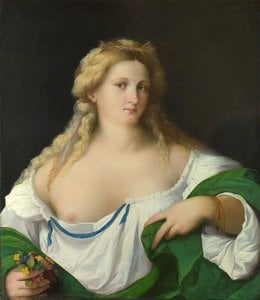
Palma Vecchio, 1480 – 1528

De 100 mest berømte malerier af Palma Vecchio

Maleriet, der gjorde Palma Vecchio berømt, er Madonna and Child (1515); det hænger på Hermitage Museum i Sankt Petersborg. Portrait of a Man (1512) og Judith (1525) følger efter i samlernes og museumsgæsternes hjerter. Af de 107 værker af Palma Vecchio i vores katalog er disse 100 de mest beundrede, hver præsenteret med sit årstal, sit museum og det, der gør værket unikt.

Rangordnet efter vores popularitetsscore, som kombinerer søgninger, besøg og ordrer for hvert værk. Opdateret oktober 2026. Hvert mesterværk på denne side kan bestilles som en håndmalet oliereproduktion i museumskvalitet eller som et kunsttryk i den størrelse, du vælger.

Portræt af Palma Vecchio
Palma Vecchio · 1480 – 1528
Født · død
1480 – 1528, Serina
Bevægelse
High renaissance
Værker i vores katalog
107
Mest kendte
Madonna and Child (1515)
Flest værker hos
Kunsthistorisches Museum

Palma Vecchio: de ti mesterværker

Madonna and Child (1515) af Palma Vecchio
1

Madonna and Child

1515 · Oil On Canvas · Hermitage Museum, Sankt Petersborg

To stand before this depiction of the Madonna and Child is to be drawn into a moment suspended outside the rush of time—a sanctuary painted by the masterful hand of Palma Vecchio. This work, dating from 1515, transcends mere portraiture; it is an eloquent meditation on maternal love, divine connection, and the profound mystery of creation. The composition centers on the Virgin Mary, portrayed with a tender intimacy as she…

The Adoration of the Shepherds with a Donor af Palma Vecchio
4

The Adoration of the Shepherds with a Donor

Oil On Canvas

The air in the painting feels heavy with the scent of damp earth and hay. In a rural landscape of rolling hills and distant, pale buildings, a small light gathers around the Holy Family. Mary holds the infant Jesus close, her form a soft curve against the shadows. Beside them, Joseph stands as a steady presence. A shepherd boy kneels in the dirt, his posture a study in humility before…

Lucretia (1520) af Palma Vecchio
5

Lucretia

1520 · Oil · Kunsthistorisches Museum, Wien

The air feels heavy, thick with the scent of velvet and the silent weight of an impending end. Lucretia sits before us, her pale skin luminous against a backdrop of deep, swallowing shadows. A sharp, diagonal line of a dagger presses against her chest, creating a point of tension that vibrates through the stillness. Her reddish-blonde hair flows in soft, organic waves, framing a face caught in a moment of…

Portrait of a Gentleman (1520) af Palma Vecchio
6

Portrait of a Gentleman

1520 · Oil On Panel · Philadelphia Museum of Art, Philadelphia

In this 1520 portrait, we are met with a man whose steady gaze bridges the distance between his era and our own. He is positioned slightly off-center, a choice that lends a sense of naturalism to his posture, as if he has just paused in thought to acknowledge our presence. The composition is a medium close-up, focusing our attention on the quiet dignity of his features. His long, flowing brown…

John the Baptist (1527) af Palma Vecchio
7

John the Baptist

1527 · Oil On Panel · Kunsthistorisches Museum, Wien

A single light source enters from the upper left, carving a face out of the heavy darkness. This is the world of Palma Vecchio, where deep browns and muted greens emerge from a nearly black background. The man, identified as John the Baptist, looks directly at the viewer with a piercing, steady gaze. His reddish-brown hair falls in soft, organic waves around a face marked by contemplation. A thin, dark…

John the Evangelist (1528) af Palma Vecchio
8

John the Evangelist

1528 · Oil On Canvas · Kunsthistorisches Museum, Wien

An elderly man sits within a heavy shadow. His face, etched by time, turns toward an unseen light from the upper left. A thick, white beard flows over a deep green tunic. Over one shoulder, a red cloak rests with the weight of heavy wool. The skin of his hands and brow catches the glow, pulling him out from the dark, atmospheric background.

The Holy Family with St Mary Magdalen (1514) af Palma Vecchio
9

The Holy Family with St Mary Magdalen

1514 · Oil On Panel · The Ashmolean Museum of Art and Archaeology, Oxford

In this 1514 oil on panel, we find ourselves drawn into a private, outdoor moment of the Holy Family. The composition is intimate, centered on a man holding a child while a woman stands nearby, her hands resting upon a vase. This arrangement creates a sense of domesticity within a sacred context. The background, filled with the soft presence of trees, suggests a natural setting that allows the figures to…

Young Woman in Profile (1512) af Palma Vecchio
10

Young Woman in Profile

1512 · Oil · Kunsthistorisches Museum, Wien

The portrait presents a young woman in a strict profile view, her head and shoulders occupying the majority of the frame. She is positioned against a dark, circular backdrop that creates a halo-like effect around her silhouette. The subject's skin is rendered in warm, fleshy tones, transitioning through soft shadows that define the structure of her face and neck. This technique, known as sfumato, allows for a gradual blending of…

Flere mesterværker af Palma Vecchio, fra 11 til 100

John the Baptist (1528) af Palma Vecchio
#12

John the Baptist

1528 · Kunsthistorisches Museum

The figure of John the Baptist emerges from the shadows of history in this religious painting by Palma Vecchio. He stands alone, a solitary presence caught in a…

Tag den med hjem →
Saint Sebastian (1527) af Palma Vecchio
#13

Saint Sebastian

1527 · Kunsthistorisches Museum

This religious work, titled Saint Sebastian, was executed by the Venetian painter Palma Vecchio around 1527. The painting focuses on the Roman martyr, a figure venerated for his…

Bestil en reproduktion →
The Raising of Lazarus (1514) af Palma Vecchio
#14

The Raising of Lazarus

1514 · Philadelphia Museum of Art

is a dramatic Renaissance oil painting that captures a crowded and dynamic biblical scene. The composition focuses on a central group of figures gathered around a stone tomb,…

Bestil en reproduktion →
The Three Sisters (1520) af Palma Vecchio
#15

The Three Sisters

1520 · Gemäldegalerie Alte Meister

“The Three Sisters” by Palma Vecchio, painted around 1520, stands as a captivating example of Venetian High Renaissance portraiture. This half-length composition depicts three young women, widely believed…

Bestil en håndmalet kopi →
Saint Magdalene (1504) af Palma Vecchio
#17

Saint Magdalene

1504 · Bavarian State Painting Collections

Saint Magdalene by Palma Vecchio is a bust-length portrait presented in a close-up composition. The female figure is positioned slightly off-center, her body angled toward the viewer while…

Tag den med hjem →
The Triumph of Caesar (1510) af Palma Vecchio
#19

The Triumph of Caesar

1510 · Lowe Gallery

is a large-scale Renaissance oil painting by the Venetian artist Palma Vecchio. Executed around 1510, the work captures a Roman triumphal procession through a densely populated ceremonial scene.

Bestil en reproduktion →
Daphnis (1514) af Palma Vecchio
#21

Daphnis

1514 · Bavarian State Painting Collections

Daphnis, attributed to Palma Vecchio, presents a mythological depiction of the shepherd boy Daphnis. Created around 1513/15, the work draws upon the pastoral traditions of antiquity. The subject…

Tag den med hjem →
Allegory (1510) af Palma Vecchio
#22

Allegory

1510 · Philadelphia Museum of Art

The painting titled Allegory is a work by the Venetian painter Palma Vecchio. Created around 1510, this oil painting belongs to the Italian High Renaissance. The artist, born…

Bestil en reproduktion →
Venus and Cupid (1511) af Palma Vecchio
#23

Venus and Cupid

1511 · Statens Museum for Kunst

is a work by the Venetian painter Palma Vecchio. Created in 1511, the painting belongs to the Italian High Renaissance. The artist, born in Serina, Italy, was a…

Tag den med hjem →
The Holy Family (1515) af Palma Vecchio
#24

The Holy Family

1515 · Gemäldegalerie

In Palma Vecchio's The Holy Family, the arrangement of figures creates a quiet, centered gravity. The Virgin Mary forms the heart of the scene, kneeling in a posture…

Tag den med hjem →
The Virgin and Child (1502) af Palma Vecchio
#25

The Virgin and Child

1502 · Gemäldegalerie

A serene and intimate scene unfolds within a High Renaissance composition, where the Virgin Mary is captured in a moment of private study. Seated toward the right of…

Tag den med hjem →
The Holy Family (1514) af Palma Vecchio
#26

The Holy Family

1514 · Nationalmuseet i Kraków

The Holy Family is an oil on panel painting by the Venetian artist Palma Vecchio. Executed in 1514, this work presents a religious scene centered on the Madonna,…

Bestil en håndmalet kopi →
Visitation (1522) af Palma Vecchio
#30

Visitation

1522 · Kunsthistorisches Museum

The air in the painting feels heavy with the weight of a quiet afternoon. Two women meet in the center of the frame, their bodies leaning into one…

Bestil en reproduktion →
Mars, Venus and Cupid (1520) af Palma Vecchio
#33

Mars, Venus and Cupid

1520

This Renaissance-style oil painting presents a mythological scene featuring three central figures: a muscular man, a woman, and a small winged child. The figures are situated within a…

Tag den med hjem →
Sacred Conversation (detail) (1525) af Palma Vecchio
#37

Sacred Conversation (detail)

1525 · Gallerie dell'Accademia di Venezia

The air feels heavy with a silent, holy stillness as the Virgin Mary cradles the infant Jesus. She sits draped in a deep blue gown, her presence the…

Tag den med hjem →
Portrait of Paola Priuli (1527) af Palma Vecchio
#41

Portrait of Paola Priuli

1527 · Fondazione Querini Stampalia

In the soft, luminous glow of the High Renaissance, few portraits capture the intersection of aristocratic poise and intimate vitality as masterfully as Palma Vecchio’s Portrait of Paola…

Tag den med hjem →
Sacred Conversation (1522) af Palma Vecchio
#43

Sacred Conversation

1522 · Kunsthistorisches Museum

In the quiet, hallowed atmosphere of Sacred Conversation, the viewer is transported directly into the heart of the Venetian High Renaissance. Painted around 1522 by the master Jacopo…

Bestil en håndmalet kopi →
Sacred Conversation (1525) af Palma Vecchio
#53

Sacred Conversation

1525 · Gallerie dell'Accademia di Venezia

In the quiet, luminous atmosphere of Palma Vecchio’s Sacred Conversation, dated to 1525, the viewer is invited into a moment of profound spiritual intimacy. This masterpiece serves as…

Bestil en reproduktion →
De heilige familie af Palma Vecchio
#54

De heilige familie

Rijksmuseum

The air within the scene feels heavy with a soft, twilight stillness. A group of five figures gathers in a serene, classical arrangement, their presence anchored by the…

Bestil en reproduktion →
A Blonde Woman af Palma Vecchio
#67

A Blonde Woman

National Gallery

A single figure dominates the composition, her pale skin and long blonde hair emerging from a dark, indeterminate background. She gazes toward the viewer with a sidelong, pensive…

Tag den med hjem →
A Blonde Woman (1520) af Palma Vecchio
#68

A Blonde Woman

1520 · National Gallery

To stand before Palma Vecchio's "A Blonde Woman" is to encounter a moment suspended in time—a breath held just before revelation. This portrait, dating from 1520, transcends a…

Bestil en reproduktion →
Venus (1520) af Palma Vecchio
#85

Venus

1520 · Gemäldegalerie Alte Meister

The painting Venus by Palma Il Vecchio is a masterpiece of Renaissance art, showcasing the artist's skill in capturing the beauty and elegance of the female form. Created…

Tag den med hjem →
Assumption of Mary (1512) af Palma Vecchio
#94

Assumption of Mary

1512 · Gallerie dell'Accademia di Venezia

In this oil on panel from 1512, we witness a moment of profound transition. The Virgin Mary occupies the center of the composition, her arms outstretched as she…

Bestil en håndmalet kopi →

Palma Vecchios malerier efter periode

De motiver Palma Vecchio malede mest

De fire motiver, der optræder hyppigst blandt disse mesterværker, med det fineste eksempel på hvert enkelt.

Hvor kan man se Palma Vecchio's malerier

De 8 museer, der rummer flest af malerierne på denne side.

Museum By Værker af Palma Vecchio Malerier fra denne liste
Kunsthistorisches Museum, WienKunsthistorisches Museum Wien 13 Lucretia, John the Baptist, John the Evangelist
Szépművészeti Múzeum, BudapestSzépművészeti Múzeum Budapest 7 Madonna and Child with the Infant Saint John and a Bishop Saint, The Holy Family with a Female Saint and Saint Francis of Assisi, Portrait of a Young Woman
Gallerie dell'Accademia di Venezia, VenedigGallerie dell'Accademia di Venezia Venedig 6 Sacred Conversation (detail), Sacred Conversation (detail), Sacred Conversation
Gemäldegalerie, BerlinGemäldegalerie Berlin 5 The Holy Family, The Virgin and Child, Portrait of a young woman with bare chest
National Gallery, LondonNational Gallery London 4 A Blonde Woman, A Blonde Woman, Saint George and a Female Saint
Hermitage Museum, Sankt PetersborgHermitage Museum Sankt Petersborg 3 Madonna and Child, Portrait of a Man, Christ and the Woman Taken in Adultery
Galleria degli Uffizi, FirenzeGalleria degli Uffizi Firenze 3 Judith, Judith with the Head of Holofernes, The Holy Family with Mary Magdalene and the infant saint John
Philadelphia Museum of Art, PhiladelphiaPhiladelphia Museum of Art Philadelphia 3 Portrait of a Gentleman, The Raising of Lazarus, Allegory

Palma Vecchio, årti for årti: det definerende maleri for hvert enkelt

  1. 1500s
    Saint Magdalene (1504) af Palma Vecchio
    Rang 17 ud af 100

    Saint Magdalene

    Alder 20 – 29 · Bavarian State Painting Collections

    Saint Magdalene by Palma Vecchio is a bust-length portrait presented in a close-up composition. The female figure is positioned slightly off-center, her body angled toward the viewer while…

  2. 1510s
    Madonna and Child (1515) af Palma Vecchio
    Nr. 1 ud af 100

    Madonna and Child

    Alder 30 – 39 · Hermitage Museum

    To stand before this depiction of the Madonna and Child is to be drawn into a moment suspended outside the rush of time—a sanctuary painted by the masterful…

  3. 1520s
    Judith (1525) af Palma Vecchio
    Nr. 3 ud af 100

    Judith

    Alder 40 – 48 · Galleria degli Uffizi

Palma Vecchios mesterværker: spørgsmål og svar

Hvilket maleri er Palma Vecchio bedst kendt for?Vis svaret

Madonna and Child (1515), Hermitage Museum, Sankt Petersborg. Derefter følger Portrait of a Man (1512) og Judith (1525).

Hvor gammel var Palma Vecchio, da Madonna and Child blev malet?Vis svaret

35 år gammel: Madonna and Child er fra 1515, og Palma Vecchio blev født i 1480.

Hvad er Palma Vecchios ti største malerier?Vis svaret

Madonna and Child, Portrait of a Man, Judith, The Adoration of the Shepherds with a Donor, Lucretia, Portrait of a Gentleman, John the Baptist, John the Evangelist, The Holy Family with St Mary Magdalen og Young Woman in Profile. Ranglisten ovenfor angiver årstallet og museet for hver af dem.

Hvor mange værker malede Palma Vecchio?Vis svaret

Vores katalog indeholder 107 værker af Palma Vecchio, dateret fra 1502 til 1528.

I hvilke museer kan jeg se Palma Vecchios mesterværker?Vis svaret

De fleste af dem findes i Kunsthistorisches Museum (Wien), Szépművészeti Múzeum (Budapest) og Gallerie dell'Accademia di Venezia (Venedig). Tabellen ovenfor lister museerne enkeltvis.

Hvornår malede Palma Vecchio mesterværkerne?Vis svaret

I 1520s: 37 af de 100 værker på denne side stammer fra denne periode, herunder Judith.

Hvad er de første og sidste berømte malerier af Palma Vecchio?Vis svaret

Det tidligste på denne side er The Virgin and Child (1502), det seneste John the Evangelist (1528).

Hvad var Palma Vecchios foretrukne motiver?Vis svaret

Woman (29), Man (22) og Landscape (21), blandt de 100 værker på denne side.

Hvilken teknik foretrak Palma Vecchio?Vis svaret

Oil On Canvas: 18 ud af de 100 værker på denne side.

Hvilken kunstretning tilhører Palma Vecchio?Vis svaret

High renaissance, som malerierne på denne side viser.

Hvilke mesterværker af Palma Vecchio hænger på Kunsthistorisches Museum?Vis svaret

Lucretia, John the Baptist og John the Evangelist er blandt de 12 værker på denne side, som er i Kunsthistorisches Museum, Wien's samling.

Kan jeg eje en reproduktion af et mesterværk af Palma Vecchio?Vis svaret

Ja. Hvert maleri på denne side kan bestilles som en håndmalet oliereproduktion i museums kvalitet eller som et kunstprint i den størrelse, du ønsker, direkte fra maleriets egen side.

Livet for Palma Vecchio

En venetiansk mester af sensualitet: Livet og kunsten hos Palma Vecchio

Jacopo Negretti, som historien kender som Palma Vecchio – ”Palma den Ældre” – trådte frem fra det kunstneriske landskab i det tidlige 16. århundredes Venedig som en skelsættende skikkelse, der brobyggede mellem højrenæssancen og de spirende manieristiske stilarter. Han blev født omkring 1480 i Serina Alta nær Bergamo, og hans karriere udfoldede sig fuldt ud i den livlige Republik Venedig, en by der allerede var dybt forankret i kunstnerisk innovation. Selvom de dokumenterede optegnelser om hans tidligste uddannelse er sparsomme, antages det, at han muligvis først var i lære hos Andrea Previtali, før han blev draget mod de revolutionerende metoder hos Giovanni Bellini og ultimativt mod de fortryllende verdener skabt af Giorgione og Titian. Palmas ankomst til Venedig faldt sammen med en periode præget af intens kunstnerisk konkurrence; sammen med Lorenzo Lotto etablerede han sig hurtigt som et formidabelt talent, der opsugede sine forgængeres lærdom, mens han samtidig banede sin egen, distinkte vej.

Tidlige indflydelser og udviklingen af en unik stil

De indledende stadier af Palmas karriere afslører en tydelig taknemmelighedsgæld til Giovanni Bellinis raffinerede teknik og hengivne stil. Det var dog Giorgiones banebrydende værker – med deres poetiske atmosfære og gådefulde fortællinger – der for alvor antændte hans kunstneriske fantasi. Han omfavnede hurtigt Giorgiones brug af farve, lys og komposition og besjælede sine egne malerier med en lignende følelse af lyrisk skønhed. Alligevel var Palma ikke blot en efterligner; han besad en unik evne til at fremstille den menneskelige form med en sanselig ynde og en fængslende realisme, der adskilte ham fra mængden. I takt med at Titian vandt fremme, fortsatte Palma sin udvikling og udviste en bemærkelsesværdig evne til at syntetisere forskelligartede indflydelser til et harmonisk og overbevisende visuelt sprog. Denne periode så fremkomsten af to primære temaer i hans værk: sacra conversazione, eller scener med hellig samtale, og halvfigur-portrætter af idealiserede kvinder, som man ofte spekulerer i er afbildninger af Venedigs berømte kurtisaner.

Mytens forførelse og det venetianske portræt

Palma Vecchio blev berømt for sin evne til at gennemstrømme den klassiske mytologi med en udpræget venetiansk sensibilitet. Hans pastorale scener er ikke blot genfortællinger af antikke fortællinger; de er livlige fejringer af skønhed, kærlighed og jordisk nydelse, sat mod baggrund af frodige landskaber, der syder af liv. Disse værker imødekom smagen hos de velhavende venetianske mæcener, som søgte kunst, der afspejlede deres sofistikerede livsstil og deres værdsættelse af sanselige glæder. Samtidig fangede hans portrætter – især dem af kvinder – publikum med deres udsøgte detaljerigdom og psykologiske dybde. Han udviklede en karakteristisk type: blonde skønheder med et forførende blik og en subtil aura af mystik. Identiteten på disse modeller forbliver i vid udstrækning ukendt, hvilket har næret spekulationer om deres forbindelse til byens demimonde. Hans beherskelse af farven – gennem transparente lasurer, der skabte lysende effekter – blev særligt hyldet, selvom mange af disse delikate lag desværre er nedbrudt over tid. Den rene maleriske kapacitet i hans håndtering af maling og farve fremhæves ofte som et definerende kendetegn ved hans arbejde.

Store bedrifter og kunstnerisk arv

Blandt Palma Vecchios mest betydningsfulde bedrifter finder man de seks malerier, der blev bestilt til kirken Santa Maria Formosa i Venedig, med det storslåede St. Barbara-alterstykke som det centrale omdrejningspunkt. Denne monumentale komposition udstiller hans exceptionelle evne til at skildre komplekse fortællinger og harmoniske grupperinger af figurer. Hans senere værker vidner om en mesterlig beherskelse af contrapposto – den elegante balance af modstridende kræfter i en figurs positur – og en forfinet farvepalette, der udstråler både værdighed og ynde. Selvom han i sin tidlige karriere lod sig inspirere af impulser fra Centralitalien, herunder Michelangelo, formåede Palma Vecchio i sidste ende at smede en stil, der var helt hans egen. En væsentlig milepæl i hans karriere var bestillingen på et hovedalter i Sant'Elena i Venedig i 1525. Dog efterlod hans pludselige død i 1528, i en alder af omkring 47 år, adskillige ufuldendte værker, som måtte færdiggøres af hans værksted og elever. På trods af denne for tidlige afslutning var Palma Vecchios indflydelse på det venetianske maleri dyb og gennemgribende; han fungerede som et afgørende bindeled mellem højrenæssancens mestre som Titian og Giorgione og den fremspirende manieristiske generation, hvilket inspirerede kunstnere som Bonifazio Pitati og Giovanni Busi.

Historisk betydning og genopdagelse

I århundreder forblev Palma Vecchios værker en smule overskygget af hans mere berømte samtidige mestre. Men i de seneste årtier er der opstået en voksende anerkendelse af hans unikke bidrag til den venetianske kunst. Kunsthistorikere har genovervejet værker, der tidligere blev tilskrevet Giorgione og Titian, efter at de har genkendt de helt særlige kvaliteter, der kendetegner Palma Vecchio's stil. Hans malerier fejres i dag for deres sanselige skønhed, tekniske genialitet og deres evne til at indfange selve ånden i renæssancens Venedig. Han repræsenterer et fascinerende skæringspunkt for kunstneriske indflydelser, hvor han bygger bro mellem generationer og tilbyder et dragende indblik i sin tids kulturelle værdier og æstetiske sanselighed. Palma Vecchio står som et vidnesbyrd om den venetianske malerkunsts vedvarende kraft – en mester, hvis værker fortsat formår at fange og inspirere publikum den dag i dag.

Alle 107 værker af Palma Vecchio →