Max Slevogt, 1868 – 1932

Max Slevogt Paintings: The 100 Most Famous Works, Ranked

Max Slevogt's most famous painting is The Quarry at Albersweiler (1912). With The Singer Francisco d'Andrade as Don Giovanni in Mozart's Opera (1912) and Frau Voll mit Tochter (1895), it completes the three works everyone recognises. Our catalogue lists 102 works by Max Slevogt; the 100 below are the ones the world looks at most, each with its year, the museum that holds it and why it matters.

Rangordnet efter vores popularitetsscore, som kombinerer søgninger, besøg og ordrer for hvert værk. Opdateret oktober 2026. Every masterpiece on this page can be ordered as a museum-quality, hand-painted oil reproduction or a fine art print, at the size you choose.

Portræt af Max Slevogt
Max Slevogt · 1868 – 1932
Født · død
1868 – 1932, Landshut
Bevægelse
Impressionism
Værker i vores katalog
102
Mest kendte
The Quarry at Albersweiler (1912)
Flest værker hos
Bavarian State Painting Collections

The 10 most famous Max Slevogt paintings

The Quarry at Albersweiler (1912) af Max Slevogt
1

The Quarry at Albersweiler

1912

A Glimpse into Industrial Transformation: Max Slevogt’s *The Quarry at Albersweiler* (1912) Max Slevogt's *The Quarry at Albersweiler*, painted in 1912, is more than just a landscape; it’s a compelling visual document of a changing world. Measuring 72 x 101 cm and executed with oil on canvas, the painting captures a pivotal moment where human industry begins to dramatically reshape the natural environment. While seemingly serene at first glance, a…

The Singer Francisco d'Andrade as Don Giovanni in Mozart's Opera (1912) af Max Slevogt
2

The Singer Francisco d'Andrade as Don Giovanni in Mozart's Opera

1912 · Oil On Canvas · Alte Nationalgalerie, Berlin

The canvas captures a moment of profound tension from Mozart's opera, specifically the graveyard scene where Don Giovanni invites the statue of the Commendatore to supper. Francisco d'Andrade, marking his thirtieth year on stage, is rendered with a sense of disembodied, floating quality. He is draped in a voluminous white cloak that flows toward the right, creating a stark contrast against a dark, moody background of muted blues and blacks.…

Frau Voll mit Tochter (1895) af Max Slevogt
3

Frau Voll mit Tochter

1895 · Oil · Alte Nationalgalerie, Berlin

Two figures emerge from a heavy, indistinct darkness. On the left, a woman gazes outward with a weary, solemn expression, her face etched with subtle shadows and fine lines. Her hair is pulled back tightly, a stark contrast to the soft, pale skin of her features. Beside her, a younger girl leans her head toward the older woman, her expression pensive and tired. A single patch of bright blue fabric…

Prince Regent Luitpold in the Ermine Cloak (1908) af Max Slevogt
4

Prince Regent Luitpold in the Ermine Cloak

1908 · Oil On Canvas · Bavarian State Painting Collections, München

In this 1908 oil on canvas, an elderly man, identified as Prince Regent Luitpold, is positioned against a dark, undifferentiated background. The subject is rendered in a vertical composition, standing slightly off-center. He wears a heavy blue mantle, which is lined with white ermine fur. The lighting originates from the upper left, casting illumination across the subject's face, the white fabric of his shirt, and the folds of the blue…

Theater Curtain (1931) af Max Slevogt
6

Theater Curtain

1931 · Painting · Bavarian State Painting Collections, München

The composition presents a formal, pyramidal arrangement of a multi-generational family, captured in a moment of staged stillness. Subjects are organized into two distinct rows: a seated group in the foreground and a standing assembly in the background. The scene is rendered in monochromatic sepia and warm reddish-brown tones, suggesting the chemical aging of a vintage photographic process. Soft, directional lighting defines the contours of facial features and the heavy…

Lady Adventure (1894) af Max Slevogt
7

Lady Adventure

1894 · Oil On Canvas · Städel Museum, Frankfurt

The oil on canvas presents a close-up view of two figures locked in a physical encounter. A figure clad in silver-toned metallic armor is intertwined with a nude female form. The composition follows a diagonal axis, creating a sense of movement through the interlocking limbs. Dark, moody tones of deep black and murky green dominate the background, which remains largely obscured by shadow. High-contrast lighting, or chiaroscuro, catches the edges…

Sailboats on the Alster River in the Evening (1905) af Max Slevogt
9

Sailboats on the Alster River in the Evening

1905 · Oil On Canvas

In the gentle transition from day to dusk, Max Slevogt’s Sailboats on the Alster River in the Evening captures a moment of profound serenity and communal joy. This 1905 masterpiece serves as a window into a bygone era of leisure, where the rhythmic movement of sailboats across the water mirrors the quiet pulse of life along the riverbanks. As the evening light begins to soften, Slevogt masterfully orchestrates a scene…

Max Slevogt, paintings 11 to 100

The Libyan Desert (1914) af Max Slevogt
#33

The Libyan Desert

1914

The painting The Libyan Desert is a stunning work of art created by the renowned artist Max Slevogt in 1914. This beautiful piece is a testament to the…

Bring it home →
Sailing into Syracuse Harbor (1914) af Max Slevogt
#35

Sailing into Syracuse Harbor

1914 · Bayerische Staatsgemaldesammlungen

Introduction to Max Slevogt and Sailing Into Syracuse Harbor Max Slevogt (1868-1932) represents a pivotal moment in German Impressionist painting, securing his place as a master of landscape…

Bring it home →
Summer House Garden (1912) af Max Slevogt
#78

Summer House Garden

1912

The Summer House Garden painting, created in 1912 by renowned German artist Max Slevogt, is a stunning representation of Impressionist art. This beautiful piece measures 62 x 77…

Order a reproduction →
Palatinate Landscape (1923) af Max Slevogt
#81

Palatinate Landscape

1923

In the quietude of 1923, Max Slevogt captured a moment that transcends time in his masterpiece, Palatinate Landscape. This evocative oil on canvas is far more than a…

Order a reproduction →
Det Palatinate Landskab (1921) af Max Slevogt
#85

Det Palatinate Landskab

1921 · Staatliche Kunsthalle

Max Slevogt og Palatinate Landscape – Et Øjeblik Af Efterår Max Slevogt (1868-1932) repræsenterede en betydelig udvikling inden for den tyske impressionisme og er kendt for sine dygtige…

Order a reproduction →
Garden Steps in Neukastel (1916) af Max Slevogt
#86

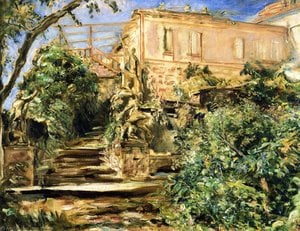
Garden Steps in Neukastel

1916

The Max Slevogt painting, Garden Steps in Neukastel, is a beautiful depiction of a serene garden setting. Created in 1916, this oil on canvas piece is a prime…

Bring it home →

Max Slevogt's paintings by period

The subjects Max Slevogt painted most

The four subjects that return most often among these masterpieces, with the finest example of each.

Where to see Max Slevogt's paintings

De 8 museer, der rummer flest af malerierne på denne side.

Museum By Værker af Max Slevogt Malerier fra denne liste
Bavarian State Painting Collections, MünchenBavarian State Painting Collections München 18 Prince Regent Luitpold in the Ermine Cloak, Theater Curtain, Angela von Tschudi
Staatliche Kunstsammlungen Dresden, DresdenStaatliche Kunstsammlungen Dresden Dresden 6 Sudanese women, Pirates, Sandstorm in the Libyan Desert
Lenbachhaus, MünchenLenbachhaus München 5 Danae, Luise Papenhagen, Self-Portrait with Black Hat
Alte Nationalgalerie, BerlinAlte Nationalgalerie Berlin 4 The Singer Francisco d'Andrade as Don Giovanni in Mozart's Opera, Frau Voll mit Tochter, Requiem for the St. Georgsknights
Nationalmuseet i Warszawa, WarszawaNationalmuseet i Warszawa Warszawa 3 Faun and a girl, Grape harvest., Landscape with a view of Landau
Westfälisches Landesmuseum, MünsterWestfälisches Landesmuseum Münster 3 Man on a Forest Path, Flower Garden I in Neu Cladow, Still life with Melon
Städel Museum, FrankfurtStädel Museum Frankfurt 2 Lady Adventure, Blossoming Lilac
Museum Kunstpalast, DüsseldorfMuseum Kunstpalast Düsseldorf 2 Female Nude from the Back, Neukastel - View of the Madenburg

Max Slevogt's most famous painting of each decade

  1. 1890s
    Frau Voll mit Tochter (1895) af Max Slevogt
    #3 of 100

    Frau Voll mit Tochter

    Alder 22 – 31 · Alte Nationalgalerie

    Two figures emerge from a heavy, indistinct darkness. On the left, a woman gazes outward with a weary, solemn expression, her face etched with subtle shadows and fine…

  2. 1900s
    Prince Regent Luitpold in the Ermine Cloak (1908) af Max Slevogt
    #4 of 100

    Prince Regent Luitpold in the Ermine Cloak

    Alder 32 – 41 · Bavarian State Painting Collections

    In this 1908 oil on canvas, an elderly man, identified as Prince Regent Luitpold, is positioned against a dark, undifferentiated background. The subject is rendered in a vertical…

  3. 1910s
    The Quarry at Albersweiler (1912) af Max Slevogt
    Rank 1 / 100

    The Quarry at Albersweiler

    Alder 42 – 51

    A Glimpse into Industrial Transformation: Max Slevogt’s *The Quarry at Albersweiler* (1912) Max Slevogt's *The Quarry at Albersweiler*, painted in 1912, is more than just a landscape; it’s…

  4. 1920s
  5. 1930s
    Theater Curtain (1931) af Max Slevogt
    #6 of 100

    Theater Curtain

    Alder 62 – 64 · Bavarian State Painting Collections

    The composition presents a formal, pyramidal arrangement of a multi-generational family, captured in a moment of staged stillness. Subjects are organized into two distinct rows: a seated group…

Questions about Max Slevogt's paintings

What is Max Slevogt's most famous painting?Show the answer

The Quarry at Albersweiler (1912). Next come The Singer Francisco d'Andrade as Don Giovanni in Mozart's Opera (1912) and Frau Voll mit Tochter (1895).

How old was Max Slevogt when The Quarry at Albersweiler was painted?Show the answer

44 years old: The Quarry at Albersweiler dates from 1912 and Max Slevogt was born in 1868.

What are the top 10 paintings by Max Slevogt?Show the answer

The Quarry at Albersweiler, The Singer Francisco d'Andrade as Don Giovanni in Mozart's Opera, Frau Voll mit Tochter, Prince Regent Luitpold in the Ermine Cloak, Requiem for the St. Georgsknights, Theater Curtain, Lady Adventure, Angela von Tschudi, Sailboats on the Alster River in the Evening og Scheherazade (Telling the Stories from 1001 Nights to the Caliph). The ranking above gives the year and the museum of each.

How many paintings did Max Slevogt make?Show the answer

Our catalogue lists 102 works by Max Slevogt, dated from 1893 to 1931.

Where are Max Slevogt's most famous paintings?Show the answer

Most of them are in Bavarian State Painting Collections (München), Staatliche Kunstsammlungen Dresden (Dresden) og Lenbachhaus (München). The table above lists the museums one by one.

When did Max Slevogt paint the most famous works?Show the answer

In 1910s: 33 of the 100 works on this page date from then, among them The Quarry at Albersweiler.

What are Max Slevogt's earliest and latest famous paintings?Show the answer

The earliest on this page is Red Arbor with Thundercounds (1893), the latest Theater Curtain (1931).

What did Max Slevogt paint most often?Show the answer

Landscape (11), People (6) og Gardens and parks (5), among the 100 works on this page.

What medium did Max Slevogt use most?Show the answer

Oil On Canvas: 15 of the 100 works on this page.

Which art movement does Max Slevogt belong to?Show the answer

Impressionism, as the paintings on this page show.

Which Max Slevogt paintings can I see at the Bavarian State Painting Collections?Show the answer

Prince Regent Luitpold in the Ermine Cloak, Theater Curtain og Angela von Tschudi are among the 18 works on this page held by the Bavarian State Painting Collections, München.

Can I buy a reproduction of a Max Slevogt painting?Show the answer

Yes. Every painting on this page can be ordered as a museum-quality, hand-painted oil reproduction or a fine art print, in the size you choose, from the painting's own page.

About Max Slevogt

Max Slevogts lysende eftermæle

Max Slevogt står som en hjørnesten i tysk impressionistisk maleri, anerkendt for sine mesterlige skildringer af landskaber og sin evne til at indfange naturens flygtige skønhed med en bemærkelsesværdig følsomhed. Han blev født i Landshut, Bayern, i 1868, og påbegyndte en kunstnerisk rejse, der førte ham fra mørke, akademiske tonale skitser til levende lærreder fyldt med lys og farve—et stilistisk skift, der var emblematisk for den bredere bevægelse, som omformede europæisk kunst ved århundredeskiftet. Hans formative år blev brugt på at forfine sine færdigheder ved München-akademiet, hvor han indledningsvis udforskede mørkere paletter og teknikker påvirket af den herskende akademiske stil i samtiden.

Dog antændte et skelsættende besøg i Paris i 1889 en dybtgående transformation i hans kunstneriske sjæl. Ved at blive eksponeret for de revolutionerende idéer, som mestre som Édouard Manet kæmpede for, blev Slevogts vision drevet mod en modigere tilgang, der prioriterede den direkte observation af den naturlige verden. Dette møde med den franske avantgarde pustede liv i hans penselstrøg og opmuntrede ham til at omfavne plein air-maleri for at opsøge lysets flygtige dans over landskabet. Hans arbejde begyndte at pulsere med en atmosfærisk vitalitet, idet han bevægede sig væk fra stive atelierkompositioner mod en mere spontan og sanselig interaktion med virkeligheden.

En mesterlig beherskelse af lys og landskab

Selvom Slevogts omfattende produktion spændte over forskellige genrer, herunder illustration, portrætkunst og genrebilleder, var det landskaberne, der konsekvent dominerede hans storslåede værk. Han opnåede særlig berømmelse for sine stemningsfulde skildringer af Bayerns alpine regioner, især Neukastel, som blev hans livslange hjem og en vedvarende kilde til inspiration. Hans lærreder fejres for deres evne til at indfange de subtile nuancer i lys og skygge, hvilket vidner om en metodisk opmærksomhed på tekstur og farve, der adskiller ham fra mange af hans samtidige.

Kunstnerens tekniske udvikling er præget af flere centrale karakteristika:

  • Dynamiske penselstrøg: En overgang fra kontrollerede, akademiske strøg til mere flydende og energiske påføringer af maling.
  • En stigende afhængighed af en levende palet for at formidle sollysets varme og skumringens kølighed.
  • Atmosfærisk dybde: Brugen af bløde kanter og lysdiffusion til at genskabe følelsen af fugt, tåge og luft i en scene.

Udover de fredfyldte skønheder i hans landskaber besad Slevogt en bemærkelsesværdig evne til at indfange menneskehistoriens tyngde. Hans senere værker afspejler en dybere og mere dyster involvering med verden, herunder stemningsfulde skildringer af Egypten og de rædselsvækkende lidelser under 1. verdenskrig. Denne evne til at skifte fra det idylliske til det dypsindige demonstrerer den emotionelle spændvidde, der definerer hans storhed.

Kulturel indflydelse og historisk betydning

Udover sine individuelle kunstneriske bedrifter cementerede Slevogts engagement i kulturelle institutioner sin position i det intellektuelle landskab i Weimar-republikkens Tyskland. Som et fremtrædende medlem af Berlin Secession og Den Preussiske Kunstakademi befandt han sig i hjertet af tidens mest betydningsfulde æstetiske debatter. Han omfavnede avantgardens ånd, mens han opretholdt en urokkelig forpligtelse til traditionelle kunstneriske principper, hvilket gjorde det muligt for ham at bygge bro mellem klassisk træning og moderne innovation.

Hans alsidighed strakte sig endda ind i scenekunsten; bemærkelsesværdigt nok designede han scenografien til Mozarts Don Giovanni, hvilket viste hans evne til at oversætte sin maleriske vision til det teatralske rum. Gennem sit arbejde i tidsskrifter som Simplicissimus og sin varige indflydelse på tysk impressionisme efterlod Max Slevogt et uudsletteligt mærke på kunsthistorien. Han forbliver en fejret skikkelse, hvis værk fortsat vil resonere hos enhver, der bevæges af samspillet mellem lys, farve og naturens evige ånd.

Alle 102 værker af Max Slevogt →