Masaccio, 1401 – 1428

Masaccio Paintings: The 97 Most Famous Works, Ranked

Masaccio's most famous painting is Treenigheden (1428). With Betalingspengene (1425) and Uddrivelsen fra Paradiset (1426), it completes the three works everyone recognises. Our catalogue lists 97 works by Masaccio; the 97 below are the ones the world looks at most, each with its year, the museum that holds it and why it matters.

Rangordnet efter vores popularitetsscore, som kombinerer søgninger, besøg og ordrer for hvert værk. Opdateret oktober 2026. Every masterpiece on this page can be ordered as a museum-quality, hand-painted oil reproduction or a fine art print, at the size you choose.

Portræt af Masaccio
Masaccio · 1401 – 1428
Født · død
1401 – 1428, San Giovanni Valdarno
Bevægelse
Tidlig renæssance
Værker i vores katalog
97
Mest kendte
Treenigheden (1428)
Flest værker hos
Santa Maria del Carmine

The 10 most famous Masaccio paintings

Treenigheden (1428) af Masaccio
1

Treenigheden

1428 · Fresco

Treenigheden af Masaccio var et banebrydende værk, der introducerede flere kunstneriske innovationer. Det er et af de første monumentale renæssancemalerier, der benytter lineærperspektiv, hvilket skaber en overvældende fornemmelse af dybde og rumlighed. Gennem en mesterlig brug af chiaroscuro og sfumato-teknikker tilføjes der volumen og tekstur til figurerne, hvilket får dem til at fremstå med en næsten skræmmende realisme.

Betalingspengene (1425) af Masaccio
2

Betalingspengene

1425 · Fresco

Scenen udfolder sig i Brancacci-kapellet i basilikaen Santa Maria del Carmine i Firenze. Her bringer freskoen med titlen Betalingspengene af Masaccio en bibelsk fortælling til live på kapellets vægge. Dette værk, bestilt af Felice Brancacci, udgør en væsentlig del af en større cyklus dedikeret til Sankt Peters liv. Luften i kapellet synes at bære vægten af denne hellige historie, idet figurerne bevæger sig gennem et øjeblik af dyb betydning.

Uddrivelsen fra Paradiset (1426) af Masaccio
3

Uddrivelsen fra Paradiset

1426 · Fresco

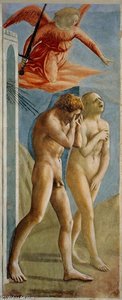
Den tunge stilhed i Brancacci-kapellet i kirken Santa Maria del Carmine i Firenze, Italien, bærer vægten af en dyb tragedie. Her ånder væggene med fortællingen om Uddrivelsen fra Paradiset, en fresco malet af Masaccio omkring 1425. Luften synes at fortættes omkring figurerne, idet de står over for deres pludselige, irreversible udvisning fra paradiset. Denne scene markerer begyndelsen på en større fortælling og fungerer som den første fresco i en serie…

Rendering af Tribute Money (detalje) af Masaccio
4

Rendering af Tribute Money (detalje)

Fresco

Denne fængslende detalje stammer fra Masaccios banebrydende fresko, ”Tribute Money”, et skelsættende værk i Brancacci-kapellet i Firenze. Maleriet, der blev udført omkring 1426, repræsenterer et vendepunkt i vestlig kunst, hvor man bevægede sig væk fra den gotiske periodes stiliserede konventioner mod en ny æra præget af naturalisme og humanistisk udtryk.

Predella panel from the Pisa Altar (1426) af Masaccio
5

Predella panel from the Pisa Altar

1426 · Oil On Panel · Staatliche Museen zu Berlin, Berlin

To stand before this Predella panel from the Pisa Altar is to encounter a moment frozen in time, yet vibrating with raw, undeniable human drama. Dating to 1426, this work captures Masaccio at the zenith of his revolutionary power. It is not merely a depiction of the Crucifixion; it is a profound meditation on sacrifice, community, and the weight of divine narrative rendered with startling immediacy. The composition draws the…

The Madonna of Humility (1424) af Masaccio
6

The Madonna of Humility

1424 · Tempera On Panel

In the quiet, profound stillness of Masaccio’s The Madonna of Humility, we encounter one of the most moving snapshots of the Early Italian Renaissance. Created around 1424, this masterpiece transcends mere religious iconography to offer a window into a moment of raw, maternal intimacy. The scene is set not upon a celestial throne, but on the earth itself, where the Virgin Mary sits upon a blue patterned cushion. This choice…

Trinity (detail) (1425) af Masaccio
7

Trinity (detail)

1425 · Fresco · Santa Maria Novella, Florence

The image presents a detail from a fresco painting created in 1425 by Masaccio. Within this specific view, a figure is depicted that appears to be Mary Magdalene, identified by the traditional iconography of her long hair and a head covering. She possesses a contemplative expression, directing her gaze slightly downwards toward an object held in her right hand, which may be interpreted as a symbol of faith or devotion.

Two panels from the Pisa Altarpiece (1426) af Masaccio
8

Two panels from the Pisa Altarpiece

1426 · Tempera On Panel · Staatliche Museen zu Berlin, Berlin

In the quiet, hallowed halls of art history, few works capture the dawn of a new era as poignantly as Masaccio’s Two Panels from the Pisa Altarpiece. Completed in 1426, these panels are far more than mere fragments of a lost polyptych; they are windows into a transformative moment when the rigid conventions of the Gothic period began to dissolve, giving way to the profound humanism of the Early Italian…

Trinity (1425) af Masaccio
9

Trinity

1425 · Fresco · Santa Maria Novella, Florence

To step before Masaccio’s Holy Trinity is to witness the exact moment when the flattened, symbolic world of the Middle Ages dissolved into the profound, breathing reality of the Renaissance. Painted between 1425 and 1427 within the hallowed walls of Santa Maria Novella in Florence, this fresco does not merely depict a religious scene; it carves a hole in the very wall of the chapel, inviting the viewer to step…

Trinity (detail) (1425) af Masaccio
10

Trinity (detail)

1425 · Acrylic On Canvas · Santa Maria Novella, Florence

Masaccio’s “Trinity (detail),” housed within the magnificent Santa Maria Novella in Florence, isn't merely a fresco; it’s a pivotal moment in art history – a visual manifesto declaring the arrival of the High Renaissance. Painted between 1425 and 1427, this intimate section captures the essence of Masaccio’s revolutionary approach to depicting reality, a departure from the stylized elegance of the preceding Gothic era and a profound influence on generations of…

Masaccio, paintings 11 to 97

Freskoer i Brancacci Kapellen (venstre syn) (1426) af Masaccio
#19

Freskoer i Brancacci Kapellen (venstre syn)

1426 · Santa Maria del Carmine

Frescoes in the Cappella Brancacci (left view) – Et Pionerenes Ånd Masaccio revolutionerede italiensk kunst i begyndelsen af Quattrocento med sin banebrydende brug af perspektiv og chiaroscuro, hvilket…

Bring it home →
Crucifixion (1426) af Masaccio
#22

Crucifixion

1426 · Museo di Capodimonte

Masaccio’s Crucifixion, painted in 1426 during his tragically brief career, isn’t merely a depiction of a pivotal biblical event; it’s a foundational moment in Western art. Born in…

Order a reproduction →
Distribution of Alms and Death of Ananias (1425) af Masaccio
#48

Distribution of Alms and Death of Ananias

1425

In the quiet, profound depths of Masaccio’s Distribution of Alms and Death of Ananias, we encounter a moment where the divine intersects with the earthly through the simple,…

Plate of Nativity (Berlin Tondo) (1427) af Masaccio
#77

Plate of Nativity (Berlin Tondo)

1427 · Staatliche Museen zu Berlin

In the quiet intimacy of the Plate of Nativity (Berlin Tondo), we witness one of the most profound transformations in the history of Western art. Painted in 1427…

Bring it home →
Adoration of the Magi (1426) af Masaccio
#85

Adoration of the Magi

1426 · Staatliche Museen zu Berlin

To stand before Masaccio’s Adoration of the Magi is not merely to observe a painting; it is to step directly into the revolutionary atmosphere of the early Italian…

Order a reproduction →
Predella panel from the Pisa Altar (1426) af Masaccio
#87

Predella panel from the Pisa Altar

1426 · Staatliche Museen zu Berlin

The world of 15th-century Florentine painting was undergoing a seismic shift, and at the heart of this transformation stood Masaccio – a name that resonates with an almost…

Bring it home →
St. Andrew (1426) af Masaccio
#93

St. Andrew

1426 · J. Paul Getty Museum

A Revolutionary Vision of Faith: Masaccio’s St. Andrew Masaccio's *St. Andrew*, painted in 1426, is a landmark work of the Early Renaissance, embodying the seismic shift towards naturalism…

Bring it home →
Crucifixion of St Peter (1426) af Masaccio
#97

Crucifixion of St Peter

1426 · Staatliche Museen zu Berlin

Masaccio's 1426 painting, *Crucifixion of St. Peter*, is not merely a depiction of a pivotal moment in Christian history; it’s a foundational cornerstone of the Early Italian Renaissance.…

Commission a hand-painted copy →

Masaccio's paintings by period

Tidlig periode

1425 – 1428 · 3 værker på denne liste

The subjects Masaccio painted most

The four subjects that return most often among these masterpieces, with the finest example of each.

Where to see Masaccio's paintings

De 8 museer, der rummer flest af malerierne på denne side.

Museum By Værker af Masaccio Malerier fra denne liste
Santa Maria del Carmine, FirenzeSanta Maria del Carmine Firenze 7 Udsigt til Cappella Brancacci (før restaurering), Freskoer i Cappella Brancacci (højre syn), Freskoer i Brancacci Kapellen (venstre syn)
Staatliche Museen zu Berlin, BerlinStaatliche Museen zu Berlin Berlin 6 Predella panel from the Pisa Altar, Two panels from the Pisa Altarpiece, Plate of Nativity (Berlin Tondo)
Gemäldegalerie, BerlinGemäldegalerie Berlin 5 Martyrdom of San Giovanni Battista, A Bearded Carmelite Saint, San Agustín
Santa Maria Novella, FlorenceSanta Maria Novella Florence 4 Trinity (detail), Trinity, Trinity (detail)
Lindenau-Museum, AltengauLindenau-Museum Altengau 3 Christ in the Garden of Gethsemane (detail), Christ in the Garden of Gethsemane (detail), Christ in the Garden of Gethsemane
National Gallery of Art, WashingtonNational Gallery of Art Washington 2 Profile Portrait of a Young Man, Madonna of Humility
National Gallery, LondonNational Gallery London 2 Madonna with Child and Angels, St.Girolamo end Giovanni Battista
Museo di Capodimonte, NapoliMuseo di Capodimonte Napoli 1 Crucifixion

Masaccio's most famous paintings, year by year

Masaccio painted for barely 9 years, from 1420 to 1428: follow that decade year by year, through the paintings that made the name.

  1. 1420
  2. 1422
  3. 1422
  4. 1422
    San Giovenale Triptych. Left panel (1422) af Masaccio
    No. 63 of 97

    San Giovenale Triptych. Left panel

    Alder 21

    The San Giovenale Triptych, Left Panel by Masaccio is a seminal work of art that showcases the artist's innovative style and technique. Created in 1422, this painting is…

  5. 1422
  6. 1423
  7. 1423
  8. 1424
    The Madonna of Humility (1424) af Masaccio
    No. 6 of 97

    The Madonna of Humility

    Alder 23

    In the quiet, profound stillness of Masaccio’s The Madonna of Humility, we encounter one of the most moving snapshots of the Early Italian Renaissance. Created around 1424, this…

  9. 1424
    Christ in the Garden of Gethsemane (detail) (1424) af Masaccio
    No. 21 of 97

    Christ in the Garden of Gethsemane (detail)

    Alder 23 · Lindenau-Museum

    The garden holds a heavy stillness. In this detail from 1424, a single figure kneels upon the earth, hands clasped in a tight knot of devotion. The light…

  10. 1424
  11. 1424
    Christ in the Garden of Gethsemane (1424) af Masaccio
    Rank 62 / 97

    Christ in the Garden of Gethsemane

    Alder 23 · Lindenau-Museum

    The painting Christ in the Garden of Gethsemane is a renowned work by the Italian artist Masaccio, created in 1424. This tempera painting, measuring 62 x 44 cm,…

  12. 1425
    Betalingspengene (1425) af Masaccio
    No. 2 of 97

    Betalingspengene

    Alder 24

    Scenen udfolder sig i Brancacci-kapellet i basilikaen Santa Maria del Carmine i Firenze. Her bringer freskoen med titlen Betalingspengene af Masaccio en bibelsk fortælling til live på kapellets…

  13. 1425
    Trinity (detail) (1425) af Masaccio
    #7 of 97

    Trinity (detail)

    Alder 24 · Santa Maria Novella

    The image presents a detail from a fresco painting created in 1425 by Masaccio. Within this specific view, a figure is depicted that appears to be Mary Magdalene,…

  14. 1425
    Trinity (1425) af Masaccio
    #9 of 97

    Trinity

    Alder 24 · Santa Maria Novella

    To step before Masaccio’s Holy Trinity is to witness the exact moment when the flattened, symbolic world of the Middle Ages dissolved into the profound, breathing reality of…

  15. 1425
    Trinity (detail) (1425) af Masaccio
    No. 10 of 97

    Trinity (detail)

    Alder 24 · Santa Maria Novella

    Masaccio’s “Trinity (detail),” housed within the magnificent Santa Maria Novella in Florence, isn't merely a fresco; it’s a pivotal moment in art history – a visual manifesto declaring…

  16. 1426
    Uddrivelsen fra Paradiset (1426) af Masaccio
    Rank 3 / 97

    Uddrivelsen fra Paradiset

    Alder 25

    Den tunge stilhed i Brancacci-kapellet i kirken Santa Maria del Carmine i Firenze, Italien, bærer vægten af en dyb tragedie. Her ånder væggene med fortællingen om Uddrivelsen fra…

  17. 1426
    Predella panel from the Pisa Altar (1426) af Masaccio
    Rank 5 / 97

    Predella panel from the Pisa Altar

    Alder 25 · Staatliche Museen zu Berlin

    To stand before this Predella panel from the Pisa Altar is to encounter a moment frozen in time, yet vibrating with raw, undeniable human drama. Dating to 1426,…

  18. 1426
    Two panels from the Pisa Altarpiece (1426) af Masaccio
    #8 of 97

    Two panels from the Pisa Altarpiece

    Alder 25 · Staatliche Museen zu Berlin

    In the quiet, hallowed halls of art history, few works capture the dawn of a new era as poignantly as Masaccio’s Two Panels from the Pisa Altarpiece. Completed…

  19. 1426
    Udsigt til Cappella Brancacci (før restaurering) (1426) af Masaccio
    Rank 11 / 97

    Udsigt til Cappella Brancacci (før restaurering)

    Alder 25 · Santa Maria del Carmine

    Forestillingen om Masaccos ‘View of the Cappella Brancacci (before restoration)’ er mere end blot et fotografi; det er et vindue til en tidlig, revolutionerende æra inden for kunsthistorien.…

  20. 1427
  21. 1427
    Baptism of the Neophytes (1427) af Masaccio
    No. 20 of 97

    Baptism of the Neophytes

    Alder 26

    The Baptism of the Neophytes is a renowned fresco painted by Masaccio in the early 15th century. This iconic artwork is part of the decoration of the Brancacci…

  22. 1427
    Plate of Nativity (Berlin Tondo) (1427) af Masaccio
    Rank 77 / 97

    Plate of Nativity (Berlin Tondo)

    Alder 26 · Staatliche Museen zu Berlin

    In the quiet intimacy of the Plate of Nativity (Berlin Tondo), we witness one of the most profound transformations in the history of Western art. Painted in 1427…

  23. 1428
    Treenigheden (1428) af Masaccio
    #1 of 97

    Treenigheden

    Alder 27

    Treenigheden af Masaccio var et banebrydende værk, der introducerede flere kunstneriske innovationer. Det er et af de første monumentale renæssancemalerier, der benytter lineærperspektiv, hvilket skaber en overvældende fornemmelse…

  24. 1428
  25. 1428

Questions about Masaccio's paintings

What is Masaccio's most famous painting?Show the answer

Treenigheden (1428). Next come Betalingspengene (1425) and Uddrivelsen fra Paradiset (1426).

How old was Masaccio when Treenigheden was painted?Show the answer

27 years old: Treenigheden dates from 1428 and Masaccio was born in 1401.

What are the top 10 paintings by Masaccio?Show the answer

Treenigheden, Betalingspengene, Uddrivelsen fra Paradiset, Rendering af Tribute Money (detalje), Predella panel from the Pisa Altar, The Madonna of Humility, Trinity (detail), Two panels from the Pisa Altarpiece, Trinity og Trinity (detail). The ranking above gives the year and the museum of each.

How many paintings did Masaccio make?Show the answer

Our catalogue lists 97 works by Masaccio, dated from 1420 to 1428.

Where are Masaccio's most famous paintings?Show the answer

Most of them are in Santa Maria del Carmine (Firenze), Staatliche Museen zu Berlin (Berlin) og Gemäldegalerie (Berlin). The table above lists the museums one by one.

When did Masaccio paint the most famous works?Show the answer

In 1426: 41 of the 97 works on this page date from then, among them Uddrivelsen fra Paradiset.

What are Masaccio's earliest and latest famous paintings?Show the answer

The earliest on this page is Madonna of Humility (1420), the latest Treenigheden (1428).

What did Masaccio paint most often?Show the answer

Saints (30), Religious (25) og Renaissance (15), among the 97 works on this page.

What medium did Masaccio use most?Show the answer

Fresco: 9 of the 97 works on this page.

Which art movement does Masaccio belong to?Show the answer

Tidlig renæssance, as the paintings on this page show.

Which Masaccio paintings can I see at the Santa Maria del Carmine?Show the answer

Udsigt til Cappella Brancacci (før restaurering), Freskoer i Cappella Brancacci (højre syn) og Freskoer i Brancacci Kapellen (venstre syn) are among the 7 works on this page held by the Santa Maria del Carmine, Firenze.

Can I buy a reproduction of a Masaccio painting?Show the answer

Yes. Every painting on this page can be ordered as a museum-quality, hand-painted oil reproduction or a fine art print, in the size you choose, from the painting's own page.

About Masaccio

Masaccio (1401-1428): Tommaso di Ser Giovanni di Simone – Pionjeren af Renæssancens Realisme

Tommaso di Ser Giovanni di Simone Guidi Cassai, bedre kendt som Masaccio (født 21. december 1401 i San Giovanni Valdarno nær Firenze og død efter sommeren 1428 i Rom), regnes sammen med Giotto blandt de vigtigste italienske malere i den tidlige renæssance. Sammen med Masolino malede Masaccio 1425-1428 freskerne i Santa Maria del Carmine i Firenze med motiver fra apostlen Peters liv. Masaccios karriere blev ikke lang – han døde 27 år gammel – men realismen og centralperspektivet fik stor indflydelse på kunsthistorien og satte nye standarder for hvordan menneskeligheden skulle repræsenteres i kunsten. Selvom hans korte liv var præget af tragedie, er Masaccio’s betydning som kunstner ubestridelig og hans værker fortsætter med at fascinere kunstnere og forskere verden over.

Tidligt Liv og Uddannelse

Masaccio blev født i Castel San Giovanni di Valdarno, mellem Firenze og Arezzo, omkring 40 kilometer sydøst for Firenze. Hans far var Ser Giovanni di Mone Cassai, en notar, og hans mor, Monna Iacopa, var søn af en værtshusinde. Masaccio’s bror Giovanni var også kunstner; han blev kendt som Lo Scheggia (“den Splinter”), og selvom han kun signe

Alle 97 værker af Masaccio →