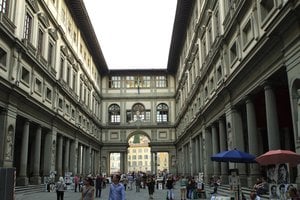
Giorgio Vasari, 1511 – 1574

Giorgio Vasari: De 100 mest berømte malerier

Domedagens Dommedag (detalje) (1572) er det mest berømte maleri af Giorgio Vasari, som er i Duomo Firenzes samling i Firenze. Allegory of Justice (1543) og The Last Judgment (detail) (1572) er de næste to værker, som verden kender bedst. Udvalgt fra de 122 værker af Giorgio Vasari i vores katalog er her de 100, som samlere og museumsgæster oftest opsøger, inklusiv årstal, museum og historien bag hvert værk.

Rangordnet efter vores popularitetsscore, som kombinerer søgninger, besøg og ordrer for hvert værk. Opdateret oktober 2026. Hvert mesterværk på denne side kan bestilles som en håndmalet oliereproduktion i museumskvalitet eller som et kunsttryk i den størrelse, du vælger.

Portræt af Giorgio Vasari
Giorgio Vasari · 1511 – 1574
Født · død
1511 – 1574, Arezzo
Bevægelse
Manierisme
Værker i vores katalog
122
Mest kendte
Domedagens Dommedag (detalje) (1572)
Flest værker hos
Palazzo Vecchio

Top 10: Giorgio Vasaris mest kendte malerier

Domedagens Dommedag (detalje) (1572) af Giorgio Vasari
1

Domedagens Dommedag (detalje)

1572 · Fresco · Duomo Firenze, Firenze

“Det Sidste Dommedag” af Giorgio Vasari og Federico Zuccari er mere end blot et vægmaleri; det er en monumental oplevelse, der trækker betragteren ind i hjertet af renæssancens ånd. Maleriets placering på loftet af Firenze’s katedral, Santa Maria del Fiore, gør det til et af de mest imponerende syn man kan møde i byen – et monument over både religiøs tro og kunstnerisk ambition. Det er en scene der udspiller…

Allegory of Justice (1543) af Giorgio Vasari
2

Allegory of Justice

1543 · Acrylic On Canvas · Museo di Capodimonte, Napoli

Giorgio Vasari's 1543 fresco, “Allegory of Justice and Truth,” residing within the Palazzo Cancelleria in Rome, is far more than a mere decorative panel; it’s a meticulously constructed visual sermon on virtue, governance, and the very foundations of Renaissance ideals. Commissioned by Cardinal Alessandro Farnese, this monumental work transcends its initial purpose as a room decoration to become a profound meditation on the principles that underpinned the burgeoning power of…

The Last Judgment (detail) (1572) af Giorgio Vasari
3

The Last Judgment (detail)

1572 · Acrylic On Canvas · Duomo Firenze, Firenze

Within the soaring dome of Florence’s Duomo, a monumental fresco unfolds – Giorgio Vasari and Federico Zuccari's “The Last Judgment,” completed between 1572 and 1579. More than just a depiction of biblical narrative, it is an immersive experience, a theatrical tableau of judgment, salvation, and the eternal consequences of earthly choices. The sheer scale—over 3,600 square meters—immediately overwhelms the viewer, drawing them into a world of swirling figures, dramatic light,…

Marriage at Cana (1566) af Giorgio Vasari
4

Marriage at Cana

1566 · Oil On Canvas · Szépművészeti Múzeum, Budapest

Giorgio Vasari's “Marriage at Cana,” completed in 1566, transcends mere depiction; it embodies the fervor and humanist ideals that defined the High Renaissance. Commissioned by Cardinal Alessandro Farnese for the Cappella Sistina in Rome, this monumental altarpiece isn’t simply a retelling of biblical scripture—it’s an ambitious attempt to capture the essence of faith itself through masterful artistic execution.

Triumphant entrance of Leone X in Florence (1563) af Giorgio Vasari
5

Triumphant entrance of Leone X in Florence

1563 · Oil On Canvas · Palazzo Vecchio, Firenze

A Florentine Spectacle: Witnessing Power and Faith Giorgio Vasari’s *Triumphant Entrance of Leone X in Florence* (1563) is a monumental oil painting that bursts with the energy of a civic celebration. This isn't merely a depiction of a procession; it’s a carefully constructed narrative of papal authority reasserting itself within the heart of Renaissance Florence. The scene unfolds with a deliberate chaos, teeming with figures – from the Pope himself…

Annunciation (1570) af Giorgio Vasari
6

Annunciation

1570 · Acrylic On Canvas · Móra Ferenc Múzeum, Szeged

Giorgio Vasari’s 1570 Annunciation, housed within the serene confines of the Morgan Library and Museum in New York City, isn't merely a depiction of a biblical narrative; it’s a profound meditation on divine grace, humility, and the transformative power of faith. Painted during the height of the Italian Renaissance, this fresco embodies the era’s fascination with classical ideals blended seamlessly with deeply rooted Christian symbolism. Vasari, a pivotal figure in…

Cosimo il Vecchio as San Cosma (1559) af Giorgio Vasari
7

Cosimo il Vecchio as San Cosma

1559 · Oil On Canvas · Palazzo Vecchio, Firenze

The year is 1559, and Florence pulses with the ambition of the Renaissance under the shrewd guidance of Cosimo I de’ Medici. Within the walls of the Palazzo Vecchio, a masterpiece emerges – Giorgio Vasari’s “Cosimo il Vecchio as San Cosma,” a portrait that transcends mere likeness to become a potent symbol of power, piety, and the enduring legacy of the Medici dynasty. This isn't simply a depiction of a…

Domedretning (1572) af Giorgio Vasari
8

Domedretning

1572 · Akryl på lærred · Duomo Firenze, Firenze

Giorgio Vasaris mesterværk, "Det Sidste Dommedag," malet på loftet i Firenze-domen (Duomo di Firenze), er mere end blot et religiøst billede; det er en dybtgående allegori over menneskelivets gang og den ultimative dom. Udført mellem 1572 og 1579, efter Vasaris tragiske død, af Vasari og Federico Zuccari, repræsenterer fresken et øjebliks uovertruffen kraft og følelsesmæssig resonans. Det er en scene der både skræmmer og inspirerer, og som fortsat fascinerer besøgende…

The Resurrection (1545) af Giorgio Vasari
9

The Resurrection

1545 · Oil On Canvas · Museo di Capodimonte, Napoli

Giorgio Vasari's "The Resurrection," painted in 1545, isn’t merely a depiction of a biblical event; it’s a visceral embodiment of faith and the promise of rebirth. Created during the height of the Italian Renaissance, this oil-on-canvas work transcends simple religious illustration, plunging the viewer into a world of intense drama and profound spiritual significance. Vasari, already establishing himself as a pivotal figure in art history through his “Lives of Artists,”…

Kosimo omgivet af kunstnere og studerende (1558) af Giorgio Vasari
10

Kosimo omgivet af kunstnere og studerende

1558 · Akryl på lærred · Palazzo Vecchio, Firenze

Giorgio Vasaris fresko “Cosimo I de Medici omringet af kunstnere og studerende” fra 1558 er mere end blot et billede; det er en nøgle til forståelsen af Firenze under Cosimos regeringstid og en triumf af humanistisk æstetik. Vasari, en italiensk kunsthistoriker og arkitekt, blev ikke blot en talentfuld kunstner selv, men også en banebrydende fortolkning af tiden, hvilket manifesteres i denne ikoniske værk.

Resten af Giorgio Vasari-ranglisten, fra 11 til 100

Perseus and Andromeda (1570) af Giorgio Vasari
#11

Perseus and Andromeda

1570 · Palazzo Vecchio

Giorgio Vasari’s “Perseus and Andromeda,” completed in 1570, is more than just a depiction of a classical myth; it’s a visceral embodiment of the Baroque spirit – a…

Bestil en reproduktion →
Façade on the Lungarno (1560) af Giorgio Vasari
#14

Façade on the Lungarno

1560 · Galleria degli Uffizi

In the heart of the Renaissance, where the pursuit of beauty met the rigor of intellectual discovery, Giorgio Vasari captured more than just stone and mortar in his…

Tag den med hjem →
Tribute of the Nations to Paul III (1546) af Giorgio Vasari
#17

Tribute of the Nations to Paul III

1546 · Palazzo della Cancellaria

“Tribute of the Nations to Paul III,” painted in 1546 by Giorgio Vasari, isn’t merely a portrait; it's a meticulously crafted visual symphony celebrating the papacy of Pope…

Tag den med hjem →
Interor view (1542) af Giorgio Vasari
#18

Interor view

1542 · Casa Vasari

The Interor view painting by Giorgio Vasari is a remarkable work of art that showcases the artist's skill and attention to detail. Created in 1542, this fresco is…

Martyrdom of St Stephen (1560) af Giorgio Vasari
#19

Martyrdom of St Stephen

1560 · Vatikanets Pinacoteca

A Testament to Faith Amidst Persecution: Giorgio Vasari’s Martyrdom of St Stephen The chapel walls of Saint Peter's Basilica bear witness to the enduring power of faith and…

Interor view (1555) af Giorgio Vasari
#20

Interor view

1555 · Palazzo Vecchio

Within the imposing walls of the Palazzo Vecchio in Florence resides a breathtaking fresco, “Interor View” by Giorgio Vasari – a masterpiece that transcends mere decoration and offers…

Tag den med hjem →
Sala del Cinquecento af Giorgio Vasari
#23

Sala del Cinquecento

Palazzo Vecchio

Introduction The Sala del Cinquecento, located in the Palazzo Vecchio in Florence, Italy, is a masterpiece of Florentine Renaissance art. This room was commissioned by Cosimo I de'…

Bestil en reproduktion →
View of the Studiolo (1570) af Giorgio Vasari
#25

View of the Studiolo

1570 · Palazzo Vecchio

Giorgio Vasari’s “View of the Studiolo” stands as an emblem of Renaissance intellectual curiosity and artistic patronage—a testament to Francesco I de' Medici’s ambition to embody the ideals…

Bestil en håndmalet kopi →
Ceiling decoration (1556) af Giorgio Vasari
#26

Ceiling decoration

1556 · Palazzo Vecchio

Giorgio Vasari’s “Ceiling Decoration” transcends mere pigment on plaster; it embodies the very spirit of the Florentine Renaissance, specifically its fervent embrace of Mannerism. Executed in 1556 for…

Bestil en håndmalet kopi →
Judith and Holofernes (1554) af Giorgio Vasari
#28

Judith and Holofernes

1554 · Saint Louis Art Museum

This Mannerist painting depicts the biblical scene of Judith decapitating Holofernes. The composition is tightly cropped and dynamic, focusing on the physical struggle and the tension between the…

Bestil en håndmalet kopi →
Self-Portrait (1550) af Giorgio Vasari
#29

Self-Portrait

1550 · Galleria degli Uffizi

A Window into Renaissance Identity: Examining Giorgio Vasari’s Self-Portrait Giorgio Vasari's "Self-Portrait," completed in 1567, transcends mere representation; it embodies the intellectual and artistic fervor of the High…

Bestil en reproduktion →
Saint Jerome in Meditation (1550) af Giorgio Vasari
#30

Saint Jerome in Meditation

1550 · Musée Fesch

The composition is dominated by the muscular, elderly figure of Saint Jerome, positioned diagonally across the frame. He is shown in profile, gazing upward toward a small crucifix…

Tag den med hjem →
Ceiling decoration (1556) af Giorgio Vasari
#32

Ceiling decoration

1556 · Palazzo Vecchio

Ceiling Decoration by Giorgio Vasari: A Renaissance Masterpiece The Sala di Lorenzo il Magnifico at Palazzo Vecchio stands as a testament to the grandeur and intellectual fervor of…

Allegory of Romagna (1660) af Giorgio Vasari
#34

Allegory of Romagna

1660 · Palazzo Vecchio

Allegory of Romagna, originally titled Allegoria della Romagna, is an oil painting on wood created by the Italian artist Giorgio Vasari. The work was executed between 1563 and…

Tag den med hjem →
Portrait of an old lady. (1540) af Giorgio Vasari
#35

Portrait of an old lady.

1540 · Nationalmuseet i Warszawa

The work titled Portrait of an old lady. is a tempera painting by the artist Giorgio Vasari. Created during the 1540s, this portrait captures an unidentified woman in…

Bestil en reproduktion →
The Temptation of Saint Jerome (1544) af Giorgio Vasari
#37

The Temptation of Saint Jerome

1544 · Art Institute of Chicago

The scene unfolds in the work titled The Temptation of Saint Jerome, a creation by the Italian artist Giorgio Vasari. Painted between 1541 and 1548, this piece captures…

Tag den med hjem →
Apotheosis of Cosimo I (1565) af Giorgio Vasari
#38

Apotheosis of Cosimo I

1565

Apotheosis of Cosimo I, also known as Apotheosis of Cosimo I de Medici, is an Italian Renaissance oil on panel painting. The artist Giorgio Vasari executed this work…

The Adoration of the Magi (1567) af Giorgio Vasari
#39

The Adoration of the Magi

1567 · Scottish National Gallery

Giorgio Vasari's "The Adoration of the Magi," painted in 1567, isn’t merely a depiction of a biblical scene; it’s an immersive experience—a vibrant tableau brimming with religious fervor…

Bestil en reproduktion →
Musicians (1545) af Giorgio Vasari
#42

Musicians

1545 · Isabella Stewart Gardner Museum
Holy Family (1546) af Giorgio Vasari
#43

Holy Family

1546 · Kunsthistorisches Museum

The Composition and Figures A Renaissance-style oil painting presents four figures within a tightly cropped space. At the center, a woman, identified as the Virgin Mary, holds an…

Tag den med hjem →
Entombment (1532) af Giorgio Vasari
#69

Entombment

1532 · Casa Vasari

Created in 1532, Entombment by Giorgio Vasari represents a significant early work by the artist. This devotional painting was commissioned by Ippolito de' Medici. It was likely intended…

Bestil en håndmalet kopi →
Paul III Farnese Names Cardinals and Distributes Benefices (1546) af Giorgio Vasari
#70

Paul III Farnese Names Cardinals and Distributes Benefices

1546 · Palazzo della Cancellaria

Within the hallowed, quiet halls of the Palazzo della Cancelleria in Rome, there exists a space where history breathes through pigment and plaster. Giorgio Vasari’s monumental fresco, Paul…

Three river gods af Giorgio Vasari
#71

Three river gods

Kupferstichkabinett

Giorgio Vasari's "Three River Gods," painted in 1541 during his time in Venice, offers a captivating window into the artistic and cultural landscape of Renaissance Italy. More than…

Bestil en håndmalet kopi →
Calliope (1558) af Giorgio Vasari
#73

Calliope

1558 · Palazzo Vecchio

In the heart of Florence, within the historic walls of the Palazzo Vecchio, resides a captivating portrait that transcends time. Calliope, a masterpiece from approximately 1558, presents us…

Bestil en reproduktion →
Façade (1560) af Giorgio Vasari
#83

Façade

1560 · Galleria degli Uffizi

In the quietude of Giorgio Vasari's “Façade,” painted circa 1560, we find much more than a mere architectural study; we encounter a profound meditation on permanence and the…

Bestil en håndmalet kopi →
Summer (1557) af Giorgio Vasari
#84

Summer

1557 · Palazzo Vecchio

In the heart of Florence, within the hallowed walls of Casa Vasari, lies a fresco that captures the very essence of High Renaissance tranquility. “Summer”, a collaborative masterpiece…

The Nativity (1546) af Giorgio Vasari
#87

The Nativity

1546 · Galleria Borghese

In the hallowed halls of Rome's Galleria Borghese, there exists a window into the spiritual fervor of the sixteenth century, captured through the masterful brush of Giorgio Vasari.…

Bestil en reproduktion →
Monument to Michelangelo (1570) af Giorgio Vasari
#88

Monument to Michelangelo

1570 · Santa Croce i Firenze

Within the hallowed, sun-drenched aisles of the Basilica di Santa Croce in Florence, there exists a profound dialogue between the living and the dead, captured in stone. Giorgio…

Justice (1542) af Giorgio Vasari
#89

Justice

1542 · Gallerie dell'Accademia di Venezia

In the grand tapestry of the Italian Renaissance, few works capture the profound intersection of moral philosophy and visual splendor as exquisitely as Giorgio Vasari’s “Justice.” Completed in…

Tag den med hjem →
Childhood of Jupiter (1556) af Giorgio Vasari
#90

Childhood of Jupiter

1556 · Palazzo Vecchio

Giorgio Vasari’s *Childhood of Jupiter*, painted in 1556, is more than simply a depiction of a mythological scene; it's a profound meditation on the origins of power and…

Bestil en reproduktion →
Paul III Farnese Directing the Continuance of St Peter's (1546) af Giorgio Vasari
#92

Paul III Farnese Directing the Continuance of St Peter's

1546 · Palazzo della Cancellaria

In the grand tapestry of the Italian Renaissance, few moments capture the intersection of divine authority and earthly ambition as vividly as Giorgio Vasari’s fresco, Paul III Farnese…

Winter (1557) af Giorgio Vasari
#93

Winter

1557 · Palazzo Vecchio

Giorgio Vasari's "Winter," painted in 1557, is not merely a decorative ceiling fresco; it’s a profound meditation on human experience rendered with the dramatic intensity characteristic of the…

The 1530 Siege of Florence (1558) af Giorgio Vasari
#96

The 1530 Siege of Florence

1558 · Palazzo Vecchio

In the heart of the Palazzo Vecchio, amidst the grandeur of Florentine history, Giorgio Vasari’s The 1530 Siege of Florence unfolds as a breathtaking masterwork of narrative fresco…

Patience (1542) af Giorgio Vasari
#97

Patience

1542 · Gallerie dell'Accademia di Venezia

In the quiet corridors of the Gallerie dell’Accademia in Venice, there exists a window into the soul of the High Renaissance—a masterpiece titled Patience. Painted in 1542 by…

Bestil en reproduktion →
Annunciation (1570) af Giorgio Vasari
#98

Annunciation

1570 · Pierpont Morgan Bibliotek og Museum

Giorgio Vasari’s “Annunciation,” painted in 1570, isn't merely a depiction of a biblical event; it’s a meticulously crafted window into the heart of Renaissance Florence. Born amidst the…

Bestil en reproduktion →
Foundation of Florentia, a Roman settlement af Giorgio Vasari
#99

Foundation of Florentia, a Roman settlement

Palazzo Vecchio

Foundation of Florentia, a Roman settlement is a work by Giorgio Vasari. The artist was born in Arezzo, Italy, in 1511 and remained a central figure in the…

Studiet efter maleren (1563) af Giorgio Vasari
#100

Studiet efter maleren

1563 · Casa Vasari

Giorgio Vasari’s “The Studio of the Painter,” completed around 1563, stands as a testament to the Mannerist artistic spirit—a movement that sought to transcend mere imitation of classical…

Tag den med hjem →

Giorgio Vasaris malerier efter periode

De motiver Giorgio Vasari malede mest

De fire motiver, der optræder hyppigst blandt disse mesterværker, med det fineste eksempel på hvert enkelt.

Hvor kan man se Giorgio Vasari's malerier

De 8 museer, der rummer flest af malerierne på denne side.

Museum By Værker af Giorgio Vasari Malerier fra denne liste
Palazzo Vecchio, FirenzePalazzo Vecchio Firenze 30 Triumphant entrance of Leone X in Florence, Cosimo il Vecchio as San Cosma, Kosimo omgivet af kunstnere og studerende
Galleria degli Uffizi, FirenzeGalleria degli Uffizi Firenze 7 Allegory of the Immaculate Conception, Façade on the Lungarno, Self-Portrait
Duomo Firenze, FirenzeDuomo Firenze Firenze 3 Domedagens Dommedag (detalje), The Last Judgment (detail), Domedretning
Szépművészeti Múzeum, BudapestSzépművészeti Múzeum Budapest 3 Marriage at Cana, Marriage at Cana, Pope Leo X Appointing Cardinals
Palazzo della Cancellaria, RomPalazzo della Cancellaria Rom 3 Tribute of the Nations to Paul III, Paul III Farnese Names Cardinals and Distributes Benefices, Paul III Farnese Directing the Continuance of St Peter's
Museo di Capodimonte, NapoliMuseo di Capodimonte Napoli 2 Allegory of Justice, The Resurrection
Casa Vasari, ArezzoCasa Vasari Arezzo 2 Interor view, Entombment
Bavarian State Painting Collections, MünchenBavarian State Painting Collections München 2 Holy Family with John the Baptist as child, Holy family with little John the Baptist

Giorgio Vasari gennem årtierne: et mesterværk for hvert årti

  1. 1530s
    Entombment (1532) af Giorgio Vasari
    Nr. 69 ud af 100

    Entombment

    Alder 19 – 28 · Casa Vasari

    Created in 1532, Entombment by Giorgio Vasari represents a significant early work by the artist. This devotional painting was commissioned by Ippolito de' Medici. It was likely intended…

  2. 1540s
    Allegory of Justice (1543) af Giorgio Vasari
    Nr. 2 ud af 100

    Allegory of Justice

    Alder 29 – 38 · Museo di Capodimonte

    Giorgio Vasari's 1543 fresco, “Allegory of Justice and Truth,” residing within the Palazzo Cancelleria in Rome, is far more than a mere decorative panel; it’s a meticulously constructed…

  3. 1550s
    Cosimo il Vecchio as San Cosma (1559) af Giorgio Vasari
    #7 ud af 100

    Cosimo il Vecchio as San Cosma

    Alder 39 – 48 · Palazzo Vecchio

    The year is 1559, and Florence pulses with the ambition of the Renaissance under the shrewd guidance of Cosimo I de’ Medici. Within the walls of the Palazzo…

  4. 1560s
    Marriage at Cana (1566) af Giorgio Vasari
    Nr. 4 ud af 100

    Marriage at Cana

    Alder 49 – 58 · Szépművészeti Múzeum

    Giorgio Vasari's “Marriage at Cana,” completed in 1566, transcends mere depiction; it embodies the fervor and humanist ideals that defined the High Renaissance. Commissioned by Cardinal Alessandro Farnese…

  5. 1570s
    Domedagens Dommedag (detalje) (1572) af Giorgio Vasari
    Rang 1 ud af 100

    Domedagens Dommedag (detalje)

    Alder 59 – 63 · Duomo Firenze

    “Det Sidste Dommedag” af Giorgio Vasari og Federico Zuccari er mere end blot et vægmaleri; det er en monumental oplevelse, der trækker betragteren ind i hjertet af renæssancens…

Giorgio Vasaris malerier: ofte stillede spørgsmål

Hvad er det mest berømte maleri af Giorgio Vasari?Vis svaret

Domedagens Dommedag (detalje) (1572), Duomo Firenze, Firenze. Derefter følger Allegory of Justice (1543) og The Last Judgment (detail) (1572).

Hvilken alder havde Giorgio Vasari, da Domedagens Dommedag (detalje) blev malet?Vis svaret

61 år gammel: Domedagens Dommedag (detalje) er fra 1572, og Giorgio Vasari blev født i 1511.

Hvilke er de 10 mest berømte Giorgio Vasari malerier?Vis svaret

Domedagens Dommedag (detalje), Allegory of Justice, The Last Judgment (detail), Marriage at Cana, Triumphant entrance of Leone X in Florence, Annunciation, Cosimo il Vecchio as San Cosma, Domedretning, The Resurrection og Kosimo omgivet af kunstnere og studerende. Ranglisten ovenfor angiver årstallet og museet for hver af dem.

Hvor mange malerier af Giorgio Vasari er der?Vis svaret

Vores katalog indeholder 122 værker af Giorgio Vasari, dateret fra 1532 til 1573.

Hvor kan jeg se de mest berømte Giorgio Vasari malerier?Vis svaret

De fleste af dem findes i Palazzo Vecchio (Firenze), Galleria degli Uffizi (Firenze) og Duomo Firenze (Firenze). Tabellen ovenfor lister museerne enkeltvis.

I hvilken periode malede Giorgio Vasari sine mest kendte værker?Vis svaret

I 1550s: 38 af de 100 værker på denne side stammer fra denne periode, herunder Cosimo il Vecchio as San Cosma.

Hvad er det tidligste berømte maleri af Giorgio Vasari, og hvad er det nyeste?Vis svaret

Det tidligste på denne side er Entombment (1532), det seneste Palazzo delle Logge (1573).

Hvilke motiver malede Giorgio Vasari?Vis svaret

Renaissance (25), Man (9) og Allegory (8), blandt de 100 værker på denne side.

Hvad malede Giorgio Vasari på, og med hvad?Vis svaret

Oil On Canvas: 18 ud af de 100 værker på denne side.

Hvilken stilart tilhører Giorgio Vasaris kunst?Vis svaret

Manierisme, som malerierne på denne side viser.

Hvilke malerier af Giorgio Vasari har Palazzo Vecchio i sin samling?Vis svaret

Triumphant entrance of Leone X in Florence, Cosimo il Vecchio as San Cosma og Kosimo omgivet af kunstnere og studerende er blandt de 29 værker på denne side, som er i Palazzo Vecchio, Firenze's samling.

Hvor kan jeg købe en Giorgio Vasari reproduktion?Vis svaret

Ja. Hvert maleri på denne side kan bestilles som en håndmalet oliereproduktion i museums kvalitet eller som et kunstprint i den størrelse, du ønsker, direkte fra maleriets egen side.

Giorgio Vasari: biografi

En Livsfortælling Vevet Ind i Renæssancens Fabric

Giorgio Vasari, født den 30. juli 1511 i Arezzo, Toscana, var langt mere end blot en maler; han var et sandt udtryk for den italienske renæssances ånd. Hans liv unfolded som et levende væv, broderet med tråde af kunstnerisk skabelse, arkitektonisk innovation, indsigtfuld historisk skrivning og en ubønhørlig dedikation til at fejre de mestre, der kom før ham. Fra sine tidligste træningsår under Guglielmo da Marsiglia, en dygtig håndværker i glasmalerier, blev Giorgio’s vej ledet mod visuel kunst. Men det var hans flytning til Firenze ved seksten års alderen, der virkelig antændte hans potentiale. Han fordybede sig i den dynamiske kreds omkring Andrea del Sarto og absorberede indflydelserne fra Rosso Fiorentino og Jacopo Pontormo, hvilket førte ham ud på en rejse, der skulle se ham blive en af æras mest indflydelsesrige figurer. Hans formative år var også dybt præget af Medici-familiens værdighed og venskab, et forhold, der ville forme både hans karriere og hans perspektiv på kunstens rolle i samfundet.

Den Kunstners Hånd og Øje

Vasaris kunstneriske stil er ofte kategoriseret som manierisme, hvilket afspejler de dominerende æstetiske tendenser i midten af det 16. århundrede. Hans malerier kendetegnes ved forlængede figurer, dynamiske kompositioner og en raffineret brug af farver – kvaliteter, der blev højt rost under hans levetid. Selvom han måske ikke opnåede samme varige berømmelse som nogle af de kunstnere, han kronikerede, så var Vasaris færdigheder ubestridelige. Bemærkelsesværdige værker som *The Studio of the Painter*, et fresco beliggende i Casa Vasari i Arezzo, giver et fascinerende indblik i den kunstneriske praksis på det tidspunkt. Den enorme skala og ambitionen bag hans fresiker for Palazzo Vecchio i Firenze, udført mellem 1555 og 1572, demonstrerer hans mesterskab inden for store dekorative anlæg. Hans endelige monumentale værk, *Dommedag*, udsmykkende kupolen i Firenze-katedralen – færdiggjort efter sin død af Federico Zuccari – står som et vidnesbyrd om hans urokkelige engagement i grandiose kunstneriske visioner. Ud over maleri bidrog Vasari også betydeligt inden for arkitektur. Han designede den elegante loggia af Palazzo degli Uffizi, og omdannede det til en offentlig plads og skabte et vitalt link i Florencis bylandskab. Mest berømt er hans koncept og tilsyn med konstruktionen af Vasaris korridor, en hemmelig passage, der forbinder Uffizi-galleriet med Palazzo Pitti – et ingeniørkunstnerisk mesterværk, der fortsat fascinerer besøgende i dag.

En Historiker, der Skaber Et Arv

Men det er sandsynligvis som kunsthistoriker, at Giorgio Vasari sikrede sin mest vedvarende arv. Hans monumentale værk, *Lives of the Most Excellent Painters, Sculptors, and Architects*, udgivet i 1550 (med en revideret udgave i 1568), revolutionerede måden, hvorpå kunst blev forstået og værdsat. Denne banebrydende tekst var ikke blot en samling af biografer; den etablerede en narrativ ramme for udviklingen af italiensk renæssancekunst, sporens evolution fra de tidlige mestre som Cimabue og Giotto til hans samtidige Michelangelo og Raphael. Vasaris værk introducerede konceptet om "renæssancen" – en genfødsel af klassiske idealer – og lagde grundlaget for moderne kunsthistorie som et videnskabeligt felt. Selvom han anerkendte, at Vasaris beretninger ikke er uden bias og unøjagtigheder, især når det gælder kunstnere, der kom før hans egen tid, så har *Lives*’ indflydelse været dybtgående. Det gav en afgørende historisk kontekst for kunstnerisk skabelse, hvilket hævede kunstnernes status til intellektuelle figurer værdige til akademisk undersøgelse.

Indflydelser og Vedvarende Betydning

Vasaris kunstneriske udvikling blev dybt præget af hans eksponering for renæssancens mestre. Hans besøg i Rom i 1529, hvor han studerede Michelangelos værker, var afgørende. Han absorberede deres principper for komposition, anatomisk nøjagtighed og idealiseret skønhed, hvilket integrerede dem i sin egen stil. Michelangelo, som Vasari beundrede dybt, udøvede en særlig stærk indflydelse på både hans maleri og arkitektur. Den grandiositet og dynamik, der kendetegner Michelangelos arbejde, er tydelige i mange af Vasaris projekter. Ud over specifikke kunstnere har de bredere intellektuelle strømninger i renæssancen – humanisme, klassisk læring og en genopdagelse af empirisk observation – også informeret Vasaris tilgang til kunst og historie. Giorgio Vasari døde den 27. juni 1574 i Firenze, efterlod sig en flerfacetteret arv, der fortsat resonerer i dag. Han var ikke kun en talentfuld kunstner og arkitekt, men også en pionerende historiker, hvis skrifter har formet vores forståelse af en af de mest transformative perioder i vestlig kunsthistorie. Hans værk er essentielt for enhver, der søger at udforske den rige kulturelle arv fra den italienske renæssance.

Vigtigste Opnåelser

* **Lives of the Most Excellent Painters, Sculptors, and Architects (1550):** Vasaris mest berømte værk, en banebrydende kunsthistorisk tekst, der revolutionerede måden, hvorpå kunst blev studeret og forstået. * **Design af Palazzo Uffizi:** Vasari var arkitekten bag den ikoniske loggia i Palazzo degli Uffizi, som omdannede det til et centralt offentligt rum i Firenze. * **Vasaris Korridor:** Han designede og byggede den hemmelige passage, der forbinder Uffizi-galleriet med Palazzo Pitti, et imponerende ingeniørkunstnerisk mesterværk. * **Fresker i Palazzo Vecchio:** Vasari udførte store fresiker i Palazzo Vecchio, som afspejler hans evne til at skabe grandiose dekorative anlæg. * **Dommedagskuppel (Udført efter hans død):** Han var ansvarlig for den monumentale *Dommedags* fresko på kupolen i Firenze-katedralen.

Alle 122 værker af Giorgio Vasari →