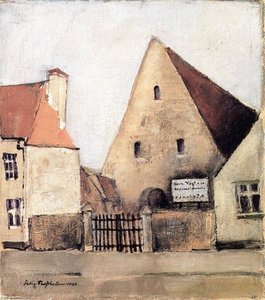
Felix Nussbaum, 1904 – 1944

Felix Nussbaums malerier: De 49 mest berømte værker, rangeret

Felix Nussbaum's mest berømte maleri er Fish Market (1936) i Kulturgeschichtliche Museum Osnabrück, Osnabrück. Sammen med Fishing Boats with Island (1933) og Loneliness (1942) udgør de de tre værker, som alle kender. Vores katalog indeholder 49 værker af Felix Nussbaum; de 49 nedenfor er dem, som verden ser mest på, hver med årstal, det museum der opbevarer det, og hvorfor det er betydningsfuldt.

Rangordnet efter vores popularitetsscore, som kombinerer søgninger, besøg og ordrer for hvert værk. Opdateret oktober 2026. Hvert mesterværk på denne side kan bestilles som en håndmalet oliereproduktion i museumskvalitet eller som et kunsttryk i den størrelse, du vælger.

Portræt af Felix Nussbaum
Felix Nussbaum · 1904 – 1944
Født · død
1904 – 1944, Osnabrück
Bevægelse
Surrealist expressionism
Værker i vores katalog
49
Mest kendte
Fish Market (1936)
Flest værker hos
Kulturgeschichtliche Museum Osnabrück

De 10 mest berømte Felix Nussbaum malerier

Memory of Norderney (1929) af Felix Nussbaum
5

Memory of Norderney

1929 · Oil On Canvas · Kulturgeschichtliche Museum Osnabrück, Osnabrück

In the hauntingly beautiful oil on canvas, Memory of Norderney, Felix Nussbaum invites us into a world that feels simultaneously vibrant and ghostly. Painted in 1929, this large-scale masterpiece captures a moment of serene leisure, yet it is imbued with a profound sense of nostalgia that transcends its literal subject matter. The scene unfolds before a stately building, perhaps a grand hotel or a coastal mansion, characterized by its classical…

Felix Nussbaum, malerier 11 til 49

Felka Platek Painting (1935) af Felix Nussbaum
#42

Felka Platek Painting

1935 · Jüdisches Museum Rendsburg

The Felka Platek Painting by Felix Nussbaum is a remarkable work of art that showcases the artist's unique style and technique. Created in 1935, this oil on canvas…

Tag den med hjem →
In the camp (1940) af Felix Nussbaum
#43

In the camp

1940 · Deutsches Historisches Museum

Felix Nussbaum’s “In The Camp” – A Portrait of Despair Rendered in Bold Minimalism The painting "In The Camp" by Felix Nussbaum, created in 1940 during his imprisonment…

Tag den med hjem →
Gypsy (1928) af Felix Nussbaum
#44

Gypsy

1928 · Kulturgeschichtliche Museum Osnabrück

The painting "Gypsy" by Felix Nussbaum is a remarkable work of art that showcases the artist's unique style and technique. Created in 1928, this oil on canvas painting…

Bestil en håndmalet kopi →
Min Moder (1926) af Felix Nussbaum
#45

Min Moder

1926 · Kulturgeschichtliche Museum Osnabrück

“My Mother,” painted in 1926 by Felix Nussbaum, stands as an arresting example of Expressionist art—a genre characterized by its fervent emotional intensity and rejection of academic conventions.…

Bestil en reproduktion →
Masquerade (1927) af Felix Nussbaum
#47

Masquerade

1927

The Masquerade painting by Felix Nussbaum is a captivating artwork that showcases the artist's unique style and technique. Created in 1927, this oil on canvas piece is a…

Bestil en reproduktion →

De motiver Felix Nussbaum malede mest

De fire motiver, der optræder hyppigst blandt disse mesterværker, med det fineste eksempel på hvert enkelt.

Hvor kan man se Felix Nussbaum's malerier

De 7 museer, der rummer flest af malerierne på denne side.

Museum By Værker af Felix Nussbaum Malerier fra denne liste
Kulturgeschichtliche Museum Osnabrück, OsnabrückKulturgeschichtliche Museum Osnabrück Osnabrück 21 Fish Market, Fear (also known as Self Portrait with His Niece Marianna), Memory of Norderney
Berlinische Galerie, BerlinBerlinische Galerie Berlin 4 The mad square, Self-Portrait in a Shroud (Group picture), Gallows (also known as Funeral)
Jødiske Museum Berlin, BerlinJødiske Museum Berlin Berlin 2 Loneliness, Self-Portrait With Painters Cloth
Niedersächsisches Landesmuseum Für Kunst Und Kulturgeschichte Oldenburg, OldenburgNiedersächsisches Landesmuseum Für Kunst Und Kulturgeschichte Oldenburg Oldenburg 1 Jew by the Window
Jüdisches Museum Rendsburg, RendsburgJüdisches Museum Rendsburg Rendsburg 1 Felka Platek Painting
Deutsches Historisches Museum, BerlinDeutsches Historisches Museum Berlin 1 In the camp
Neue Galerie New York, New York CityNeue Galerie New York New York City 1 Self-Portrait in the Camp

Felix Nussbaums mest berømte maleri fra hvert årti

  1. 1920s
    Memory of Norderney (1929) af Felix Nussbaum
    Nr. 5 ud af 49

    Memory of Norderney

    Alder 16 – 25 · Kulturgeschichtliche Museum Osnabrück

    In the hauntingly beautiful oil on canvas, Memory of Norderney, Felix Nussbaum invites us into a world that feels simultaneously vibrant and ghostly. Painted in 1929, this large-scale…

  2. 1930s
    Fish Market (1936) af Felix Nussbaum
    Rang 1 ud af 49

    Fish Market

    Alder 26 – 35 · Kulturgeschichtliche Museum Osnabrück

    is an oil painting by the German-Jewish artist Felix Nussbaum. Created about 1936, the work captures a bustling fish market. The scene is set against a cityscape, suggesting…

  3. 1940s
    Loneliness (1942) af Felix Nussbaum
    Nr. 3 ud af 49

    Loneliness

    Alder 36 – 40 · Jødiske Museum Berlin

Spørgsmål om Felix Nussbaums malerier

Hvad er Felix Nussbaums mest berømte maleri?Vis svaret

Fish Market (1936), Kulturgeschichtliche Museum Osnabrück, Osnabrück. Derefter følger Fishing Boats with Island (1933) og Loneliness (1942).

Hvor gammel var Felix Nussbaum, da Fish Market blev malet?Vis svaret

32 år gammel: Fish Market er fra 1936, og Felix Nussbaum blev født i 1904.

Hvad er de 10 bedste malerier af Felix Nussbaum?Vis svaret

Fish Market, Fishing Boats with Island, Loneliness, Fear (also known as Self Portrait with His Niece Marianna), Memory of Norderney, Entombment (also known as Organ Grinders at the Roman Forum), Lovers, The mad square, Self-Portrait With Painters Cloth og Masks and Cat. Ranglisten ovenfor angiver årstallet og museet for hver af dem.

Hvor mange malerier har Felix Nussbaum lavet?Vis svaret

Vores katalog indeholder 49 værker af Felix Nussbaum, dateret fra 1925 til 1944.

Hvor findes Felix Nussbaums mest berømte malerier?Vis svaret

De fleste af dem findes i Kulturgeschichtliche Museum Osnabrück (Osnabrück), Berlinische Galerie (Berlin) og Jødiske Museum Berlin (Berlin). Tabellen ovenfor lister museerne enkeltvis.

Hvornår malede Felix Nussbaum sine mest berømte værker?Vis svaret

I 1930s: 22 af de 49 værker på denne side stammer fra denne periode, herunder Fish Market.

Hvad er Felix Nussbaum's tidligste og seneste berømte malerier?Vis svaret

Det tidligste på denne side er Fairground (1925), det seneste Jaqui in the Street (1944).

Hvad malede Felix Nussbaum oftest?Vis svaret

Men (5), Woman (3) og Buildings (3), blandt de 49 værker på denne side.

Hvilket medie brugte Felix Nussbaum mest?Vis svaret

Oil: 2 ud af de 49 værker på denne side.

Hvilken kunstretning tilhører Felix Nussbaum?Vis svaret

Surrealist expressionism, som malerierne på denne side viser.

Hvilke Felix Nussbaum-malerier kan jeg se på Kulturgeschichtliche Museum Osnabrück?Vis svaret

Fish Market, Fear (also known as Self Portrait with His Niece Marianna) og Memory of Norderney er blandt de 21 værker på denne side, som er i Kulturgeschichtliche Museum Osnabrück, Osnabrück's samling.

Kan jeg købe en reproduktion af et maleri af Felix Nussbaum?Vis svaret

Ja. Hvert maleri på denne side kan bestilles som en håndmalet oliereproduktion i museums kvalitet eller som et kunstprint i den størrelse, du ønsker, direkte fra maleriets egen side.

Om Felix Nussbaum

A Life Etched in Exile: The Haunting Vision of Felix Nussbaum

Felix Nussbaum’s story is a stark and profoundly moving testament to the power of art born from unimaginable suffering. Born in Osnabrück, Germany, in 1904, his life unfolded against the backdrop of rising nationalism and escalating persecution, culminating in the horrors of the Holocaust. He wasn't simply a victim *of* history; he was an artist who meticulously documented its impact on his soul, creating a body of work that stands as both a personal lament and a universal warning. Nussbaum’s paintings offer a rare, unflinching glimpse into the psychological landscape of displacement, fear, and ultimately, annihilation – a perspective often absent from broader historical narratives. His father, Philipp Nussbaum, a World War I veteran with an early passion for painting himself, recognized and nurtured his son's talent, providing encouragement that would prove vital in the darkening years to come. This initial support fostered a lifelong dedication to art, even as political realities increasingly constricted his path.

Formative Years and Artistic Influences

Nussbaum’s artistic journey began with formal studies in Hamburg and Berlin in 1920, continuing for as long as circumstances allowed. His early work reveals a clear debt to the Post-Impressionist masters, particularly Vincent van Gogh and Henri Rousseau. The vibrant colors and expressive brushwork of these artists provided a foundation upon which Nussbaum would later build his unique style. However, he wasn’t content with mere imitation. He actively sought out new influences, drawn to the unsettling dreamscapes of Giorgio de Chirico and Carlo Carrà, pioneers of the *pittura metafisica* movement. The careful attention to color demonstrated by Carl Hofer's expressionist paintings also left a lasting impression on Nussbaum’s approach. These diverse inspirations coalesced into what would become known as his “New Objectivity” style – a blend of realism and surrealism, characterized by precise detail, unsettling compositions, and a pervasive sense of alienation. This period was marked by experimentation and growth, but the looming shadow of Nazi ideology soon threatened to extinguish his artistic promise.

The Surrealist Vision

Nussbaum’s embrace of Surrealism wasn't merely an aesthetic choice; it represented a profound psychological response to the anxieties of his time. Influenced by Sigmund Freud’s theories on the unconscious mind, Nussbaum sought to depict inner turmoil and emotional truth—often confronting themes of loss, trauma, and existential dread. His canvases pulsate with unsettling juxtapositions and symbolic imagery, reflecting the fractured reality experienced by individuals displaced from their homes and stripped of their identities. Recurring motifs—such as figures draped in shrouds or enveloped in darkness—underscore the pervasive sense of vulnerability and despair that permeates his oeuvre. He skillfully utilized techniques honed during his formative years to convey these complex emotions with remarkable sensitivity and conviction.

Exile, Isolation, and Artistic Transformation

The Nazi ascension to power in 1933 irrevocably altered Nussbaum’s life trajectory. Studying on a scholarship in Rome at the Berlin Academy of the Arts, he witnessed firsthand the chilling pronouncements of Hitler's propaganda minister, outlining the tenets of Nazi art – glorification of heroism and the Aryan race. It became painfully clear that as a Jew, his place within the German artistic establishment was untenable. This realization forced him into exile, first to Paris and then to Belgium, where he married Felka Platek in 1937. The following decade was defined by fear and isolation. Despite finding some measure of safety, Nussbaum lived under constant threat, haunted by the knowledge of his parents’ perilous situation back in Germany. They had initially resisted his pleas to join them in exile, clinging to a misguided hope that things would improve, but ultimately returned home only to face the full force of Nazi persecution. This loss – the severing of his spiritual and financial support – deeply impacted Nussbaum's work, infusing it with an increasingly desperate and melancholic tone. He continued to paint prolifically during this period, finding solace and purpose in his art even as his world crumbled around him.

A Legacy of Courage and Artistic Integrity

The Nazi invasion of Belgium in 1940 marked a turning point for Nussbaum’s artistic endeavors. Arrested as a “hostile alien” and interned at Saint-Cyprien camp, he experienced firsthand the dehumanizing realities of Nazi oppression. Yet, amidst this bleak circumstance, Nussbaum persevered—producing some of his most poignant and unforgettable works during his confinement. Self-Portrait with Jewish Identity Card (1943), a haunting depiction of vulnerability and despair, stands as a testament to his unwavering artistic integrity in the face of unimaginable adversity. Alongside it, masterpieces like *Triumph of Death* and *Felka Platek Painting* grapple with themes of mortality, loss, and remembrance—reflecting Nussbaum’s profound engagement with existential questions. Tragically, Nussbaum and Felka were deported to Auschwitz in July 1944, where Felix was murdered upon arrival in August of that year. His brother and sister-in-law followed soon after, completing the annihilation of his family within a single devastating year. Despite this horrific fate, Nussbaum’s art endures as a powerful symbol of resistance—a testament to the enduring human spirit's capacity for creativity and compassion amidst the darkest chapters of history. His legacy continues to inspire artists and scholars alike, ensuring that his vision—one rooted in empathy and confronting the horrors of persecution—remains relevant for generations to come.

Alle 49 værker af Felix Nussbaum →