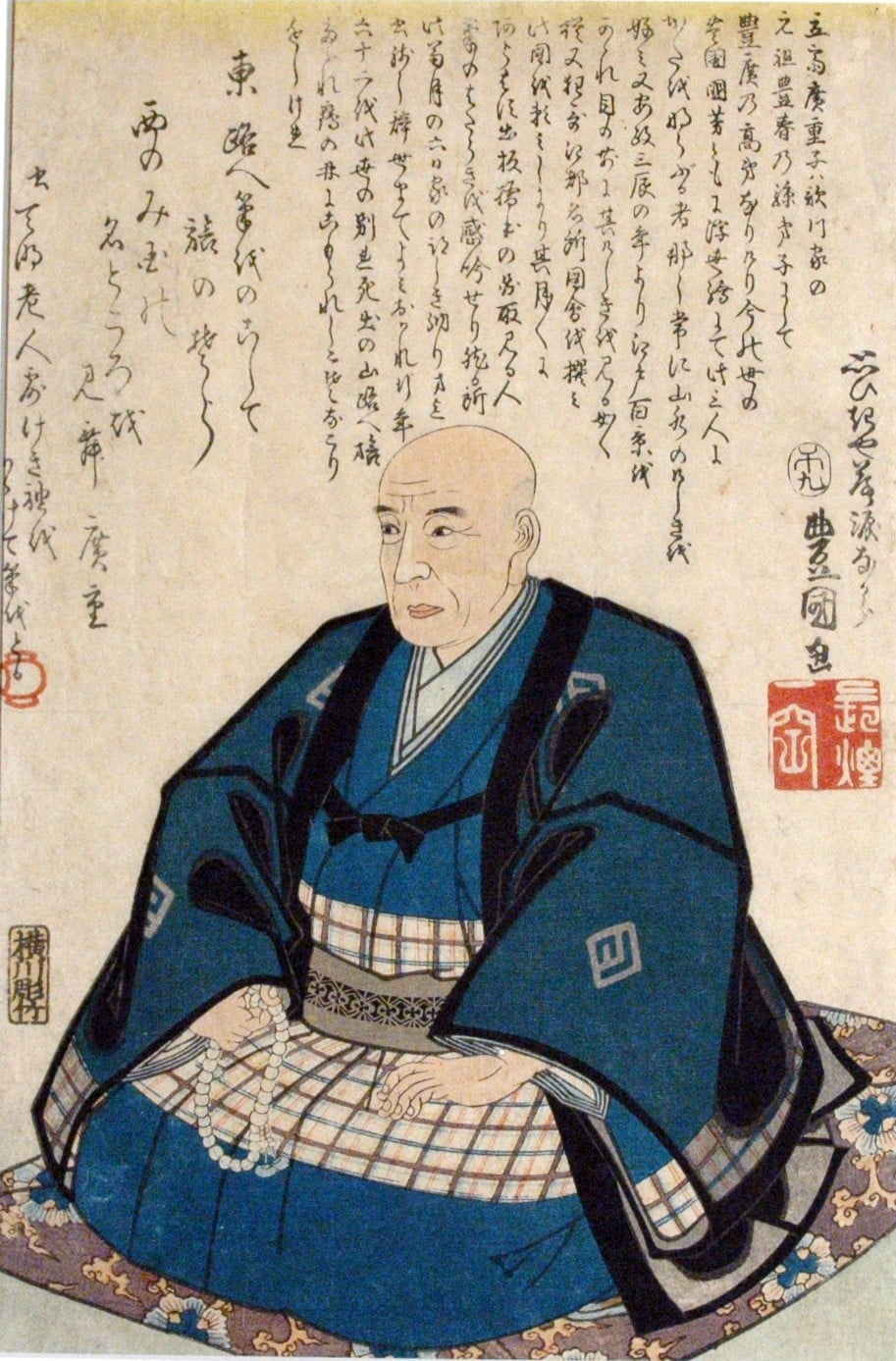
Ando Hiroshige, 1797 – 1858

Ando Hiroshiges malerier: De 100 mest berømte værker, rangeret

Ando Hiroshige's mest berømte maleri er Early Department from a Daimyo i Nakagawa-machi Bato Hiroshige Museum of Art, Nagasaki. Sammen med The maple leaves of Mama, Tekona shrine and Tsugi bridge (1857) og Hakone (1834) udgør de de tre værker, som alle kender. Vores katalog indeholder 353 værker af Ando Hiroshige; de 100 nedenfor er dem, som verden ser mest på, hver med årstal, det museum der opbevarer det, og hvorfor det er betydningsfuldt.

Rangordnet efter vores popularitetsscore, som kombinerer søgninger, besøg og ordrer for hvert værk. Opdateret oktober 2026. Hvert mesterværk på denne side kan bestilles som en håndmalet oliereproduktion i museumskvalitet eller som et kunsttryk i den størrelse, du vælger.

Portræt af Ando Hiroshige
Ando Hiroshige · 1797 – 1858
Født · død
1797 – 1858, Edo
Bevægelse
Japanese landscape painting
Værker i vores katalog
353
Mest kendte
Early Department from a Daimyo
Flest værker hos
Nakagawa-machi Bato Hiroshige Museum of Art

De 10 mest berømte Ando Hiroshige malerier

Early Department from a Daimyo af Ando Hiroshige
1

Early Department from a Daimyo

Woodblock Print · Nakagawa-machi Bato Hiroshige Museum of Art, Nagasaki

In the delicate dance of lines and muted pigments, Utagawa Hiroshige’s Early Department from a Daimyo invites us to step through a portal into the heart of Edo-period Japan. This exquisite woodblock print captures a moment of vibrant communal life along a bustling riverside, where the rigid structures of social hierarchy melt into the shared leisure of a sunny afternoon. As we gaze upon the scene, we are not merely…

The maple leaves of Mama, Tekona shrine and Tsugi bridge (1857) af Ando Hiroshige
2

The maple leaves of Mama, Tekona shrine and Tsugi bridge

1857 · Woodblock Print · Van Gogh Museet, Amsterdam

Utagawa Hiroshige (1797-1858), arguably the last titan of *ukiyo-e*, didn't merely depict landscapes; he crafted them into meditations on beauty and impermanence. “The Maple Leaves of Mama, Tekona Shrine and Tsugi Bridge,” created in 1857 during a period of significant societal transformation—the waning influence of feudal Japan as Western ideas crept in—stands as a testament to his enduring artistic legacy. More than just a visual record, it’s an embodiment of…

Hakone (1834) af Ando Hiroshige
3

Hakone

1834 · Woodblock Print · Indianapolis Kunstmuseum, Indianapolis

Utagawa Hiroshige’s “Hakone,” created in 1834, is more than just a landscape; it's a poetic meditation on the beauty and transience of nature within Edo-period Japan. This woodblock print, part of his renowned series "The Fifty-three Stations of the Tōkaidō," captures a specific moment along the vital trade route connecting Tokyo (then Edo) with Kyoto. However, Hiroshige elevates this seemingly simple depiction of a mountain pass into something profoundly evocative,…

Station 36, Goyu; Kyoka Tokaido Series (1855) af Ando Hiroshige
4

Station 36, Goyu; Kyoka Tokaido Series

1855 · Woodblock Print · Indianapolis Kunstmuseum, Indianapolis

In the delicate interplay of ink and paper, Utagawa Hiroshige’s "Station 36, Goyu; Kyoka Tokaido Series" offers much more than a mere topographical record of a journey. Completed in 1855, this exquisite woodblock print serves as a profound distillation of Edo-period sensibilities, capturing a yearning for tranquility amidst the burgeoning dynamism of a Japan in transition. As the nation stood at a pivotal crossroads between ancient feudal traditions and the…

Fushimi Station #51 (1842) af Ando Hiroshige
5

Fushimi Station #51

1842 · Akryl på lærred · Indianapolis Kunstmuseum, Indianapolis

Fushimi, Station # 51 – Et Poetisk Øje På Edo Japans Landskaber Utagawa Hiroshige er en kunstner hvis navn vil fremkalde billeder af fredfyldte japanske landskaber og atmosfæriske trædstykker. Han var ikke blot en dygtig tekniker, men også en visionær kunstner, der formåede at fange essensen af sin tid og udtrykke følelser gennem sit arbejde – hvilket har gjort hans kunst til et ikon inden for ukiyo-e og inspireret kunstnere…

Ichikoku Bridge in the Eastern Capital (Tōto: Ichikoku bashi) (1858) af Ando Hiroshige
6

Ichikoku Bridge in the Eastern Capital (Tōto: Ichikoku bashi)

1858 · Woodblock Print · Indianapolis Kunstmuseum, Indianapolis

The Ichikoku Bridge spans a quiet stretch of water in the Eastern Capital. Beneath its wooden arch, two boats drift through the current. People move across the structure, some carrying backpacks and others clutching small handbags. A mountain rises in the distance, watching over the scene. Trees frame the edges of the view, their leaves casting shadows near the water's edge.

Shinagawa Sunrise from the series Fifty-three Stations on the Tokaido Road (1834) af Ando Hiroshige
7

Shinagawa Sunrise from the series Fifty-three Stations on the Tokaido Road

1834 · Woodblock Print · Hill-Stead Museum, Farmington

In the soft, burgeoning light of a nineteenth-century morning, Utagawa Hiroshige invites us to witness a moment of profound stillness along the Tōkaidō road. Shinagawa Sunrise is not merely a depiction of a coastal village; it is a masterclass in the art of atmosphere. As the sun begins its ascent, the boundary between the heavens and the earth dissolves into a luminous haze. The water of the bay reflects a…

The Rokugo River Ferry, Kawasaki, from the series the Fifty-three Stations of the Tokaido (Hoeido edition ) af Ando Hiroshige
8

The Rokugo River Ferry, Kawasaki, from the series the Fifty-three Stations of the Tokaido (Hoeido edition )

Woodblock Print · Nakagawa-machi Bato Hiroshige Museum of Art, Nagasaki

In the delicate dance of woodblock printing, few masters captured the ephemeral beauty of Japanese life as profoundly as Utagawa Hiroshige. His masterpiece, The Rokugo River Ferry, Kawasaki, serves as a breathtaking window into the Edo period, inviting the viewer to step onto the bustling banks of one of the most vital crossings on the Tokaido road. This evocative scene from his legendary series, The Fifty-three Stations of the Tokaido,…

Itsukushima in Aki Province (1858) af Ando Hiroshige
9

Itsukushima in Aki Province

1858 · Woodblock Print · Brooklyn Museum, Brooklyn

In the delicate interplay of mist and water, Itsukushima in Aki Province offers more than a mere glimpse of a Japanese landmark; it provides a profound meditation on the ephemeral nature of existence. Created by the legendary ukiyo-e master Ando Hiroshige in 1858, this woodcut print captures the spiritual essence of the Itsukushima shrine area with a poetic sensitivity that remains unparalleled. As one gazes upon the composition, the eye…

Tenryu River Ferry Crossing, Mitsuke, from the series The Fifty-three Stations of the Tokaido (Gyosho Edition) af Ando Hiroshige
10

Tenryu River Ferry Crossing, Mitsuke, from the series The Fifty-three Stations of the Tokaido (Gyosho Edition)

Woodblock Print · Nakagawa-machi Bato Hiroshige Museum of Art, Nagasaki

The woodblock print depicts a section of the Tenryu River near the station of Mitsuke. In the center of the composition, a large sandbank divides the water into two distinct currents. Several small wooden boats occupy the river, with figures positioned within them to manage the crossing. Some vessels are moored directly against the central sandbank, while others navigate the moving water. The far shore is visible in the distance,…

Ando Hiroshige, malerier 11 til 100

Parrot og Druvbær (1800) af Ando Hiroshige
#11

Parrot og Druvbær

1800 · Indianapolis Kunstmuseum

Hiroshige’s Poetic Vision of Edo Japan: “Parrot and Grape Vines” Utagawa Hiroshige (1797-1858) stands as an undisputed titan amongst *ukiyo-e* artists, a master who irrevocably shaped the visual…

Bestil en reproduktion →
Evening Snow at Kanbara (1834) af Ando Hiroshige
#14

Evening Snow at Kanbara

1834 · Los Angeles County Museum of Art

“Evening Snow at Kanbara,” a captivating woodblock print by the legendary Utagawa Hiroshige, isn't merely a depiction of a winter landscape; it’s an invitation to step into a…

Tag den med hjem →
Dawn in the licensed quarters (1857) af Ando Hiroshige
#15

Dawn in the licensed quarters

1857 · Art Gallery of New South Wales

To gaze upon Utagawa Hiroshige's "Dawn in the licensed quarters" is to step directly into the vibrant, ephemeral heart of Edo during the mid-nineteenth century. This painting captures…

Tag den med hjem →
Night View of Saruwakacho af Ando Hiroshige
#16

Night View of Saruwakacho

A Glimpse into Edo's Nightlife: The Allure of Saruwakacho Ando Hiroshige’s “Night View of Saruwakacho” is more than just a depiction of 19th-century Japan; it’s an invitation to…

Tag den med hjem →
Station 28, Fukuroi (1855) af Ando Hiroshige
#17

Station 28, Fukuroi

1855 · Indianapolis Kunstmuseum

The woodblock print titled Station 28, Fukuroi depicts a serene landscape featuring a field dotted with trees displaying vibrant autumn foliage. Within this scene, a group of at…

Bestil en håndmalet kopi →
Keishi (Kyoto), Capital (1834) af Ando Hiroshige
#19

Keishi (Kyoto), Capital

1834 · Indianapolis Kunstmuseum

Utagawa Hiroshige’s “Keishi (Kyoto), Capital,” painted in 1834, is more than just a picturesque landscape; it’s a window into the vibrant life of Edo-period Japan. Part of his…

Bestil en håndmalet kopi →
Yokkaichi (Station #44) (1834) af Ando Hiroshige
#21

Yokkaichi (Station #44)

1834 · Indianapolis Kunstmuseum

In the delicate dance of lines and colors that defines the ukiyo-e tradition, Utagawa Hiroshige’s Yokkaichi (Station #44) emerges as a profound meditation on the harmony between humanity…

Bestil en håndmalet kopi →
Kawachi (1853) af Ando Hiroshige
#28

Kawachi

1853 · Indianapolis Kunstmuseum

Utagawa Hiroshige’s “Kawachi,” painted in 1853, isn’t merely a landscape; it’s a distilled moment of profound serenity captured with the meticulous precision and poetic sensibility that defined his…

Bestil en reproduktion →
Kanbara, NatSne (1834) af Ando Hiroshige
#37

Kanbara, NatSne

1834 · Indianapolis Kunstmuseum

Kanbara, Night Snow – Et Poetisk Øjeblik Af Edo Japans Landskab Hiroshige’s “Night Snow at Kanbara” er mere end blot et billede; det er en følelse af vinterens…

Tag den med hjem →
Wakasa (1853) af Ando Hiroshige
#51

Wakasa

1853 · Indianapolis Kunstmuseum

A Poetic Vision of Edo Japan: The Life and Art of Utagawa Hiroshige Utagawa Hiroshige (1797-1858) stands as an unparalleled luminary in the realm of *ukiyo-e*, or “pictures…

Bestil en håndmalet kopi →
Sakanoshita af Ando Hiroshige
#62

Sakanoshita

Indianapolis Kunstmuseum

Utagawa Hiroshige’s “Sakanoshita,” part of his renowned series The Fifty-three Stations of the Tōkaidō, offers more than just a scenic view; it provides a window into the heart…

Bestil en reproduktion →
Station 23, Fujieda af Ando Hiroshige
#63

Station 23, Fujieda

Indianapolis Kunstmuseum

Station 23, Fujieda – Et Utagawa Hiroshiges Poetiske Blik På Edo Japans Vej Utagawa Hiroshige (1797–1858) var en kunstner af enorm betydning inden for japansk *ukiyo-e*, eller ”billeder…

Tag den med hjem →
Dog (1858) af Ando Hiroshige
#91

Dog

1858 · Indianapolis Kunstmuseum

This woodblock print, titled Dog, presents a landscape featuring a mountain topped with snow in the background. A river flows through the valley below the mountain. Several trees…

Bestil en reproduktion →
Akasaka, nr. 37 af Ando Hiroshige
#95

Akasaka, nr. 37

Indianapolis Kunstmuseum

Akasaka, No. 37 – Et Poetisk Øje På Edo Japans Daglig Liv Utagawa Hiroshige er en kunstner hvis navn vil fremkalde billeder af rolige japanske landskaber og atmosfæren…

Bestil en reproduktion →
Yoshiwara af Ando Hiroshige
#97

Yoshiwara

Indianapolis Kunstmuseum

A landscape unfolds through a series of layered compositions, leading the eye toward distant, hazy mountains. In the foreground, figures on horseback traverse a narrow path cutting through…

Bestil en reproduktion →
Fuchu, No. 20 af Ando Hiroshige
#98

Fuchu, No. 20

Indianapolis Kunstmuseum

The water ripples with a gentle energy as figures immerse themselves in the cool depths of the river. In this scene from Fuchu, life moves at the pace…

Bestil en håndmalet kopi →
Woman Walking in the Snow (1850) af Ando Hiroshige
#99

Woman Walking in the Snow

1850 · Metropolitan Museum of Art

In his prints, Hiroshige used the unprinted white paper to represent snow, a technique also exploited in this painting, in which unpainted silk, reserved against the pale ink…

Bestil en håndmalet kopi →
82. Moon Viewing (1857) af Ando Hiroshige
#100

82. Moon Viewing

1857

A Serene Escape: Ando Hiroshige’s “82. Moon Viewing” Subject & Composition: This exquisite ukiyo-e woodblock print transports viewers to a tranquil scene of Edo-era Japan, capturing the intimate…

Tag den med hjem →

Ando Hiroshiges malerier efter periode

De motiver Ando Hiroshige malede mest

De fire motiver, der optræder hyppigst blandt disse mesterværker, med det fineste eksempel på hvert enkelt.

Hvor kan man se Ando Hiroshige's malerier

De 8 museer, der rummer flest af malerierne på denne side.

Museum By Værker af Ando Hiroshige Malerier fra denne liste
Nakagawa-machi Bato Hiroshige Museum of Art, NagasakiNakagawa-machi Bato Hiroshige Museum of Art Nagasaki 30 Early Department from a Daimyo, The Rokugo River Ferry, Kawasaki, from the series the Fifty-three Stations of the Tokaido (Hoeido edition ), Tenryu River Ferry Crossing, Mitsuke, from the series The Fifty-three Stations of the Tokaido (Gyosho Edition)
Indianapolis Kunstmuseum, IndianapolisIndianapolis Kunstmuseum Indianapolis 36 Hakone, Station 36, Goyu; Kyoka Tokaido Series, Fushimi Station #51
Metropolitan Museum of Art, New YorkMetropolitan Museum of Art New York 8 Shibaura Bay of Musashi Province, Koyurugi Beach of Sagami Province, Honmoku Bay of Musashi Province
Brooklyn Museum, BrooklynBrooklyn Museum Brooklyn 4 Itsukushima in Aki Province, 62 (55) Komakata Hall and Azuma Bridge, Sakanoshita: the Throwing Away the Brush Peak
Hill-Stead Museum, FarmingtonHill-Stead Museum Farmington 3 Shinagawa Sunrise from the series Fifty-three Stations on the Tokaido Road, Evening Snow at Asakusa or Woman with Umbrella from the series Eight Views of the Environs of Edo
Los Angeles County Museum of Art, Los AngelesLos Angeles County Museum of Art Los Angeles 2 Evening Snow at Kanbara, Night View of Matsuchiyama and the San
Van Gogh Museet, AmsterdamVan Gogh Museet Amsterdam 1 The maple leaves of Mama, Tekona shrine and Tsugi bridge
Art Gallery of New South Wales, SydneyArt Gallery of New South Wales Sydney 1 Dawn in the licensed quarters

Ando Hiroshiges mest berømte maleri fra hvert årti

  1. 1830s
    Hakone (1834) af Ando Hiroshige
    Nr. 3 ud af 100

    Hakone

    Alder 33 – 42 · Indianapolis Kunstmuseum

    Utagawa Hiroshige’s “Hakone,” created in 1834, is more than just a landscape; it's a poetic meditation on the beauty and transience of nature within Edo-period Japan. This woodblock…

  2. 1840s
    Fushimi Station #51 (1842) af Ando Hiroshige
    #5 ud af 100

    Fushimi Station #51

    Alder 43 – 52 · Indianapolis Kunstmuseum

    Fushimi, Station # 51 – Et Poetisk Øje På Edo Japans Landskaber Utagawa Hiroshige er en kunstner hvis navn vil fremkalde billeder af fredfyldte japanske landskaber og atmosfæriske…

  3. 1850s
    The maple leaves of Mama, Tekona shrine and Tsugi bridge (1857) af Ando Hiroshige
    Rang 2 ud af 100

    The maple leaves of Mama, Tekona shrine and Tsugi bridge

    Alder 53 – 61 · Van Gogh Museet

    Utagawa Hiroshige (1797-1858), arguably the last titan of *ukiyo-e*, didn't merely depict landscapes; he crafted them into meditations on beauty and impermanence. “The Maple Leaves of Mama, Tekona…

Spørgsmål om Ando Hiroshiges malerier

Hvad er Ando Hiroshiges mest berømte maleri?Vis svaret

Early Department from a Daimyo, Nakagawa-machi Bato Hiroshige Museum of Art, Nagasaki. Derefter følger The maple leaves of Mama, Tekona shrine and Tsugi bridge (1857) og Hakone (1834).

Hvad er de 10 bedste malerier af Ando Hiroshige?Vis svaret

Early Department from a Daimyo, The maple leaves of Mama, Tekona shrine and Tsugi bridge, Hakone, Station 36, Goyu; Kyoka Tokaido Series, Fushimi Station #51, Ichikoku Bridge in the Eastern Capital (Tōto: Ichikoku bashi), Shinagawa Sunrise from the series Fifty-three Stations on the Tokaido Road, The Rokugo River Ferry, Kawasaki, from the series the Fifty-three Stations of the Tokaido (Hoeido edition ), Itsukushima in Aki Province og Tenryu River Ferry Crossing, Mitsuke, from the series The Fifty-three Stations of the Tokaido (Gyosho Edition). Ranglisten ovenfor angiver årstallet og museet for hver af dem.

Hvor mange malerier har Ando Hiroshige lavet?Vis svaret

Vores katalog indeholder 353 værker af Ando Hiroshige, dateret fra 1833 til 1858.

Hvor findes Ando Hiroshiges mest berømte malerier?Vis svaret

De fleste af dem findes i Nakagawa-machi Bato Hiroshige Museum of Art (Nagasaki), Indianapolis Kunstmuseum (Indianapolis) og Metropolitan Museum of Art (New York). Tabellen ovenfor lister museerne enkeltvis.

Hvornår malede Ando Hiroshige sine mest berømte værker?Vis svaret

I 1850s: 43 af de 100 værker på denne side stammer fra denne periode, herunder The maple leaves of Mama, Tekona shrine and Tsugi bridge.

Hvad er Ando Hiroshige's tidligste og seneste berømte malerier?Vis svaret

Det tidligste på denne side er Shirasuga, Shiomi-zaka zu (View of Shima Slope) (1833), det seneste Ichikoku Bridge in the Eastern Capital (Tōto: Ichikoku bashi) (1858).

Hvad malede Ando Hiroshige oftest?Vis svaret

Edo period (32), Woodblock print (22) og Ukiyo-e (22), blandt de 100 værker på denne side.

Hvilket medie brugte Ando Hiroshige mest?Vis svaret

Woodblock Print: 61 ud af de 100 værker på denne side.

Hvilken kunstretning tilhører Ando Hiroshige?Vis svaret

Japanese landscape painting, som malerierne på denne side viser.

Hvilke Ando Hiroshige-malerier kan jeg se på Nakagawa-machi Bato Hiroshige Museum of Art?Vis svaret

Early Department from a Daimyo, The Rokugo River Ferry, Kawasaki, from the series the Fifty-three Stations of the Tokaido (Hoeido edition ) og Tenryu River Ferry Crossing, Mitsuke, from the series The Fifty-three Stations of the Tokaido (Gyosho Edition) er blandt de 29 værker på denne side, som er i Nakagawa-machi Bato Hiroshige Museum of Art, Nagasaki's samling.

Kan jeg købe en reproduktion af et maleri af Ando Hiroshige?Vis svaret

Ja. Hvert maleri på denne side kan bestilles som en håndmalet oliereproduktion i museums kvalitet eller som et kunstprint i den størrelse, du ønsker, direkte fra maleriets egen side.

Om Ando Hiroshige

Utagawa Hiroshige: En Poetisk Betragter af Edo-Japan

Utagawa Hiroshige, født Andō Tokutarō i 1797 i den pulserende by Edo (moderne Tokyo), står som en central figur i verden af *ukiyo-e*, eller “billeder fra det flydende verden.” Selvom han var dybt forankret i traditionerne i japansk træblokstik, overgik Hiroshige blot at reproducere; han indgydede sine landskaber med en poetisk sanselighed, der resonerede dybt både inden for Japan og senere på tværs af den vestlige kunstverden. Hans liv udspillede sig under en periode med relativ fred og velstand under Tokugawa-shogunen, men også én præget af stigende social forandring og den efterfølgende vestliggørelse – kræfter, der bidrog til *ukiyo-e’s* nedgang, selvom de forstærkede Hiroshige's vedvarende arv. I første omgang var han bestemt til en mere konventionel vej inden for en samurai-familie – hans far tjente som brandvagt – men Hiroshige's kunstneriske tilbøjeligheder førte ham til et lærerskab under Utagawa Toyohiro, en mester i Utagawas skole. Dette viste sig at være et afgørende vendepunkt, der drev ham væk fra de populære fremstillinger af kurtisiner og skuespillere, som mange *ukiyo-e*-kunstnere foretrak, mod fokus på landskab, en genre han i sidste ende ville gendefinere.

Fra Genrebilleder til Evocative Landskaber

Hiroshige's tidlige arbejde fulgte skolens konventioner, med portrætter og scener fra dagligdagen. Men det var hans omfavnelse af landskab, der virkelig skilte ham ud. Påvirket af tidligere mestre som Hokusai – hvis *Tretti seks visninger af Fuji* allerede havde fangeres publikums opmærksomhed – udviklede Hiroshige en unik stil karakteriseret ved atmosfærisk perspektiv, subtile farvepaletter og en dyb følsomhed over for skiftene årstider. Han portrætterede ikke blot steder; han fremkaldte deres stemning, fangede essensen af et bestemt øjeblik i tiden. Serien *De femtysne stationer på Tōkaidō* (1833–1834), måske hans mest berømte præstation, dokumenterede rejsen langs Tōkaidō-vejen, den vigtigste rute mellem Edo og Kyoto, ikke som en simpel rejsebeskrivelse, men som en serie af evocative vignetter – et pludseligt regnskyl i Shono, en fjerntliggende udsigt til Fuji fra Kanaya, den travle aktivitet ved Odawara. Hvert tryk er gennemsyret af en følelse af forgængelighed og stille skønhed, der inviterer seerne til at opleve rejsen sammen med de reisende. Han udnyttede mesterligt *bokashi*, en teknik, der involverer flere tryk i samme område for at skabe subtile nuancer af farve, hvilket tilføjede dybde og atmosfære til sine kompositioner.

En Mester af Atmosfære og Teknik

Hiroshige's tekniske færdigheder var lige så bemærkelsesværdige som hans kunstneriske vision. Han var ikke blot interesseret i nøjagtig gengivelse; han søgte at fange *følelsen* af et sted. Hans brug af farver, selvom den ofte var mere sparsommelig end hos nogle af sine samtidige, var afgørende for at opnå dette. Han udnyttede ofte flere blokke for en enkelt farve, hvilket tillod ham at skabe nuancerede nuancer og atmosfæriske effekter, der var utroligt vanskelige at efterligne. De delikate blå nuancer i hans fremstillinger af regn eller tåge, de varme toner af efterårsblade – disse var ikke tilfældige; de var omhyggeligt overvejede elementer designet til at vække specifikke følelser og sansninger. Udover *bokashi* var Hiroshige dygtig til at udnytte tomrum – *ma*, et koncept centralt for japansk æstetik, der tillod områder af trykket at "trække vejret" og forbedrede den overordnede følelse af ro. Hans serie *En hundrede berømte visninger af Edo* (1856–1858) viste yderligere hans mesterskab, hvilket tilbød intime glimt ind i livet og landskaberne i hans elskede by.

Indflydelse og Arv

Hiroshige's arbejde var ikke uden forudgående indflydelser. Han var dybt påvirket af den kinesiske traditionelle malerkunst, især *sumi-e*, og af den mere formelle kanon i den ældre *ukiyo-e*-skole. Samtidig lærte han af Hokusai's radikale tilgang til landskabstrykkene, der var en markant afvigelse fra de traditionelle motiver. Hiroshige fandt sin egen unikke stil ved at kombinere disse elementer og skabe et mere atmosfærisk og poetisk udtryk. Hans tryk blev hurtigt populære i Japan, men det var først i Vesten, hvor de blev anerkendt for deres kunstneriske værdi og deres evne til at fange den flygtige skønhed i naturen. Impressionister og post-impressionister som Monet og Van Gogh var dybt fascineret af Hiroshiges farver og kompositioner, der inspirerede dem til at eksperimentere med lignende teknikker og motiver i deres egne værker. Hiroshige's død markerede starten på en hurtig nedgang i *ukiyo-e*-traditionen, accelereret af Meiji-restaureringen og den efterfølgende vestliggørelse. Alligevel har hans indflydelse på kunstverdenen vist sig at være bemærkelsesværdigt vedvarende. I det sene 19. århundrede strømmede japanske tryk til Europa, hvilket udløste et fænomen kendt som *Japonisme*. Kunstnere som Manet og Van Gogh blev betaget af *ukiyo-e’s* dristige kompositioner, flade perspektiver og ukonventionelle farveskalaer, der inspirerede dem til at inkorporere disse elementer i deres egne værker. Hiroshige's arbejde er et vidnesbyrd om en kunstners evne til at fange essensen af øjeblikket og skabe billeder, der fortsat fascinerer og inspirerer os i dag.

Alle 353 værker af Ando Hiroshige →