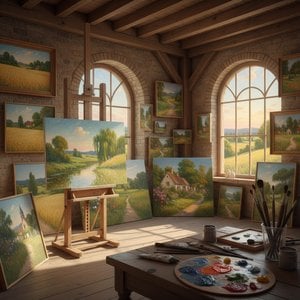
Robert Cree Crawford: A Scottish Painter of Light and Character
Born in 1842 in Rachan, Scotland, Robert Cree Crawford’s life and art were inextricably linked to the landscape of his upbringing – a remote, windswept corner of Sutherland. His early years were spent immersed in the rhythms of rural life, a formative experience that profoundly shaped his artistic vision. Crawford wasn't a flamboyant figure; he was a quiet observer, meticulously capturing the essence of his surroundings and the individuals who inhabited them. He eschewed grand narratives or dramatic compositions, instead focusing on the subtle beauty of everyday scenes – fishing boats bobbing in lochs, weathered cottages nestled amongst heather-clad hills, and portraits that revealed more than mere likenesses, hinting at character and inner life.
Crawford’s artistic journey began modestly. He initially trained as a draughtsman, honing his observational skills and developing a keen eye for detail. However, it was the influence of his uncle, Henry B. Marshall, a fellow artist who had spent considerable time in Scotland, that truly ignited Crawford's passion for painting. Marshall introduced him to the techniques of Impressionism and Realism, encouraging him to capture the fleeting effects of light and shadow – a crucial element in Crawford’s distinctive style. His early works were largely influenced by the Scottish Colourists, particularly their emphasis on capturing the vibrant hues of the Highlands, though Crawford's palette remained more restrained, favoring muted tones and subtle gradations.
A pivotal moment in Crawford’s career came with his portraiture work. He quickly established a reputation for creating remarkably insightful portraits of Scottish industrialists and businessmen – figures like William Loudon Reid, the Glasgow physician, and James Watt Douglas, a prominent shipping magnate. These weren't merely formal likenesses; Crawford imbued them with personality, capturing their bearing, expressions, and even a hint of their inner thoughts. He achieved this through careful observation, subtle shifts in pose, and an ability to convey mood and atmosphere. His technique involved layering thin glazes of oil paint, building up the image gradually and allowing the colors to blend seamlessly – a hallmark of his distinctive style.
Beyond portraiture, Crawford produced a significant body of landscape paintings. He possessed a remarkable sensitivity to light, expertly rendering the shifting qualities of sunlight on water, hillsides, and buildings. His landscapes are not idealized or romanticized; they are grounded in reality, reflecting the rugged beauty and often harsh conditions of the Scottish Highlands. He frequently depicted scenes from his own surroundings – lochs, mountains, and coastal views – capturing their atmospheric depth and sense of solitude. The influence of J.M. Whistler is evident in some of his later landscape works, particularly his use of color and composition to create evocative mood pieces.
Crawford’s artistic output was substantial, comprising over 300 paintings. He exhibited widely throughout Britain, receiving critical acclaim for his portraits and landscapes. He was elected an Associate of the Royal Scottish Academy in 1902 – a significant recognition of his talent and contribution to Scottish art. Despite achieving considerable success, Crawford remained a private and unassuming individual, dedicated to his craft and deeply connected to his homeland. He died in 1924, leaving behind a legacy of quietly powerful paintings that continue to resonate with viewers today. His work offers a poignant glimpse into the life and landscape of rural Scotland, revealing both its beauty and its inherent dignity.
Key Works & Notable Achievements
- Portrait of Henry B. Marshall (1898): A foundational piece showcasing Crawford’s early Impressionistic style and his ability to capture the essence of a subject through subtle observation.
- William Loudon Reid (1890): A masterful portrait demonstrating Crawford's skill in conveying character and personality through nuanced expression and pose.
- Portrait of Mrs Henderson and her Daughters, Maysie and Lesley (1893): An intimate portrayal of a family, highlighting Crawford’s ability to capture the warmth and connection between individuals.
- Drying Nets (1886): A quintessential Highland scene, demonstrating Crawford's mastery of light and color in capturing the atmosphere of rural life.
Influences & Artistic Style
Crawford’s artistic development was shaped by a confluence of influences. The Scottish Colourists, with their vibrant palette and focus on depicting contemporary life, provided an early inspiration. The Impressionist movement, particularly the work of Monet and Whistler, instilled in him a sensitivity to light and color. However, Crawford ultimately forged his own distinctive style – characterized by its quiet observation, subtle tonal gradations, and ability to convey mood and atmosphere. He was less concerned with dramatic effects than with capturing the essence of his subjects and their surroundings.
Legacy & Historical Significance
Robert Cree Crawford’s work holds a significant place in Scottish art history. He represents a bridge between the traditional landscape painting of earlier generations and the more modern, psychologically-oriented approaches of the 20th century. His portraits are particularly noteworthy for their insightful characterizations and their ability to reveal something of the inner lives of his subjects. Crawford’s paintings offer a valuable record of rural life in Scotland during a period of rapid social and economic change, providing a poignant glimpse into the beauty and dignity of a disappearing world.
Spørgsmål og svar
Kan jeg udforske Robert Cree Crawfords værker efter emne?
Siden Emneoversigt kortlægger Robert Cree Crawfords kunstværker efter motiv.
Hvordan er Robert Cree Crawfords karriere opdelt i perioder?
En kronologisk gennemgang af Robert Cree Crawfords værker er tilgængelig på kunstnerens Kronologi-side, hvor værkerne præsenteres i rækkefølge efter deres skabelse, kapitel for kapitel.
Kan jeg gennemse Robert Cree Crawfords værker efter stemning?
Robert Cree Crawfords værker kan udforskes efter stemning på kunstnerens Stemningsfulde rum-side, hvor kunstværkerne er sorteret efter deres registrerede stemninger.