A Visionary of Decadence: The Life and Art of Franz von Bayros
Born in Zagreb in 1866, a city then nestled within the Austro-Hungarian Empire, Franz von Bayros emerged as a pivotal figure in the fin-de-siècle art world. His life was one of both privilege and controversy, marked by early artistic promise, immersion in Viennese high society, and ultimately, a reputation forged through daringly erotic and psychologically complex illustrations. From a young age, Bayros demonstrated an aptitude for drawing that led him to Vienna Academy at seventeen, studying under Eduard von Engerth. This initial exposure to the opulent world of Austrian aristocracy would profoundly shape his aesthetic sensibilities and provide access to influential circles – most notably, a connection with Johann Strauss II, whose stepdaughter Alice he married in 1896. However, this union proved short-lived, prompting a relocation to Munich the following year where Bayros continued to refine his artistic voice. His early work hinted at the themes that would come to define his career: a fascination with sensuality, dreamlike imagery, and an exploration of the darker currents beneath societal facades.
From Vienna’s Salons to Phantasmagoric Visions
Bayros quickly integrated into Munich's artistic community, achieving early recognition with a successful debut exhibition in 1904. This success afforded him opportunities for travel and further study, journeys to Paris and Italy between 1904 and 1908 that broadened his stylistic horizons. Yet, upon returning to Vienna, he found himself somewhat alienated from the prevailing artistic trends. It was during this period of creative searching that Bayros began to develop the unique style that would set him apart – a meticulous draftsmanship combined with dramatic compositions and an evocative use of light and shadow. This distinctive approach drew inspiration from artists like Aubrey Beardsley and Gustave Moreau, masters of intricate line work and symbolic imagery who similarly explored themes of decadence and the macabre. However, Bayros wasn’t merely imitating; he was forging his own path, one that would lead him to challenge conventional morality and push the boundaries of artistic expression.
Tales at the Dressing Table: A Scandalous Masterpiece
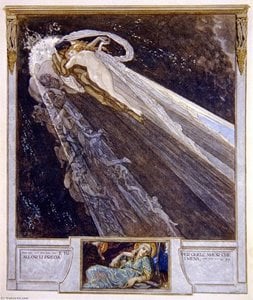
The year 1911 marked a turning point in Bayros's career with the publication of Tales at the Dressing Table, a portfolio of illustrations that remains his most famous – and controversial – work. These images, depicting scenes of veiled eroticism and psychological intrigue, were far ahead of their time, challenging societal norms and sparking outrage among conservative critics. The portfolio’s frank portrayal of female desire and ambiguous narratives led to legal repercussions and accusations of obscenity. While the work was condemned by many, it also garnered a devoted following among those who appreciated its artistic merit and daring exploration of taboo subjects. Beyond Tales at the Dressing Table, Bayros dedicated considerable effort to illustrating Dante Alighieri’s Divine Comedy. These illustrations showcase his remarkable skill in depicting both the sublime and the grotesque, capturing the epic poem's dramatic intensity and complex symbolism with stunning visual clarity.
A Legacy of Decadence and Psychological Depth
Franz von Bayros’s art provides a fascinating window into the cultural anxieties and artistic trends of the late 19th and early 20th centuries. His work reflects the influence of the Decadent movement, characterized by its fascination with artificiality, morbidity, and sensual pleasure. Recurring themes in his oeuvre include decadence, eroticism, phantasmagoria, and psychological complexity. He often depicted dreamlike scenarios and ambiguous narratives, inviting viewers to interpret their meaning on a personal level. Despite facing censorship and societal disapproval, Bayros’s art continues to be studied and appreciated for its unique aesthetic qualities and profound psychological depth. His untimely death in Vienna in 1924, from a cerebral hemorrhage, cut short a promising career, but his legacy as a visionary artist who dared to challenge conventions remains firmly intact. He left behind over 2000 illustrations, each one a testament to his exceptional talent and unwavering commitment to exploring the darker corners of the human psyche.