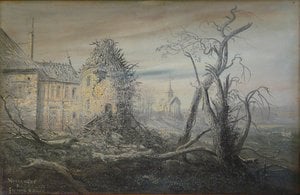
Fernand Combes, 1856 – 1943

De 11 mest berømte malerier af Fernand Combes

Maleriet, der gjorde Fernand Combes berømt, er Vieux Paris, Quartier St Victor, La Rue Des Boulangers (1910). Paris, Carrefour Près Saint Germain Des Prés, des rues de l'Abbaye, Cardinal Lemoine, de Bourbon le Château, et de l'Echaudé St Germain (1910) og Paris, Port des Orfèvres, l'hiver, avec la Seine gelée (1910) følger efter i samlernes og museumsgæsternes hjerter. Af de 11 værker af Fernand Combes i vores katalog er disse 11 de mest beundrede, hver præsenteret med sit årstal, sit museum og det, der gør værket unikt.

Rangordnet efter vores popularitetsscore, som kombinerer søgninger, besøg og ordrer for hvert værk. Opdateret november 2026. Hvert mesterværk på denne side kan bestilles som en håndmalet oliereproduktion i museumskvalitet eller som et kunsttryk i den størrelse, du vælger.

Portræt af Fernand Combes
Fernand Combes · 1856 – 1943
Født · død
1856 – 1943, Les Herbiers
Bevægelse
Impressionism
Værker i vores katalog
11
Mest kendte
Vieux Paris, Quartier St Victor, La Rue Des Boulangers (1910)

Fernand Combes: de ti mesterværker

Flere mesterværker af Fernand Combes, fra 11 til 11

Fernand Combes, år for år: de definerende malerier

Fra 1910 til 1925, 16 års Fernand Combess kunst, år for år, gennem dens fineste malerier.

Fernand Combess mesterværker: spørgsmål og svar

Hvilket maleri er Fernand Combes bedst kendt for?Vis svaret

Vieux Paris, Quartier St Victor, La Rue Des Boulangers (1910). Derefter følger Paris, Carrefour Près Saint Germain Des Prés, des rues de l'Abbaye, Cardinal Lemoine, de Bourbon le Château, et de l'Echaudé St Germain (1910) og Paris, Port des Orfèvres, l'hiver, avec la Seine gelée (1910).

Hvor gammel var Fernand Combes, da Vieux Paris, Quartier St Victor, La Rue Des Boulangers blev malet?Vis svaret

54 år gammel: Vieux Paris, Quartier St Victor, La Rue Des Boulangers er fra 1910, og Fernand Combes blev født i 1856.

Hvad er Fernand Combess ti største malerier?Vis svaret

Vieux Paris, Quartier St Victor, La Rue Des Boulangers, Paris, Carrefour Près Saint Germain Des Prés, des rues de l'Abbaye, Cardinal Lemoine, de Bourbon le Château, et de l'Echaudé St Germain, Paris, Port des Orfèvres, l'hiver, avec la Seine gelée, Paris, Quartier St Paul, Rue Du Figuier, Scène Biblique (Moïse), Paysanne Sablaise, Honfleur, La Rue Gambetta, Mondement, Pérouges, Rue Des Princes og "Si Imprenabilis Pérouges Des Pérouges" Pérouges, Porte d'en Haut. Ranglisten ovenfor angiver årstallet og museet for hver af dem.

Hvor mange værker malede Fernand Combes?Vis svaret

Vores katalog indeholder 11 værker af Fernand Combes, dateret fra 1910 til 1925.

Hvornår malede Fernand Combes mesterværkerne?Vis svaret

I 1910: 4 af de 11 værker på denne side stammer fra denne periode, herunder Vieux Paris, Quartier St Victor, La Rue Des Boulangers.

Hvad er de første og sidste berømte malerier af Fernand Combes?Vis svaret

Det tidligste på denne side er Vieux Paris, Quartier St Victor, La Rue Des Boulangers (1910), det seneste Sospel, Le Pont Vigie (1925).

Hvilken kunstretning tilhører Fernand Combes?Vis svaret

Impressionism, som malerierne på denne side viser.

Kan jeg eje en reproduktion af et mesterværk af Fernand Combes?Vis svaret

Ja. Hvert maleri på denne side kan bestilles som en håndmalet oliereproduktion i museums kvalitet eller som et kunstprint i den størrelse, du ønsker, direkte fra maleriets egen side.

Livet for Fernand Combes

Early Life and Artistic Beginnings

Fernand Combes, born François Georges Fernand Combès in Les Herbiers, France, on August 4th, 1856, emerged from a rural landscape that would subtly yet profoundly shape his artistic vision. While initially pursuing studies at the École des Beaux-Arts in Paris, the rigid academic traditions of the time proved somewhat stifling for the burgeoning artist. Combes wasn’t drawn to grand historical narratives or mythological allegories; instead, he found himself captivated by the ephemeral beauty of everyday life and the shifting moods of nature. This inclination steered him away from direct competition within the Salon system and towards the nascent Impressionist movement, though his connection remained nuanced rather than a full embrace of its tenets. He sought to capture reality not through strict adherence to optical truth, but through an emotional resonance with the scenes before him.

The Parisian Years and Developing Style

Combes’s artistic journey truly blossomed during his time in Paris. The city itself became a primary subject, particularly its intimate corners and bustling street life. Unlike some of his contemporaries who focused on the glamorous boulevards, Combes often depicted quieter moments – winter scenes along the Seine, like Paris, Port des Orfèvres, l'hiver, avec la Seine gelée (1910), revealing a sensitivity to atmospheric conditions and the subtle play of light. These works demonstrate an Impressionistic leaning, characterized by loose brushwork and a focus on capturing fleeting impressions. However, Combes’s palette often retained a more traditional earthiness than the brighter hues favored by Monet or Renoir. He also explored scenes of provincial life, as seen in Honfleur, La Rue Gambetta (1913), showcasing his skill with monochrome drawings and an ability to convey realism and nostalgia.

Beyond Landscapes: Religious Themes and Diverse Subjects

While celebrated for his landscapes and Parisian streetscapes, Combes’s oeuvre extended beyond these familiar subjects. He engaged with religious themes, creating works like Scène Biblique (Moïse), revealing a depth of contemplation and narrative skill. This exploration suggests a broader intellectual curiosity and a willingness to tackle diverse artistic challenges. His versatility is further evidenced by his work in etching, engraving, and drawing, demonstrating a mastery of various techniques and a commitment to exploring different modes of visual expression. Combes wasn’t confined to a single style or subject matter; he possessed an adaptable talent that allowed him to navigate the complexities of the art world with quiet confidence.

Legacy and Historical Significance

Fernand Combes passed away in 1943, leaving behind a body of work that, while not as widely recognized as some of his Impressionist peers, offers a valuable insight into the artistic currents of late 19th and early 20th century France. He occupies an interesting position – a painter influenced by Impressionism but not wholly defined by it. His works provide a bridge between traditional academic painting and the more radical experiments of the avant-garde. Combes’s contributions lie in his ability to capture the essence of a place and moment with sensitivity and skill, imbuing his scenes with an emotional depth that resonates even today.
  • Key Characteristics: Impressionistic landscapes, Parisian street scenes, religious works, versatile technique (painting, etching, drawing).
  • Influences: École des Beaux-Arts training, Impressionist movement.
  • Major Achievements: Capturing the atmosphere of Paris and provincial France; exploring diverse subjects with skill and sensitivity.
His art continues to be appreciated for its quiet beauty, technical proficiency, and unique perspective on a pivotal era in French painting.