A Legacy of Light and Lineage
To understand the artistry of Charles Émile Hippolyte Lecomte Vernet, one must first look to the illustrious bloodline from which he emerged. Born in Paris in 1821, his very identity was woven into the fabric of French painting history. He was not merely a student of art, but a descendant of a veritable dynasty of masters; his great-paragraph grandfather was the celebrated Claude Joseph Vernet, and his father, Hippolyte Lecomte, was a renowned battle painter. This profound heritage provided him with an early immersion in the nuances of light, composition, and the grand traditions of European art. Growing up amidst such creative giants, Lecomte Vernet inherited a technical precision that would later allow him to navigate between the delicate intimacy of portraiture and the sweeping grandeur of landscape and Orientalist themes.
His formal education was shaped by the titans of his era, most notably Horace Vernet and Léon Cogniet. Under their tutelage, he mastered the ability to capture not just the physical likeness of his subjects, but the atmospheric weight of a scene. His early career saw him finding success within the prestigious halls of the Paris Salon, where his debut in 1843 earned him a bronze medal. It was during this period that he began to adopt the signature Vernet-Lecomte moniker, a subtle nod to his desire to honor his lineage while establishing a distinct artistic persona. His initial forays into the art world were marked by sophisticated portraits of the French aristocracy and the wealthy bourgeoisie, works that demanded an exquisite command of texture, skin tones, and the psychological depth required to capture the essence of the era's social elite.
The Allure of the Orient and the Drama of History
As his career matured, Lecomte Vernet’s gaze drifted beyond the borders of France, finding profound inspiration in the exoticism of the East. He became a significant figure within the Orientalist movement, a genre that captivated the 19th-century imagination through its depiction of distant lands, vibrant cultures, and mysterious landscapes. His works from the late 1840s onwards began to feature numerous portraits of Middle Eastern women, rendered with a sensitivity that balanced ethnographic interest with aesthetic beauty. This fascination with the Orient allowed him to experiment with a more diverse palette, utilizing sun-drenched hues and dramatic shadows to evoke the heat and atmosphere of North African and Near Eastern settings.
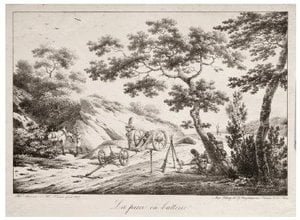
Yet, Lecomte Vernet was not content to remain solely within the realm of the beautiful and the exotic; he possessed a keen awareness of the turbulent political currents of his time. Following in the footsteps of his father, the battle painter, he utilized his brush to document the gravity of contemporary conflicts. His canvases became windows into the tragedies of history, such as his poignant depictions of the Crimean War and the devastating events of the 1860 Mount Lebanon civil war. In these works, the artist moved away from mere decoration toward a powerful form of visual journalism, using his mastery of composition to convey the chaos, sorrow, and raw human emotion inherent in warfare.
A Timeless Artistic Impression
The enduring significance of Lecomte Vernet lies in his ability to bridge the gap between different artistic movements and subject matters. Whether he was painting a tranquil Italian Landscape, a soulful portrait of a noblewoman, or a harrowing scene of historical conflict, his work remained anchored by a consistent devotion to technical excellence and emotional resonance. His ability to transition from the structured traditions of Romanticism to the more atmospheric, light-focused sensibilities that prefigured Impressionism demonstrates an artist who was deeply attuned to the evolving aesthetic spirit of the 19th century.
Today, the works of Charles Émile Hippolyte Lecomte Vernet continue to captivate collectors and historians alike. His paintings serve as vital cultural artifacts, offering a window into the social hierarchies, colonial fascinations, and historical traumas of his age. Through his meticulous use of color and light, he achieved a sense of timelessness that allows his visions—from the sun-soaked hillsides of Provence to the dusty plains of the Orient—to remain as evocative and hauntingly beautiful today as they were during his lifetime.