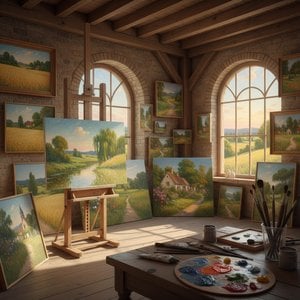
Bela Spanyi: A Hungarian Master of Light and Landscape
Béla Spányi, a name perhaps less familiar than some of his contemporaries, nevertheless represents a significant voice in the late 19th and early 20th-century European art scene. Born in Pest (now Budapest) in 1852, Spányi’s artistic journey was one shaped by rigorous study, a deep connection to the Hungarian landscape, and an evolving engagement with Impressionistic principles. His life, though relatively short – he passed away in Budapest in 1914 – produced a body of work that continues to resonate with its evocative depictions of nature and its subtle mastery of light and color.
Spányi’s early artistic development was rooted in Vienna, where he initially studied at the Academy of Fine Arts. This period provided him with a foundational understanding of academic techniques, but it was his subsequent travels through Munich and Paris that truly ignited his creative spirit. In Munich, he encountered the burgeoning German Impressionist movement, absorbing its emphasis on capturing fleeting moments and the effects of light. Paris, however, proved to be the most transformative environment. Surrounded by artistic innovation and a vibrant cultural landscape, Spányi began to experiment with looser brushstrokes, brighter palettes, and a more direct approach to depicting the natural world – hallmarks of Impressionism. Crucially, he also found himself working alongside Árpád Feszty, a prominent Hungarian painter known for his monumental historical paintings, an association that undoubtedly influenced Spányi’s own compositional skills and understanding of grand scale.
Spányi's artistic focus centered almost exclusively on landscape painting. He wasn’t interested in dramatic vistas or heroic scenes; instead, he sought to capture the quiet beauty of rural Hungary – rolling hills, meandering rivers, and expansive fields bathed in sunlight. His subjects were often humble: flocks of birds taking flight, solitary farmhouses nestled amongst the trees, and the subtle shifts in light across a landscape. This dedication to the everyday, combined with his technical skill, allowed him to imbue his paintings with a remarkable sense of tranquility and authenticity. He wasn’t merely depicting scenery; he was conveying an emotional response to it – a feeling of peace, solitude, or perhaps even nostalgia for a disappearing rural world.
A key element in Spányi's style was his masterful use of light. He meticulously observed how sunlight transformed the landscape throughout the day, capturing the golden hues of dawn and dusk, the shimmering reflections on water, and the dappled shadows cast by trees. His brushwork became increasingly fluid and expressive as he sought to render these ephemeral effects with remarkable accuracy. His paintings are not photographic reproductions; they are interpretations – imbued with his own artistic sensibility and a deep appreciation for the beauty of the natural world. The influence of artists like Claude Monet and Camille Pissarro is evident in his adoption of broken color techniques and his focus on capturing atmospheric conditions, but Spányi developed a distinctly Hungarian voice within this broader Impressionistic framework.
Among Spányi’s most celebrated works are “Kleine Hirtin” (Little Shepherds), a serene depiction of sheep grazing in a rolling hillside landscape, and "Approaching Storm Over A Lake," which masterfully captures the drama of an impending storm over a still lake. These paintings exemplify his ability to convey both the beauty and the power of nature. His work was also featured prominently in the grand cyclorama “Arrival of the Hungarians,” created under the direction of Árpád Feszty, demonstrating his skill in large-scale compositions and his understanding of historical narrative. Spányi’s legacy extends beyond individual paintings; he played a vital role in shaping the development of landscape painting in Hungary, inspiring generations of artists to explore the beauty of their homeland. His work is now held in several museums across Europe, testament to its enduring appeal and artistic merit.
Spányi's Artistic Techniques and Influences
Spányi’s artistic journey reveals a fascinating interplay between formal training, personal observation, and stylistic influences. His initial studies at the Vienna Academy provided him with a solid grounding in traditional techniques – perspective, anatomy, and composition—but it was his time in Munich and Paris that truly liberated his creative spirit. The German Impressionists, particularly artists like Max Liebermann and Wilhelm von Kempelen, demonstrated the possibilities of capturing fleeting moments and the effects of light through broken color and loose brushwork. Spányi embraced these techniques, adapting them to suit his own artistic vision and the specific qualities of the Hungarian landscape.
However, Spányi’s style was not simply a mimicry of Impressionism; he developed a distinctly personal approach rooted in his deep connection to Hungary. He wasn't interested in replicating the bright, airy palettes often associated with Parisian Impressionism. Instead, he favored more subdued colors—earthy greens, muted blues, and warm ochres—that reflected the tones of the Hungarian countryside. His brushwork remained relatively firm, particularly in his earlier works, creating a sense of solidity and structure that contrasted with the looser, more ephemeral strokes of some of his contemporaries.
Furthermore, Spányi’s work was influenced by the Romantic tradition of landscape painting, which emphasized the sublime beauty and spiritual significance of nature. Artists like Caspar David Friedrich had explored themes of solitude, contemplation, and the relationship between humanity and the natural world. Spányi shared this interest in conveying a sense of emotional resonance through his landscapes, but he did so with a greater emphasis on realism and observation. He wasn't seeking to evoke awe or terror; rather, he aimed to capture the quiet beauty and tranquility of the Hungarian countryside—a vision that resonated deeply with viewers of his time.
Key Influences: German Impressionism (Monet, Pissarro), Romantic Landscape Painting (Friedrich)
Béla Spányi’s artistic output spanned several decades, resulting in a substantial body of work that reflects his evolving style and interests. Several paintings stand out as particularly significant examples of his talent and vision. “Kleine Hirtin” (Little Shepherds), painted around 1890, is perhaps his most iconic work—a serene depiction of sheep grazing on a hillside bathed in golden sunlight. The painting’s simplicity and tranquility have made it a beloved favorite among art enthusiasts.
Another notable piece is "Approaching Storm Over A Lake," created in the late 1890s. This dramatic composition captures the power and beauty of an impending storm over a still lake, utilizing a dynamic range of colors and brushstrokes to convey the sense of movement and tension. Spányi’s ability to capture atmospheric conditions is particularly evident in this work.
Beyond these individual paintings, Spányi also contributed significantly to large-scale projects, such as the frescoes he painted in the Hunters' Hall of the Hungarian Parliament building in 1893. These monumental works showcased his skill in composition and his understanding of historical narrative. His involvement with Árpád Feszty on the “Arrival of the Hungarians” cyclorama further cemented his reputation as a leading artist in Hungary.
Key Works: "Kleine Hirtin," "Approaching Storm Over A Lake," Frescoes in the Hungarian Parliament
Recognition: Grand Prize Medal from the Berlin Fine Arts Society (1893)
Spányi's Legacy and Historical Significance
Béla Spányi’s contribution to Hungarian art is often understated, overshadowed by the more celebrated figures of Árpád Feszty and others. However, his work deserves recognition as a pivotal voice in the late 19th and early 20th-century landscape movement. He helped to establish a distinctly Hungarian approach to Impressionism—one that retained a strong connection to traditional techniques while embracing modern aesthetic principles.
Spányi’s focus on the everyday beauty of the Hungarian countryside offered a refreshing counterpoint to the grand historical narratives favored by many of his contemporaries. His paintings captured a sense of tranquility and authenticity that resonated deeply with viewers, reflecting a growing appreciation for nature and rural life in Hungary at the time. His work continues to be exhibited in museums across Europe, demonstrating its enduring appeal and artistic merit. Spányi’s legacy lies not only in his individual paintings but also in his influence on subsequent generations of Hungarian landscape artists—artists who followed in his footsteps and continued to explore the beauty of their homeland.
Af WahooArt.com redaktionen
Kunstquiz
Der er kun ét korrekt svar på hvert spørgsmål.
Spørgsmål 1:
Béla Spányi was primarily known for his paintings of:
Spørgsmål 2:
Which art movement is most closely associated with Bela Spányi's work?
Spørgsmål 3:
Bela Spányi studied at which of the following institutions?
Spørgsmål 4:
Bela Spányi's work often depicted scenes from:
Spørgsmål 5:
In what country was Bela Spányi primarily active as an artist?
Explore the profound beauty of village scene art. From Impressionist light to pastoral realism, discover how timeless landscapes capture nostalgia through expert artistry and historical depth. Perfect for collectors seeking evocative, museum-quality landscape inspirations.
Discover the profound tranquility of rural art through an expert exploration of Impressionist landscapes. From pastoral scenes to textured oil masterpieces, learn how timeless nature-inspired artworks bring enduring elegance and serenity to sophisticated collectors.