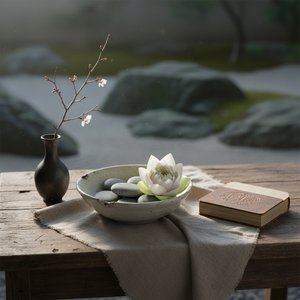
The transition from the noise of a busy street to the threshold of a quiet landscape is often subtle. It begins when we stop looking for landmarks and start noticing the way light settles upon a surface. In many ways, entering a gallery dedicated to nature is much like stepping into a clearing after a long walk through dense thickets. The air seems to change. There is a weight to the silence found in these works, a stillness that does not feel empty but rather full of held breath.
In the early stages of landscape development, artists often used the natural world as a stage for larger stories. We see this in the works of the Northern Renaissance, where the land was rarely just scenery. For an artist like Joachim Patinir, the landscape was an expansive, almost fantastical territory. His approach helped establish the "world landscape," where mountains and valleys were not merely backgrounds but characters in their own right. To look at his work is to see the birth of a new way of seeing, where the eye is invited to wander through vast, imagined terrains that feel both grounded and otherworldly.
A Pioneer of the Northern Renaissance Landscape Joachim Patinir, a name often whispered alongside that of Albrecht Altdorfer as a foundational figure in landscape painting, emerged from the artistic milieu of the Low Countries during the early 16th c...
Moving further into these vistas, the horizon often reveals a more structured, yet equally peaceful, perspective. The early 16th-century masters brought a meticulousness to the earth that demanded our full attention. There is a certain gravity in the way rocks and ridges were rendered, a sense of permanence that contrasts with the fleeting light we find in later eras.
When we look closer at these older traditions, we see how much was learned from observing the smallest details. The influence of artists like Gerard David, known for his precise realism, can be felt in the way textures were handled. This discipline provided a foundation for everything that followed. Even when landscapes became more imaginative, they remained anchored by this fundamental respect for the physical world—the weight of a stone, the slope of a hill, and the enduring presence of the earth beneath our feet.
A Symphony of Light and Nature: Exploring Renoir’s ‘Landscape 15’ Pierre-Auguste Renoir's *Landscape 15* is a captivating embodiment of Impressionism, transporting the viewer to a realm of serene beauty and fleeting moments. More than just a depictio...
As we move from the structured horizons of the Renaissance into the late 19th century, the light begins to shift. The edges of the world soften. We find ourselves no longer looking at fixed shapes, but at the way sunlight filters through a canopy of leaves. This is where the Impressionist movement fundamentally altered our perception. Artists like Pierre-Auguste Renoir moved away from the rigid rules of the Academy to capture the ephemeral.
In works such as Landscape 15, we see Renoir using broken brushstrokes to simulate the dance of light across a field. There are no harsh outlines here; instead, colors are juxtapently placed to create an optical mix. A single tree is not just a botanical study but a vertical accent that establishes depth and stability within a sun-drenched scene. Similarly, in Cagnes Landscape, the warmth of yellows and reds reflects the golden glow of light filtering through foliage. This technique allows us to witness a moment as it unfolds, capturing the transient beauty of a summer afternoon before the shadows lengthen.
A Symphony of Governance and Grace In the heart of Fleet, Hampshire, an extraordinary dialogue unfolds between the structured world of civic duty and the ethereal beauty of British landscape artistry. The Hart District Council offers a cultural exper...
The atmosphere changes again as we turn toward the British tradition, where the landscape often takes on a more tonal, moody character. Here, the focus shifts to the interplay of shadow and mist, particularly in the works that celebrate the English countryside. There is a particular kind of peace found in these dampened, overcast scenes, where the world feels intimate and enclosed.
The collections held by institutions like the Hart District Council offer a window into this pastoral tranquility. Through the works of artists such as William Luker II, we see the rhythmic quality of the English woods—the way light and shadow play within shaded retreats. This tradition extends to the more expressive brushwork of James Henry Monk, whose depictions of the Somerset countryside utilize tonal gradations to convey the grandeur of hillsides and valleys. In these paintings, the landscape is not a distant spectacle but a lived-in reality, characterized by the quiet, rural moments of a world defined by soft light and heavy air.
--- title: Chinese landscape painting – Smarthistory author: The British Museum url: https://smarthistory.org/chinese-landscape-painting/ hostname: smarthistory.org description: From mountain-shaped incense burners to paradisiacal Buddhist paintings,...
Leaving the European tradition, we encounter a different kind of stillness in the East. In Chinese and Japanese landscape art, peace is often found not in what is painted, but in what is left out. The concept of negative space—the "void"—is essential here. In many Chinese landscapes, mountains and water are depicted with a minimalist grace, where empty spaces represent clouds or mist, allowing the viewer's eye to complete the scene.
This approach is deeply tied to philosophies like Daoism, which emphasizes harmony with the natural world. The use of ink on paper or silk creates a subtle, restrained palette that avoids aggression. We see this in the Landscape of the Four Seasons, where soft, calm formations exist without sharp lines. Similarly, Japanese woodblock prints, such as Hiroshige’s Evening Snow at Kanbara, use the white of the snow to define the outlines of trees and mountains. The silence in these works is palpable; it is a quiet that is broken only by the implied sound of footsteps in the snow, inviting a profound sense of meditative presence.
A Brush with Serenity: The Life and Landscapes of George Herbert McCord George Herbert McCord, a name resonating with the quiet beauty of American landscape painting, has dedicated his life to capturing the essence of nature’s tranquility. While biog...
As we cross the Atlantic, the landscape takes on a different scale, often blending meticulous detail with an atmospheric perspective that feels both expansive and intimate. The American tradition, influenced by the Hudson River School, brought a reverence for the natural world that sought to capture the dignity of the land.
Artists like George Herbert McCord focused on the harmonious relationship between nature and human presence. His work does not portray an untamed wilderness but rather the peaceful stillness of a forest clearing or a river winding through farmland. There is a gentle, contemplative quality to these scenes, particularly when depicting the rolling hills of Vermont or the changing seasons of New York. This approach provides a sense of groundedness, reminding us that even in the vastness of a landscape, there is a place for quiet, human observation.
Returning to the Quiet Room
After wandering through these varied terrains—from the heavy stones of the Renaissance to the misty English woods and the ethereal voids of the East—we return to our own space. The purpose of observing these works is not merely to admire technique, but to bring a piece of that stillness back with us. A well-placed landscape can transform a room, acting as a window into a world that remains calm regardless of the chaos outside.
Whether it is a large-scale mural that recreates a historical ceiling or a carefully chosen oil reproduction that adds texture and depth to a wall, art allows us to curate our environment for reflection. At WahooArt.com, we believe in this power of discovery. We provide the means to bring these moments of serenity into your home through hand-painted oils on cotton canvas, where every visible brushstroke serves as a reminder of the artist's hand and the enduring beauty of the natural world. Through our professional digital mockups and custom services, we help you find the exact piece of peace that belongs within your frame.
Oplev impressionismens magi! Dyk ned i historierne bag 10 ikoniske malerier fra Monet, Degas og Renoir. Find inspiration til din indretning med smukke kunsttryk af høj kvalitet på WahooArt.com – museumskvalitet direkte til dit hjem. Udforsk samlingen online!
Explore the profound beauty of serenity in art history & contemporary works. Discover how artists evoke calm through color, composition & minimalism. Find artwork to cultivate peace and wellbeing.



 Joachim Patinir
 Landscape 15
 Hart District Council
 George Herbert Mccord