Introduction
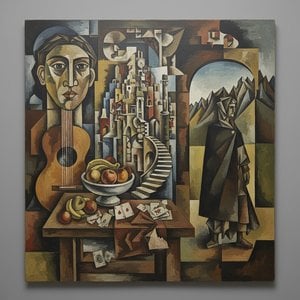
To step into the world of Cubist Expressionism is to witness a profound shattering of tradition, where the serene stability of the past meets the fractured, emotive energy of the modern age. It is an art movement that does not merely ask you to look, but demands that you feel the very vibration of form and color. Imagine standing before a canvas where the boundaries between object and atmosphere dissolve; where the analytical precision of Cubism—the deconstruction of space into geometric planes—is infused with the raw, visceral intensity of Expressionism.
Emerging from the cultural turbulence of the early 20th century, this movement served as a visual language for a world in flux. As the industrial revolution accelerated and the psychological landscapes of humanity deepened, artists sought to move beyond mere representation. They began to paint not just what the eye perceives, but how the soul experiences the fragmentation of reality. It was a period of radical experimentation, where the structured logic of Picasso and Braque met the emotive, often turbulent brushwork of those seeking to express inner truths through distorted shapes and heightened palettes.
These masterpieces remain profoundly meaningful today because they mirror our own contemporary experience—a world of rapid movement, digital fragmentation, and overlapping perspectives. The tension between the structured plane and the expressive stroke continues to resonate in our modern aesthetic, reminding us that truth is rarely found in a single viewpoint, but rather in the beautiful, complex intersection of many.
In the following curation, we shall guide you through a selection of ten definitive works. Each piece serves as a window into this transformative era, showcasing the moment when geometry learned to weep, and abstraction found its heartbeat. Prepare to encounter canvases that redefine the limits of perception and celebrate the enduring power of the human spirit.
Compositional Study for ‘To Russia, to the Asses and Others’ - Marc Chagall
 Compositional Study for ‘To Russia, to the Asses and Others’ - Marc Chagall
In the delicate 1912 study for ‘To Russia, to the Asses and Others’ , Marc Chagall offers more than a mere preparatory sketch; he presents a portal into the subconscious. This work stands as a cornerstone among the top 10 masterpieces that defined the Cubist Expressionism art movement , masterfully bridging the gap between structured geometric fragmentation and raw, emotive storytelling. The composition vibrates with a joyous yet disorienting palette of pinkish reds and deep blues, where figures appear suspended in a dreamlike state of flux.
Chagall’s genius lies in his ability to weave the angularity of Cubism with the soulful, folkloric narratives of his Belarusian roots. The sight of a figure perched atop an animal, rendered with a whimsical lack of anatomical certainty, evokes a sense of profound spiritual journeying. In today's curated interiors, such works remain vital cultural touchstones; they resonate with the modern desire for art that transcends literal reality, offering a sophisticated, surrealist escape that celebrates the beautiful chaos of the human imagination.
Portrait of the Artist Léopold Survage - Amedeo Clemente Modigliani
 Portrait of the Artist Léopold Survage - Amedeo Clemente Modigliani
What story does the stripped-back, abstract environment of Portrait of the Artist Léopold Survage tell? In this 1918 masterpiece, Amedeo Modigliani removes all worldly distractions, leaving only a neutral, atmospheric void that forces an encounter with the subject's very soul. Emerging from the radical shifts of the early 20th-century avant-garde, this work stands as a pillar of the Cubist Expressionism movement by merging the geometric fragmentation of Cubism with a profound, emotive distortion.
Modigliani utilizes his signature stylized elongation —stretching the neck and smoothing facial planes into sculptural forms inspired by African masks—to transform Survage into an icon of introspection. The palette, a sophisticated arrangement of muted earth tones, deep greens, and velvety blacks, offers a sense of timelessness. For the discerning collector or interior designer, such a piece serves as a curated escape; it brings the quiet, melancholic dignity of a Parisian studio into the modern home, providing a focal point of profound psychological depth and historical prestige.
Woman Knitting - Paul Klee
 Woman Knitting - Paul Klee
In Paul Klee’s 1915 masterpiece, Woman Knitting , we encounter a profound fragment of geometric harmony that transcends mere domesticity. This work serves as a cornerstone of the Cubist Expressionism movement, where the boundaries between the tangible world and abstract thought dissolve into a rhythmic dance of lines. Through a restrained palette of charcoal blacks, soft grays, and ethereal whites, Klee transforms a quiet, everyday gesture into a complex visual puzzle of triangles and trapezoids.
The composition rejects traditional perspective, opting instead for a deliberate flattening of space that invites the viewer to find beauty in structural purity. There is a tactile, almost meditative quality to the way the angular forms intersect, mirroring the rhythmic motion of the knitting itself. Owning a piece of this legacy isn’t merely a purchase; it is an inheritance of taste. At WahooArt, we allow you to bring this lineage into your own sanctuary. Whether through a hand-painted oil reproduction that captures every expressive brushstroke or a museum-quality print, Klee’s ability to find the infinite within the infinitesimal becomes a permanent part of your architectural narrative.
Fire at Full Moon - Paul Klee
 Fire at Full Moon - Paul Klee
In Paul Klee’s Fire at Full Moon , one does not merely observe a landscape; one feels the rhythmic pulse of a nocturnal dream. The painting captures an internalized experience of darkness, where the primary emotion is a profound, meditative tension between stillness and sudden energy. As a cornerstone of the Cubist Expressionism movement, this masterpiece utilizes a fractured grid of geometric shapes to mirror the complexities of the human psyche.
The composition is anchored by a luminous yellow orb—the moon—which casts a soft, diffused glow over a palette of melancholic blues and purples. This cool serenity is dramatically interrupted by a vibrant, fiery red quadrant, symbolizing passion or perhaps the volatility of the subconscious. Such visual dialogue between stability and chaos makes Klee’s work a universal mirror for our own internal fluctuations. For the discerning collector, integrating this piece into a private study or a quiet corner of a home can transform a personal sanctuary into a space for profound reflection, inviting a sense of cosmic calm and intellectual depth.
Beatris Hastings - Amedeo Clemente Modigliani
 Beatris Hastings - Amedeo Clemente Modigliani
In the heart of Paris, amidst the bohemian fervor of the early twentieth century, Amedeo Clemente Modigliani captured a moment of profound stillness in his 1915 masterpiece, Beatris Hastings . This portrait is far more than a mere likeness; it is an evocative exploration of the human psyche, rendered through the lens of Expressionism and the structural innovations of Cubism . The subject emerges from a textured, abstract backdrop with a presence that is both haunting and dignified, making this piece a cornerstone for any collection focused on the transformative power of modern portraiture.
The composition is masterfully orchestrated to draw the eye toward Hastings’ enigmatic gaze. Modiglani famously utilized the signature elongation of the neck—a stylistic hallmark inspired by the rhythmic lines of African sculpture—to create an ethereal, otherworldly quality. Through a palette of warm, earthy browns and creams, punctuated by sharp black accents, the artist achieves a visual tension between organic curves and rigid, geometric forms. To possess such a work is to invite transformation into your home; it is not mere decoration, but a way to turn your private space into a gallery of the soul .
Young Woman in a Yellow Dress (also known as Madame Modot) - Amedeo Clemente Modigliani
 Young Woman in a Yellow Dress (also known as Madame Modot) - Amedeo Clemente Modigliani
To encounter Amedeo Modigliani’s 1918 masterpiece, “Young Woman in a Yellow Dress” (also known as Madame Modot ), is to step into a moment of profound, cinematic stillness. The painting opens with a visceral pull; the sun-drenched, vibrant yellow of her attire acts as a radiant focal point, cutting through the atmospheric shadows to command the viewer's gaze. Within this work, Modigliani masterfully bridges the gap between Cubist structural experimentation and Expressionist emotional depth, utilizing his signature elongated forms and mask-like facial features to evoke a sense of hauntingly beautiful melancholy.
The subject sits with a sculptural grace, her hands clasped in quiet contemplation, while subtle details—like the delicate presence of birds in the background—add layers of symbolic mystery. For the discerning collector or interior designer, this portrait offers an unparalleled atmospheric anchor. Its ability to radiate both warmth and introspection makes it a transformative addition to a sophisticated study or a contemporary gallery space, infusing any environment with intellectual depth, elegance, and a timeless, soulful resonance.
Family Portrait 1 - Pablo Picasso
 Family Portrait 1 - Pablo Picasso
To encounter Family Portrait 1 by Pablo Picasso is to step into a sanctuary of stillness, unveiling a rare moment where the world's most revolutionary icon sought solace in domestic intimacy. As a cornerstone of the Cubist Expressionism movement, this masterpiece transcends the radical fragmentation of Picasso’s earlier years, offering instead a rhythmic, sun-drenched composition that breathes with vitality. The painting captures a quiet familial gathering, utilizing a warm spectrum of yellows and reds to imbue the canvas with a palpable sense of warmth and protection.
What secures its place among the top 10 masterpieces is Picasso’s masterful use of Synthetic Cubism ; he moves away from cold geometry toward an integrated, textured approach where visible brushstrokes create a physical depth. For the discerning collector or interior designer, this work offers more than mere decoration—it provides an architectural anchor for luxury interiors. The interplay of light and the symbolic stability of the central figures offer a timeless beauty that resonates within refined modern spaces, making it an essential study in both emotional intelligence and aesthetic legacy.
Los amantes en la calle - Pablo Picasso
 Los amantes en la calle - Pablo Picasso
In the profound lineage of Cubist Expressionism, Los Amantes en la Calle by Pablo Picasso stands as a breathtaking testament to the power of fragmented intimacy. This masterpiece does not merely depict an embrace; it deconstructs the very essence of human connection. Through his revolutionary analytical approach, Picasso dissolves the boundaries between the lovers and the urban chaos surrounding them, utilizing sharp angles and overlapping planes to capture a multidimensional experience of affection.
The painting vibrates with a restless energy, where the woman’s vibrant attire and the man's form are broken into geometric shards, suggesting that love is as much a psychological reconstruction as a physical encounter. As you contemplate this work, you realize that Los Amantes en la Calle by Pablo Picasso isn’t just in the Top 10; it’s in the hearts of those who dare to surround themselves with genius. To possess such a piece is to invite a transformation into your home—turning a mere room into a gallery of the soul, where the fleeting beauty of a stolen glance becomes an eternal, tactile reality.
Broken Forms - Franz Marc
 Broken Forms - Franz Marc
To stand before Franz Marc’s Broken Forms is to witness the very moment the physical world dissolves into spiritual energy. Painted in 1914, this masterpiece captures a universe in flux, where the boundaries between object and atmosphere vanish. The canvas vibrates with a rhythmic dance of geometric fragments—triangles, squares, and rectangles—that cascade across the surface like shards of a shattered prism. Marc’s palette is nothing short of symphonic; luminous blues, fiery reds, and sun-drenched yellows clash and harmonize to evoke a profound, underlying cosmic order.
As a cornerstone of the Cubist Expressionism movement, this work transcends mere abstraction by infusing Cubist fragmentation with the raw, emotional pulse of German Expressionism. The large, anchoring circles act as celestial beacons amidst the dynamic chaos, inviting the viewer into a state of deep reflection. For the discerning collector, bringing such a piece into a contemporary interior offers more than decoration; it introduces a sophisticated focal point that inspires creativity and a sense of transcendent calm, transforming a modern room into a sanctuary of historical depth and intellectual vigor.
Small Composition II - Franz Marc
 Small Composition II - Franz Marc
In Franz Marc’s Small Composition II , the lines are not merely drawn; they are choreographed . Created in 1914, this masterpiece serves as a profound spiritual distillation of the Cubist Expressionism movement. Within its compact frame, we witness a dance frozen in time, where the geometric rigor of Cubism meets the emotive pulse of German Expressionism. A sturdy house shape anchors the left, while a luminous circle and sharp triangles radiate outward, interwoven with organic elements like reaching branches and heart-shaped motifs.
Marc utilizes a vibrant palette of reds, greens, and yellows—not as decoration, but as a rhythmic language to evoke earthly vitality and divine yearning. As a co-founder of Der Blaue Reiter , Marc transcends mere abstraction to create a world where color and shape coalesce into harmony. This work is a testament to his ability to make complex chaos feel like a balanced, breathing rhythm. Imagine your own space holding this same equilibrium; a wall that does not just display art, but breathes rhythm through the legacy of a master.
Conclusion
As the light fades from the gallery walls and the shadows of these fractured, emotive forms lengthen, we are left with a profound realization: Cubist Expressionism is far more than a mere chapter in an art history textbook. These masterpieces do not exist as static relics of a bygone era, frozen behind museum glass; rather, they remain living, breathing forces that continue to pulse with the raw energy of human experience. They are whispers of movement and echoes of emotion that refuse to be silenced by time.
To stand before these works is to witness the moment where structure meets soul, where the analytical precision of geometry dissolves into the visceral depth of feeling. This enduring tension continues to shape our modern aesthetic, finding new life in the curated corners of contemporary homes and the grand halls of the world's most sophisticated interiors. They remind us that even when reality is broken into fragments, there is a profound, underlying beauty to be found in the reconstruction.
Whether you are drawn to the rhythmic distortions of a portrait or the complex, layered landscapes of the movement, we invite you to carry this sense of wonder into your own surroundings. We invite you to explore our full collection , where the spirit of these masters is meticulously preserved through hand-painted oil reproductions, allowing the timeless dialogue of Cubist Expressionism to continue within your own private sanctuary.