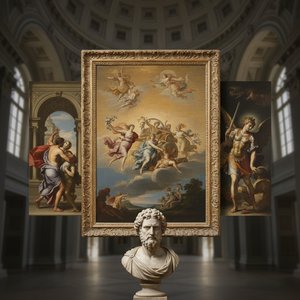
baroque vs rococo art
Baroque and Rococo represent two distinct European eras. The Baroque period, flourishing from the early 1600s to the 1750s, emphasizes dramatic intensity, monumental scale, and religious or political power. In contrast, the Rococo style emerged in the 1730s as a lighter, more intimate reaction, favoring playful grace, pastel colors, and decorative elegance.
In our workshop, we see this transition through the physical handling of paint and light. The Baroque era was a seismic cultural event, often used by the Catholic Church during the Counter-Reformation to inspire awe. Architects and painters utilized massive scales and heavy ornamentation to project authority. Conversely, the Rococo moved away from the rigid, formal grandeur of the Louis XIV style toward the sophisticated "salon culture" of Paris.
The shift can be summarized by these technical shifts:
- Baroque: Focused on monumental scale, deep shadows, and emotional tension.
- Rococo: Focused on intimacy, asymmetrical curves, and lightheartedness.
what are the defining visual characteristics of baroque art?
 Sts Peter and Paul
, Reni Guido (Le Guide)
Baroque art is defined by dramatic movement, intense emotionality, and the mastery of chiaroscuro. It utilizes strong contrasts between deep shadows and piercing highlights to sculpt forms out of darkness, creating a sense of perpetual motion and spiritual tension that avoids the stillness found in earlier Renaissance works.
Technically, the use of chiaroscuro is central to this movement. By manipulating light and shadow, artists could create a palpable atmosphere of reverence. We see this in the works of Guido Reni, such as Sts Peter and Paul (c. 17th century) at the Pinacoteca di Brera, where a dark background intensifies the impact of the figures. Similarly, Johann Philipp Joseph Friedrich Kirnberger’s Baroque Church Façade with Obliquely Placed Towers (1760) uses these contrasts to render textures and volumes with realism.
Key visual elements include:
- Chiaroscuro: The profound interplay of light and dark to create depth.
- Dynamism: Figures caught in moments of transition or physical tension.
- Scale: Large-scale compositions, such as the frescoes by Giovanni Battista Carlone in Genoa, designed to overwhelm the viewer.
how does rococo style differ from the baroque period in terms of color and composition?
 PORTRAIT D'HOMME
, Jean François De Troy
Rococo differs from Baroque through its move toward lighter, pastel palettes and asymmetrical, fluid compositions. While Baroque relies on heavy, centered figures and dark, saturated tones like deep reds and golds, Rococo embraces the rocaille motif—inspired by shells and pebbles—and utilizes soft, airy colors to foster a sense of ease.
The transition is visible in the work of Jean-François de Troy. His Portrait d'Homme (housed in The Louvre) demonstrates how an artist can bridge these eras, combining Baroque precision and chiaroscuro with the burgeoning grace of the Rococo. While his technique involves the meticulous layering of glazes for depth, the subject matter begins to reflect a more decorative sensibility.
Compositional differences include:
- Symmetry vs. Asymmetry: Baroque favors balanced, often monumental arrangements; Rococo prefers fluid, asymmetrical curves.
- Color Temperature: Baroque uses warm, earth-toned, and saturated palettes; Rococo moves toward pastel luminosity.
- Spatial Focus: Baroque creates imposing, infinite spaces; Rococo focuses on intimate, human-scaled interiors.
what are the key thematic differences between these two movements?
 St Ignatius of Loyola Church
A Baroque Symphony in Győr: Exploring St Ignatius of Loyola Church Nestled in the heart of Győr, Hungary, St Ignatius of Loyola Church stands as a breathtaking testament to Baroque artistry and Hungarian religious heritage.
The primary thematic difference lies in the shift from the monumental to the intimate. Baroque themes center on religious fervor, political authority, and the glory of the Counter-Reformation or absolute monarchs. Rococo themes pivot toward leisure, romance, domesticity, and the lighthearted enjoyment of the European aristocracy.
The Baroque era was a tool for power. In places like the St Ignatius of Loyola Church in Győr, Hungary, art served to reaffirm faith through grandeur. Similarly, the works of Aureliano Milani in Rome utilized the muscularity of the Carracci style to depict religious narratives with intensity. These works were designed to command respect and inspire awe through their connection to divine or civil authority.
The Rococo era, however, reflected a change in social structure. Following the death of Louis XIV in 1715, the nobility moved from the formal court at Versailles to private Parisian salons. This led to themes of:
- Domesticity: A focus on country scenes and gentle allegories.
- Sensuality: An emphasis on elegance, charm, and the "feminine universe."
- Playfulness: Moving away from heroic or civic duty toward pleasure and decorative beauty.
Frequently asked questions
Where was Aureliano Milani born?
Aureliano Milani was born in Bologna, Italy.
What are the dimensions of Sts Peter and Paul by Guido Reni?
The painting Sts Peter and Paul by Guido Reni measures 197 x 140 cm.
When was Jean-François de Troy active?
Jean-François de Troy was a French artist active between 1645 and 1730.
Where is St Ignatius of Loyola Church located?
St Ignatius of Loyola Church is located in Győr, Hungary.