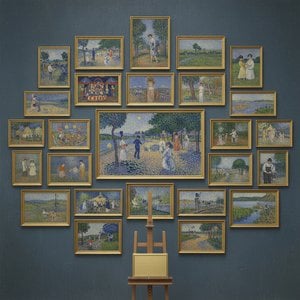
The Glitch Before the Digital: Pointillism as the Original Pixel Art
 Pointillism
Pointillism (, also US: ) is a technique of painting in which small, distinct dots of color are applied in patterns to form an image. Georges Seurat and Paul Signac developed the technique in 1886, branching from Impressionism. The term "Pointillism"...
Long before the first computer screen flickered to life or the concept of a digital pixel entered our collective consciousness, a group of radical visionaries in late 19th-century Paris was already deconstructing reality into its smallest possible units. We often think of high-definition displays and the sharp, granular precision of modern digital design as recent triumphs, but the true blueprint for this visual language was drafted with oil paint and tiny, deliberate strokes. Pointillism, or Neo-Impressionism, functioned much like a biological version of a digital render. Instead of smooth, blended transitions, artists like Georges Seurat approached the canvas as a grid of potential energy, waiting to be activated by the viewer's gaze.
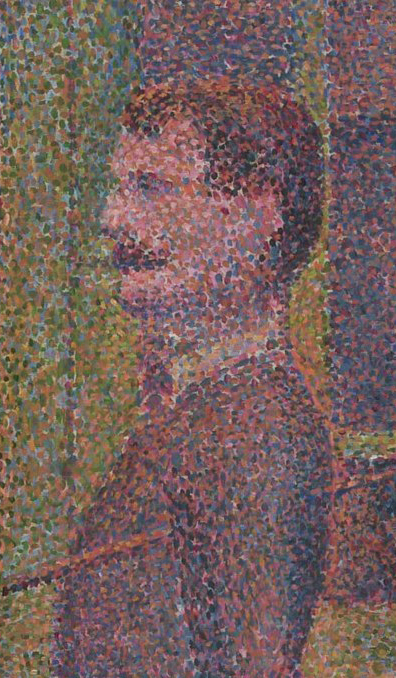
To look at a masterpiece like The Poppy Field is to witness a pre-digital experiment in resolution. Up close, the illusion dissolves into a chaotic, beautiful scatter of pure pigment—a visual glitch that feels strikingly modern. It is only when we step back, allowing our brains to perform the heavy lifting of processing these individual data points, that the landscape coalesces into a vibrant, breathing scene. This tension between the microscopic dot and the macroscopic image creates a rhythmic, almost kinetic energy that resonates deeply with our contemporary, screen-saturated lives. It was the first time art truly moved away from mere representation toward a sophisticated simulation of sight itself.
Chromoluminarism: The Science of Optical Mixing and Visual High-Definition
 Georges Seurat: Pointillism, Perception & the Scientific Foundations of Modern Art
The Genesis of Pointillism: From Impressionism to Scientific Inquiry The late 19th century was a period of profound upheaval, not just in the socio-political landscape but also within the artistic realm. The established norms of academic painting wer...
The magic behind this technique wasn't just an aesthetic whim; it was a calculated, scientific strike against the "arbitrary" nature of traditional painting. Seurat sought to move beyond the fleeting, subjective impressions of his predecessors by grounding art in the hard truths of optics. He pioneered what he called chromoluminarism, a method rooted in the study of how light interacts with the human eye. By applying small, distinct dots of primary and complementary colors directly onto the canvas, these artists bypassed the muddying effect of physical pigment mixing on a palette. They understood that when two different colors are placed side-byside, they do not just sit next to each other; they vibrate.
This process, known as optical mixing, allows for a level of luminosity that traditional blending simply cannot achieve. When a dot of lemon yellow sits adjacent to a speck of azure blue, the eye perceives a brilliance that feels as though it is emitting light rather than merely reflecting it. This was the 19th-century version of high-dynamic range (HDR) imaging. By leveraging the principles of simultaneous contrast—the way one color intensifies or suppresses another—the Neo-Impressionists created works that possessed an internal glow. It was a revolution of perception, turning the act of looking into a scientific encounter with light and frequency.
Seurat & Signac: The Visionaries Who Re-Engineered the Color Palette
 Paul Signac
The Harmonious Vision of Paul Signac Paul Victor Jules Signac, born in Paris in 1863, emerged as a pivotal figure in the evolution of modern art, inextricably linked to the birth and development of Neo-Impressionism. Initially drawn to architecture, ...
Every movement needs its architects, and for Pointillism, that duo was Georges Seurat and Paul Signac. While Seurat provided the structural genius and the scientific rigor, Signac brought a sense of expansion and evolution to the technique. Their partnership in the mid-1880s was transformative, turning a singular method into a full-scale movement. Seurat’s work often felt monumental and meticulously planned, almost architectural in its precision, as seen in his explorations of light in The Channel at Gravelines. He was obsessed with the underlying structure of the world, seeking to capture not just a moment, but the very physics of existence.
Signac, however, pushed the boundaries toward a more expressive, almost rhythmic application of color. His influence helped transition the movement from the rigid precision of Seurat toward something more fluid and emotive. Together, they studied the writings of theorists like Michel Eugène Chevreul, translating complex chemical and optical observations into brushstrokes. They weren't just painters; they were explorers of a new visual frontier, re-engineering the very way color could be deployed to evoke atmosphere and emotion. Their collaboration ensured that Pointillism would not remain a mere technical trick but would become a profound way of seeing the modern world.
From Impressionist Light to Modern Impact: The Evolution of Visual Texture
 The Poppy Field, 1884
Introduction to the Painting and its Artist Georges Pierre Seurat , a French Post-Impressionist artist, is renowned for his innovative technique known as Pointillism. This method involves applying small dots of pure color onto the canvas, which blend...
The transition from Impressionism to Neo-Impienteism represents one of the most significant shifts in art history—a move from the "fleeting" to the "structured." While the Impressionists were masters of capturing the ephemeral glow of a sunset or the shimmer of water, their work often lacked a sense of permanent form. Seurat and his contemporaries felt this lack of structure was a weakness. They wanted to take the light of Monet and infuse it with the permanence of classical composition. This evolution changed the very texture of art, moving from the soft, blended edges of a landscape to a more tactile, mosaic-like surface that demands active engagement.
This shift in texture paved the way for much of the visual impact we crave in modern design. We see the echoes of this evolution in everything from the bold, graphic lines of street art to the high-contrast aesthetics of contemporary digital illustration. The ability to manipulate texture—to move between the smooth and the granular—is a fundamental tool of the modern creator. The Pointillist legacy taught us that the way we apply color is just as important as the color itself; the "grain" of an image can communicate as much emotion as the subject matter, providing a depth and a physical presence that transcends simple representation.
The Legacy of the Dot: How Neo-Impressionism Influenced Pop Art and Beyond
 Neo-Impressionism
Neo-Impressionism is a term coined by French art critic Félix Fénéon in 1886 to describe an art movement founded by Georges Seurat. Seurat's most renowned masterpiece, A Sunday Afternoon on the Island of La Grande Jatte, marked the beginning of this ...
It is impossible to trace a line from the dots of Seurat to the bold, saturated impact of modern Pop Art without seeing the profound connection. The fascination with mass-produced imagery, the use of Ben-Day dots in Lichtenstein’s work, and the celebration of vibrant, high-impact color all find their DNA in the Pointillist revolution. While the scale changed from tiny oil dots to large, graphic printing patterns, the core objective remained: to use the mechanics of visual perception to create a powerful, unmistakable impact. The movement broke the "rules" of academic painting, much like Pop Art broke the boundaries of high and low culture.
Today, we see this legacy in the digital realms of gaming, anime, and graphic design, where every pixel is a descendant of the Pointillist dot. We continue to play with the tension between detail and abstraction, using color theory to direct the eye and create immersive worlds. The Pointillists proved that by breaking reality down into its smallest components, we can actually build something much more powerful, luminous, and enduring. They taught us that true visual impact isn't just about what you see, but how your mind assembles the pieces of the puzzle.
At WahooArt.com, we live for that high-impact, visual punch. Whether it’s a bold digital print or a custom-commissioned oil masterpiece, our mission is to bring that same energy into your space. If you're looking to transform your walls with works that command attention—from the hyper-modern to the reimagined classics—we are here to help you curate your ultimate collection.