


x


 Bestil tryk Køb højopløseligt billede
 Del
Del
 Details
 Tilføj til favoritter
 Download
 Lignende værker
 X-Ray
X-Ray
 Diasshow
 Acrylic On CanvasWallArt
 1726
1726 75.0 x 60.0 cm
 Toledo Kunstmuseum
Håndmalet olie på lærred i din valgte størrelse og ramme, udført efter bestilling af vores kunstnere.





























Vælg mellem vores forudindstillede størrelser, der matcher kunstværkets originale proportioner.

Du kan indtaste dine egne mål for at passe til en bestemt ramme eller plads. Hvis den valgte størrelse ikke stemmer overens med det originale billedes proportioner, vil vi enten beskære kunstværket eller udvide maleriet med yderligere håndmalede elementer. En digital skitse sendes til din godkendelse, før produktionen påbegyndes.
Bemærk venligst, at forhåndsvisningen på skærmen ikke afspejler den faktiske beskæring eller udvidelse. Kun skitsen vil nøjagtigt vise den endelige komposition.
Selvom specialmål er mulige, anbefaler vi at vælge en dimension fra den foruddefinerede liste for at bevare de originale proportioner.
Levering i hele verden () på 3/4 uger i stedet for de standard 5 uger. (1 juli). Ingen kompromiser med kvaliteten.


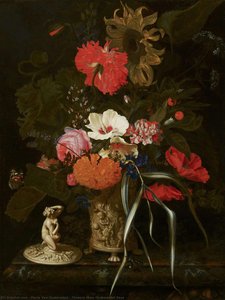
Flower Still Life
Størrelse på reproduktion
Rachel Ruysch's "Flower Still Life," painted in 1726, isn’t merely a depiction of blossoms; it’s a meticulously crafted meditation on beauty, mortality, and the burgeoning fascination with the natural world that defined the Dutch Golden Age. This exquisite work, now residing at the Toledo Museum of Art, offers a rare glimpse into the studio of one of the most celebrated female artists of her time – a woman who defied convention to establish herself as a master of botanical realism.
Ruysch’s artistic journey was profoundly shaped by her father, Frederik Ruysch, a renowned professor of anatomy and botany. He cultivated within their home not just a household but a living laboratory—a vast collection of preserved specimens, dissected animals, and meticulously documented plants. It was here that young Rachel developed an unparalleled eye for detail, learning to observe the subtle nuances of form, texture, and color with scientific precision. This early immersion instilled in her a deep respect for nature’s fragility and its inherent beauty – themes that would become central to her artistic vision.
“Flower Still Life” exemplifies Ruysch's signature style, characterized by an almost obsessive attention to detail. The composition is dominated by a profusion of flowers—poppies in vibrant reds and oranges, delicate white roses, hollyhocks reaching for the light, and a host of other blooms arranged within a dark, shadowed niche. Each petal, leaf, and stem is rendered with astonishing accuracy, capturing the velvety texture of petals, the intricate veins of leaves, and the subtle gradations of color. Ruysch’s technique isn't simply about replicating what she sees; it’s about conveying an understanding of the flower’s very essence – its structure, its life cycle, and its inherent beauty.
Beyond mere representation, Ruysch imbues her paintings with symbolic meaning. The inclusion of insects—a bee diligently gathering pollen, a caterpillar crawling along a stem, and a butterfly alighting on a bloom—adds layers of interpretation. These creatures represent the transient nature of life, the cycle of decay and renewal, and the interconnectedness of all living things. The presence of a watch within the arrangement is particularly poignant, serving as a visual reminder of the fleeting passage of time – a hallmark of the *vanitas* genre, which explored themes of mortality and vanity.
“Flower Still Life” is inextricably linked to the cultural context of the Dutch Golden Age. During this period, the Netherlands experienced an unprecedented economic boom fueled by trade and exploration. The nation became a global center for horticulture, importing exotic plants from around the world—including tulips, which had originated in Turkey. The tulip mania of 1637, a speculative bubble centered on these highly prized flowers, demonstrated the Dutch people’s fascination with beauty and their willingness to invest heavily in its pursuit. Ruysch's paintings capture this spirit of extravagance and connoisseurship, reflecting the wealth and sophistication of the era.
Today, reproductions of “Flower Still Life” are highly sought after by collectors and interior designers alike. The painting's rich colors, intricate details, and evocative symbolism make it a captivating addition to any space. When selecting a reproduction, consider the quality of the materials used—a fine-art print on archival paper will ensure that the artwork’s beauty endures for generations to come. The dynamic composition and subtle interplay of light and shadow create a sense of depth and movement, adding a touch of elegance and sophistication to any room. Ruysch's masterpiece continues to inspire with its celebration of nature's beauty and its poignant reminder of life's fleeting moments.




1664 - 1750 , Holland

Oplev de 10 mest ikoniske værker fra den hollandske guldalder! Rembrandt, Vermeer og andre mestre afsløres. Find inspiration til dit hjem & køb museumskvalitets kunsttryk på WahooArt.com.

Explore the captivating world of Severin Roesen, a major American still life painter influenced by Dutch masters. Discover his lush compositions and the symbolism within his art – a window into 19th-century America.

Explore the rich history of still life painting with WahooArt. Discover Dutch Masters, decode vanitas symbolism & learn about collecting timeless art. Expert insights and museum-quality reproductions.
Explore the rich history of flower symbolism in Western painting! Discover how artists from the Renaissance to Modernism used blossoms to convey meaning, emotion & beauty. Learn about iconic artworks and movements.
Explore the artistic brilliance of the 17th-century Dutch Golden Age & Baroque period. Discover Rembrandt, genre painting, and chiaroscuro techniques. Expert insights for art lovers & collectors.


Hold dig opdateret med de seneste kunstnyheder, eksklusive tilbud og indretningsideer.
Fortæl os om dit projekt, og vores kunsteksperter vil give dig 3 personlige kunstforslag.
Vi kuraterer 3 valgmuligheder kun til dig – Gratis!
 Del
Del








 Læs mere
 Glasmulighed er kun tilgængelig i størrelser under 110 cm


