


Håndmalet olie på lærred i din valgte størrelse og ramme, udført efter bestilling af vores kunstnere. ( Køb print Køb billede)





























Vælg mellem vores forudindstillede størrelser, der matcher kunstværkets originale proportioner.

Du kan indtaste dine egne mål for at passe til en bestemt ramme eller plads. Hvis den valgte størrelse ikke stemmer overens med det originale billedes proportioner, vil vi enten beskære kunstværket eller udvide maleriet med yderligere håndmalede elementer. En digital skitse sendes til din godkendelse, før produktionen påbegyndes.
Bemærk venligst, at forhåndsvisningen på skærmen ikke afspejler den faktiske beskæring eller udvidelse. Kun skitsen vil nøjagtigt vise den endelige komposition.
Selvom specialmål er mulige, anbefaler vi at vælge en dimension fra den foruddefinerede liste for at bevare de originale proportioner.
Levering i hele verden () på 3/4 uger i stedet for de standard 5 uger. (7 september). Ingen kompromiser med kvaliteten.


Seventeen
Størrelse på reproduktion
Paul Klee's “Seventeen,” created in 1927, stands as a cornerstone of Surrealist art—a testament to his singular ability to translate inner vision onto canvas. More than just an aesthetically pleasing composition, it’s a deliberate invitation into the realm of dreams and intuition, reflecting Klee’s profound engagement with psychoanalytic theory and mirroring Leonardo da Vinci's pioneering approach to anatomical study.
The painting eschews traditional perspective, presenting instead a flattened space populated by amorphous shapes—primarily arrows, stylized faces resembling eyes, and organic forms reminiscent of plant life. Klee’s masterful technique utilizes watercolor washes layered with meticulous detail, resulting in a surface texture that subtly captures the ethereal quality of its subject matter. The fluidity of his lines contributes to an overall sense of movement and spontaneity, defying rigid geometric constraints.
Klee’s color palette—dominated by earthy browns and tans punctuated by vibrant scarlet—is far from arbitrary. Instead, it embodies a carefully considered harmony designed to evoke emotion and stimulate contemplation. The bold red arrow serves as a focal point, directing the viewer's gaze while simultaneously symbolizing progression or perhaps even an urgent impulse. Smaller splashes of darker hues create depth and contrast, enriching the visual experience.
"Seventeen" emerged during Klee’s formative years within the Surrealist movement—a reaction against rational thought and a celebration of unconscious processes. Inspired by artists like Joan Miró and Henri Matisse, Klee sought to liberate art from representational constraints, prioritizing emotional expression over literal depiction. His theoretical writings, particularly ‘Paul Klee Notebooks,’ underscore this commitment to exploring the hidden dimensions of human experience.
Ultimately, “Seventeen” transcends its formal elements—its color palette and compositional structure—to offer a glimpse into the artist’s inner landscape. The ambiguity inherent in its forms invites viewers to engage actively with the artwork, projecting their own interpretations onto its surface. Like all great art, it remains perpetually open to debate and discovery, cementing Klee's place as one of the most influential figures in modern artistic history.


1879 - 1940 , Schweiz

Oplev Paul Klees 25 mest ikoniske malerier! Dyk ned i en verden af abstrakt kunst, ekspressionisme og farverig kreativitet. Find inspiration til din boligindretning & køb museumskvalitets reproduktioner på WahooArt.com.
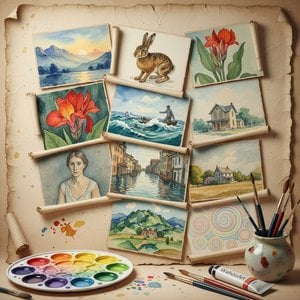
Oplev de 10 mest legendariske akvarelmesterværker, der har ændret kunsthistorien! Fra Turner til Monet – lær om teknikken og historierne bag ikoniske værker. Find museumskvalitets reproduktioner & inspiration til din indretning på WahooArt.com.

Explore the captivating world of Paul Klee! Discover his innovative art, Bauhaus influence, & unique symbolic language. Expert analysis & high-quality reproductions at WahooArt.

Oplev de 10 mest ikoniske værker inden for Abstrakt Ekspressionisme – Jackson Pollock, Mark Rothko og mere. Lær historien bag kunstnerne & teknikken. Find museumskvalitets reproduktioner på WahooArt.com.

Explore the captivating world of watercolor painting! Discover its rich history, essential techniques, influential artists & collecting tips. A comprehensive guide for art enthusiasts from WahooArt.

 Se i fuld skala
 Del
Del Del
Del
 Detaljer

 Download
 Lignende værker
 Røntgenundersøgelse
 Diasshow

 Se mere







 Glasmulighed er kun tilgængelig i størrelser under 110 cm


