x
Håndmalet olie på lærred i din valgte størrelse og ramme, udført efter bestilling af vores kunstnere.
Vælg mellem vores forudindstillede størrelser, der matcher kunstværkets originale proportioner.
Du kan indtaste dine egne mål for at passe til en bestemt ramme eller plads. Hvis den valgte størrelse ikke stemmer overens med det originale billedes proportioner, vil vi enten beskære kunstværket eller udvide maleriet med yderligere håndmalede elementer. En digital skitse sendes til din godkendelse, før produktionen påbegyndes.
Bemærk venligst, at forhåndsvisningen på skærmen ikke afspejler den faktiske beskæring eller udvidelse. Kun skitsen vil nøjagtigt vise den endelige komposition.
Selvom specialmål er mulige, anbefaler vi at vælge en dimension fra den foruddefinerede liste for at bevare de originale proportioner.
Levering i hele verden () på 3/4 uger i stedet for de standard 5 uger. (2 juli). Ingen kompromiser med kvaliteten.
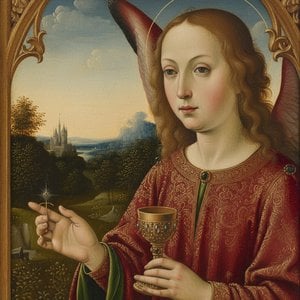
untitled (6791)
Størrelse på reproduktion
Hans Memling’s “untitled (6791)” – more commonly understood as his depiction of the Triumph of Saint Michael – is not merely a painting; it's a meticulously crafted theological statement, a visual sermon rendered with the astonishing detail characteristic of the Early Netherlandish masters. The work plunges us into a dramatic confrontation between celestial power and infernal darkness, embodying the eternal struggle between good and evil with an intensity that resonates even centuries after its creation. Memling doesn’t simply *show* us this battle; he invites us to witness it, drawing us into a claustrophobic space where the weight of divine judgment feels palpable.
To appreciate “untitled (6791)” fully is to understand its place within the blossoming artistic landscape of 15th-century Bruges. Memling, having honed his skills under Rogier van der Weyden in Brussels, brought a refined sensibility to the city’s thriving art scene. His technique exemplifies the hallmarks of the Northern Renaissance: an almost obsessive attention to detail, a preference for oil paints applied in delicate layers – or glazes – that build up luminosity and depth, and a compositional approach that prioritizes clarity of narrative over strict adherence to perspective. Look closely at Saint Michael’s armor; it isn't merely gold, but a shimmering surface reflecting an inner light. Observe the expressions etched onto the faces of the damned—each contorted in unique agony. This is not generalized suffering, but individualized torment. The subtle use of geometric forms – squares, rectangles, and circles – provides an underlying structure to the seemingly chaotic scene, lending it a sense of harmony despite its dramatic subject matter.
The painting’s power extends far beyond its technical brilliance; it is deeply imbued with symbolism. Saint Michael, archangel and warrior of God, stands as an unwavering beacon of righteousness, his raised sword a potent symbol of justice and the triumph over evil. Around him, angels proclaim victory with resounding blasts from their horns. Below unfolds a harrowing vision of damnation: naked figures, chained and writhing in despair, represent fallen humanity consumed by sin. The inclusion of scales is particularly significant – representing divine judgment, carefully weighing each soul’s worth. These aren't merely decorative elements; they are integral to the painting’s moral narrative. Even the hazy landscape in the background isn’t a realistic depiction of place but rather an atmospheric backdrop that amplifies the spiritual drama unfolding in the foreground, focusing our attention on the central conflict and its eternal consequences.
Hans Memling flourished in Bruges during a period of immense wealth and artistic patronage. The city was a vital hub for commerce, attracting merchants, aristocrats, and clergymen who eagerly commissioned works like “untitled (6791)” to express their piety and status. Memling’s clientele weren't simply seeking beautiful objects; they desired devotional pieces that would inspire contemplation and reinforce their faith. This painting likely served as such an object – perhaps adorning a private chapel or enriching the interior of a church, prompting viewers to reflect on their own mortality and spiritual well-being. It is a testament to the religious fervor and moralizing tendencies prevalent in 15th-century Northern Europe, a period deeply concerned with salvation and the consequences of earthly transgression. The enduring appeal of Memling’s work lies not only in its aesthetic beauty but also in its ability to simultaneously inspire reverence and provoke profound introspection.
Tyskland
Fortæl os om dit projekt, og vores kunsteksperter vil give dig 3 personlige kunstforslag.
Vi kuraterer 3 valgmuligheder kun til dig – Gratis!