The Genesis of a Masterpiece: Mark Rothko’s Early Years
Mark Rothko, a name synonymous with profound color fields, didn't emerge fully formed from the canvas. His artistic journey began in Daugavpils, Latvia—a city steeped in history and cultural crossroads—in 1903. Born Marcus Yakovlevich Rothkowitz to a Jewish family deeply rooted in intellectual pursuits, his early life was profoundly shaped by his father’s Marxist leanings and the vibrant, often turbulent, atmosphere of pre-war Europe. This formative period instilled within him a sensitivity to social and political currents, an element that would subtly permeate his later work. The family's emigration to Portland, Oregon, in 1913 marked a significant shift, introducing Rothko to a new landscape and a burgeoning American identity. His childhood was characterized by rigorous education—he mastered Lithuanian Yiddish, Hebrew, and Russian—and a passionate engagement with social justice issues, mirroring his father’s commitment to revolutionary ideals. This complex blend of heritage, intellectual stimulation, and early exposure to societal challenges laid the groundwork for the emotionally resonant art he would eventually create.
The Emergence of Color Field Painting: A Radical Shift
Rothko's artistic trajectory underwent a dramatic transformation during the 1940s. Initially exploring figurative painting—depicting urban scenes and portraits—he began to experiment with mythological themes and Surrealism, a response to the anxieties and uncertainties of World War II. However, it was in this decade that he embarked on a radical shift towards abstraction, driven by a desire to express fundamental human emotions rather than represent external reality. This pivotal period witnessed the birth of what would become known as Color Field painting—a movement characterized by vast expanses of luminous color applied in broad, unmodulated washes. Rothko’s focus moved away from recognizable forms and narratives, concentrating instead on the evocative power of pure color itself. He sought to create paintings that could induce a meditative state in the viewer, allowing them to experience emotions directly through the interplay of hue and tone.
‘No. 14’: A Symphony of Purple and Orange
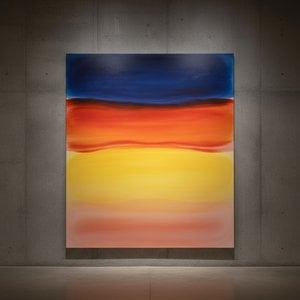
'No. 14' exemplifies Rothko’s mastery of this technique. The painting immediately commands attention with its bold juxtaposition of purple on the left side and orange on the right. These aren’t merely colors; they are imbued with a palpable sense of depth, luminosity, and emotional weight. The application of oil paint is remarkably subtle—layers build upon layers to create an almost velvety texture, while variations in tone suggest both distance and intimacy. The rectangular forms, devoid of sharp edges or defined boundaries, seem to dissolve into the surrounding color fields, drawing the viewer inward. It’s a deliberate strategy designed to bypass rational thought and tap directly into the viewer's emotional core. Rothko himself described his intention as “to express basic human emotions: tragedy, ecstasy, doom, and so on.” ‘No. 14’ powerfully embodies this ambition, inviting contemplation of these profound states.
Legacy and Influence: A Lasting Impact
Mark Rothko's influence extends far beyond his own lifetime. He is considered a pivotal figure in the development of Abstract Expressionism, alongside artists like Wassily Kandinsky and Arthur Dove. His work has been exhibited at prestigious institutions worldwide, including the Tate Gallery and the National Gallery of Australia, and its resale value continues to rise significantly. The iconic ‘No. 6 (Violet, Green and Red)’ sold for an astounding $186 million in 2014, a testament to the enduring power and appeal of his art. Rothko’s legacy lies not only in his individual paintings but also in his pioneering approach to color and form—a radical departure from traditional representation that continues to inspire artists and captivate audiences today. For those seeking a deeper understanding of this extraordinary artist and his work, we encourage you to explore the WahooArt website for further information and high-quality reproductions.
Spørgsmål & svar
Hvilket stemningsleje og hvilke følelser udtrykker "No. 14" af Mark Rothko?
"No. 14" af Mark Rothko formidler en Mystisk følelse i en overordnet Dramatisk stemning.
Er "No. 14" af Mark Rothko i det offentlige domæne?
Hvad angår ophavsret, er "No. 14" stadig beskyttet af ophavsret.
Kan jeg se et røntgenbillede af "No. 14" af Mark Rothko?
Røntgenundersøgelse-siden til "No. 14" af Mark Rothko er en interaktiv viewer, der lader dig glide gennem elleve optiske lag af værkets billede, herunder en visning i røntgenstil.



 Se i rummet
 Skift til printversion
 Send
Send Del
Del
 Detaljer
 Studieguide til kunstværker

 Download
 Lignende værker
 Røntgenundersøgelse
 Se diasshow
 Statistik

 Læs mere






































 Glasmulighed er kun tilgængelig i størrelser under 110 cm