


Giclée- eller lærredstryk i museumskvalitet med hurtig produktion og fleksible muligheder for finish. ( Køb håndlavet maleri Køb billede)





























Vælg mellem vores forudindstillede størrelser, der matcher kunstværkets originale proportioner.

Du kan indtaste dine egne mål for at passe til en specifik ramme eller et bestemt område. Hvis den valgte størrelse ikke stemmer overens med det originale billedes proportioner, vil vi enten beskære kunstværket eller udvide billedet med en spejlet eller ensfarvet kant. En digital mockup vil blive sendt til din godkendelse, før produktionen påbegyndes.
Bemærk venligst, at forhåndsvisningen på skærmen ikke afspejler den faktiske beskæring eller udvidelse. Kun mockuppen vil nøjagtigt vise den endelige komposition.
Selvom specialmål er tilgængelige, anbefaler vi at vælge et mål fra den foruddefinerede liste for at bevare de originale proportioner.
Verdensomspændende levering () på 2 uger i stedet for de sædvanlige 4/5 uger. (6 september)


Pliushkin's village
Størrelse på reproduktion
Marc Chagall’s “Pliushkin’s Village,” created in 1923, isn't merely a depiction of a Russian countryside; it’s an embodiment of Chagall’s singular artistic vision—a distillation of his childhood memories and infused with the vibrant spirit of Vitebsk. This sketch-like etching captures a moment frozen in time, prioritizing emotional resonance over meticulous realism. The artwork immediately draws the eye with its tilted perspective, subtly disrupting our expectations of spatial accuracy and contributing to an overall feeling of whimsical disorientation.
Chagall’s style is undeniably rooted in Naïve Art (Primitivism), a movement that championed unfiltered emotion and spontaneous gesture. However, it transcends simple categorization thanks to the influence of Cubism—particularly evident in the simplified geometric forms representing buildings—and a deep engagement with Jewish folklore traditions. The artist eschewed academic conventions, favoring loose lines and hatching techniques to convey texture and volume. Charcoal and pencil were skillfully employed on tracing paper, resulting in an ethereal quality that captures the essence of Chagall’s artistic impulse.
Despite its dreamlike atmosphere, “Pliushkin’s Village” utilizes a predominantly monochrome palette—primarily shades of black, grey, and white. This deliberate restriction amplifies the artwork's expressive power, focusing attention on line and form rather than coloristic detail. The composition is layered and dynamic, with buildings stacked unevenly and the ground sloping dramatically. Figures populate the scene in a scattered arrangement, seemingly adrift amidst the landscape—a visual metaphor for Chagall’s exploration of memory and imagination.
The village itself is more than just a setting; it represents Vitebsk – Chagall’s birthplace – a town defined by its confluence of Orthodox Christianity and Jewish culture. This duality finds visual expression in the artwork through recurring motifs like flying figures, symbolizing aspiration and transcendence, and stylized animals—a nod to Jewish folklore—adding layers of symbolic meaning. While there's no explicit narrative storyline, “Pliushkin’s Village” speaks volumes about Chagall’s preoccupation with personal experience and his ability to transform observation into profound emotional statement.
“Pliushkin’s Village,” executed in 1923, exemplifies Chagall's unwavering commitment to artistic freedom. It stands as a testament to the power of imagination and the enduring beauty of Naïve Art—a captivating glimpse into the artist’s inner world and his profound connection to the landscapes and traditions of his formative years. Its ethereal quality continues to inspire collectors and interior designers alike, cementing Chagall's place among the most influential artists of the 20th century.


1887 - 1985 , Hviderusland
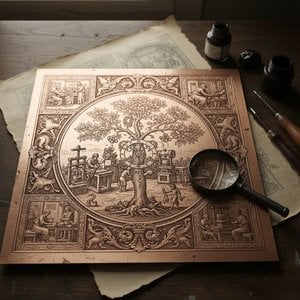
Explore the intricate world of etching and intaglio printmaking. Discover how masters use acid and metal to create profound textures and lines, from Romanticism to modern era, through an expert lens of art history and technical mastery.

Discover the enchanting world of Naive Art. Explore the profound beauty of self-taught masters like Henri Rousseau through an art-history lens, uncovering how simple forms and vibrant colors create timeless, soulful masterpieces for the discerning collector.

 Se i fuld skala
 Del
Del Del
Del
 Detaljer

 Download
 Lignende værker
 Røntgenundersøgelse
 Diasshow

 Se mere







 Glasmulighed er kun tilgængelig i størrelser under 110 cm


