Kazimierz Stabrowski's "Trees": A Symbolist Landscape of Transformation
- Artist: Kazimierz Stabrowski (1869-1929)
- Date: 1895
- Medium: Pastel on paper
- Size: 47 x 63 cm
Kazimierz Stabrowski's "Trees" is a captivating pastel drawing that transcends simple representation, offering instead a glimpse into the artist’s exploration of symbolism and romanticism within the natural world. This work, created in 1895, showcases a pivotal moment in Stabrowski's artistic development as he moves away from strict realism towards abstraction, while retaining a profound emotional depth.
Subject Matter & Composition
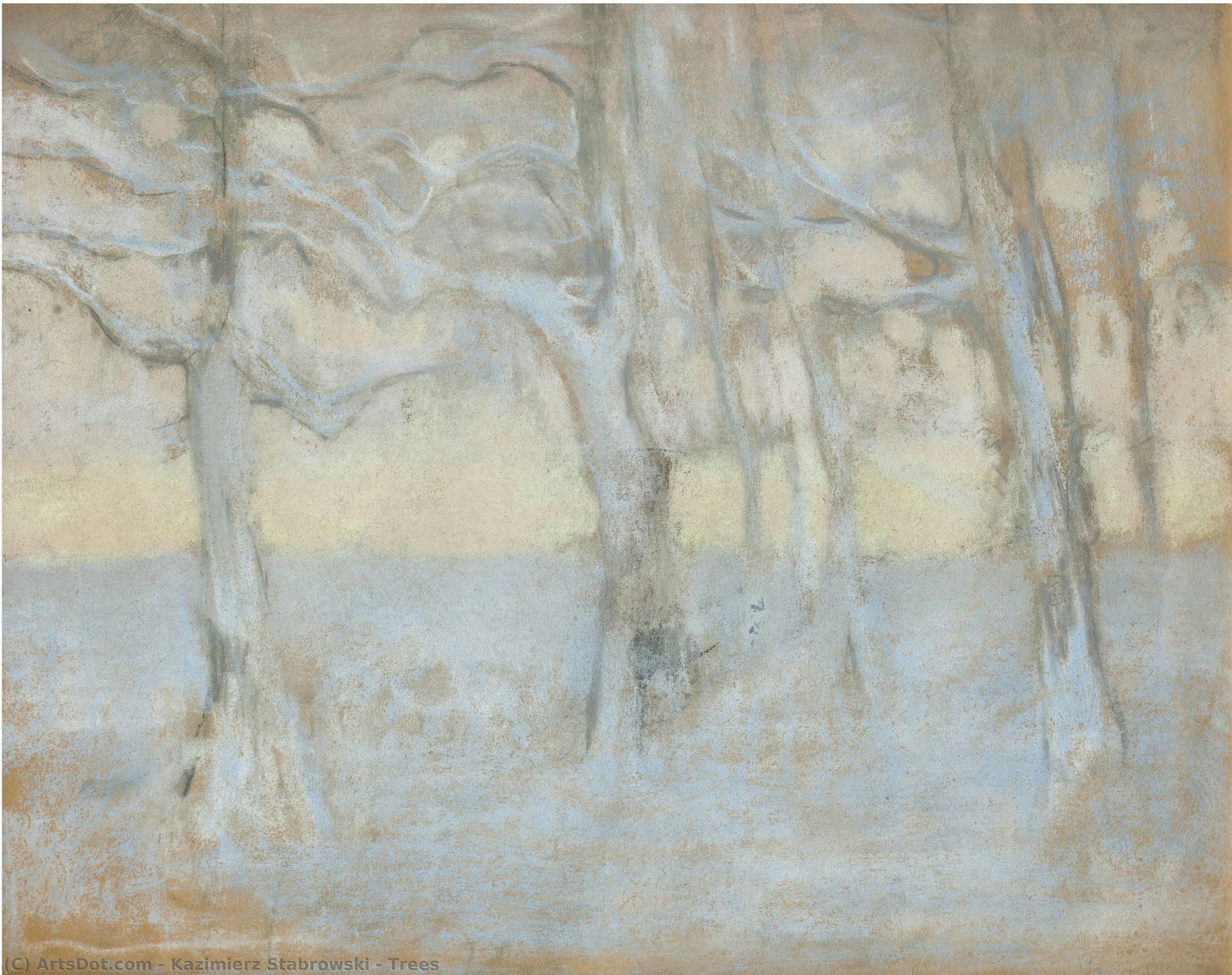
"Trees" depicts a cluster of trees set against what appears to be a beach or shoreline. The composition is dominated by the verticality of the tree trunks and branches, rendered with loose, flowing lines and blended colors. Unlike traditional landscape paintings that prioritize accurate depiction, Stabrowski prioritizes conveying an atmosphere and feeling. There's no clear focal point; instead, the eye wanders across the dense visual field created by the clustered trees, eventually settling on the hazy background suggesting a distant shoreline. The horizontal format emphasizes the breadth of the scene while maintaining a sense of intimacy through the close proximity of the trees in the foreground.
Style and Technique: A Shift Towards Abstraction
The artwork exemplifies a transition towards abstraction. Stabrowski’s technique is characterized by loose, gestural strokes that capture the essence of the trees rather than their precise form. The blending of colors—primarily muted tones of beige, grey, blue, and brown with subtle hints of yellow and green—creates a hazy, dreamlike effect. This soft palette contributes to the overall melancholic and contemplative mood. The use of pastels lends itself beautifully to this style, creating a velvety texture that enhances the sense of depth and dimension. The lines themselves are not sharp or defined but rather flow into one another, suggesting movement and growth within the trees. It's worth noting the similarities in tree depiction with those found in Mikalojus Konstantinas Čiurlionis’ “Winter” collection (1907), highlighting a shared artistic sensibility of the time.
Symbolism & Emotional Impact
Beyond its aesthetic qualities, "Trees" carries significant symbolic weight. The transforming trees represent change, growth, and potentially even spiritual evolution—themes central to Stabrowski’s interest in symbolism and romanticism. The artist's intention was not merely to depict a scene but to express ideas, feelings, and experiences through the landscape. The hazy atmosphere and muted colors evoke a sense of longing or introspection, inviting viewers to contemplate their own connection to nature and the passage of time. This work is more than just a depiction of trees; it’s an exploration of the human condition within the context of the natural world.
Historical Context & Artistic Significance
Created during a period of artistic experimentation, "Trees" reflects the broader shift away from realism and towards symbolism and abstraction in late 19th-century art. Stabrowski’s work stands as an important example of Polish Symbolism, demonstrating a desire to move beyond mere representation and explore deeper emotional and spiritual truths. His exploration of these themes, combined with his later involvement in the Theosophical Society, further enriches the interpretation of this evocative pastel drawing.
Spørgsmål & svar
Hvordan relaterer stilen i "Trees" sig til skaberens samtid?
I "Trees" af Kazimierz Stabrowski mødes Symbolism-stilen med det 19. århundrede-æraen.
I hvilken periode blev "Trees" af Kazimierz Stabrowski skabt?
"Trees" af Kazimierz Stabrowski stammer fra 19th Century-perioden. Perioden giver den historiske kontekst til værket.
Er farverne i "Trees" af Kazimierz Stabrowski mættede eller dæmpede?
Farverne i "Trees" af Kazimierz Stabrowski har en Muted mætning. Mætning beskriver, hvor livlige eller dæmpede farverne er.


 Se i rummet
 Skift til printversion
 Send
Send Del
Del
 Detaljer
 Studieguide til kunstværker

 Download
 Lignende værker
 Røntgenundersøgelse
 Se diasshow
 Statistik


 Læs mere






































 Glasmulighed er kun tilgængelig i størrelser under 110 cm