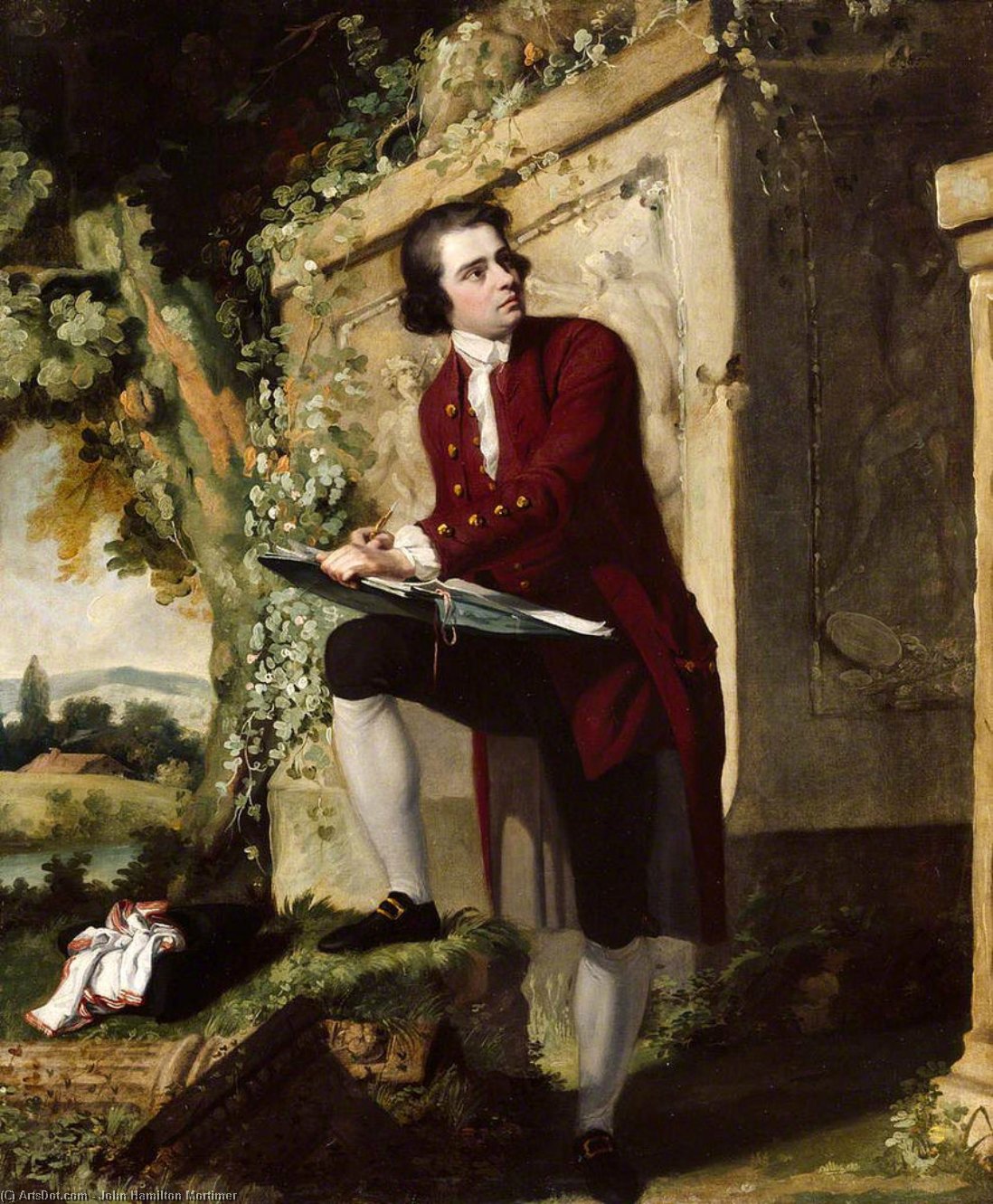
Kunstnerens biografi
John Hamilton Mortimer (1740–1779): A Life Painted in Romantic Hues
John Hamilton Mortimer, a name perhaps less instantly recognizable than his contemporaries like Reynolds or Wright of Derby, nevertheless occupies a significant and fascinating niche within the landscape of 18th-century British art. His contribution to the burgeoning Romantic movement—a subtle yet decisive bridge between classical tradition and emotive expression—deserves renewed appreciation. Born in Eastbourne, Sussex, on September 17, 1740, Mortimer’s brief but intensely productive life—he died at just thirty-nine years old—was marked by artistic ambition, a restless spirit, and an evolving style that mirrored the shifting tastes of his era. His father, Thomas Mortimer, was a customs officer with mercantile interests, providing a stable if unremarkable background for a young man destined to pursue a path steeped in creativity. By 1757, Mortimer had already gravitated towards London, enrolling at the prestigious Duke of Richmond’s Academy, where he forged a lifelong friendship with Joseph Wright, a bond that would prove mutually supportive throughout their careers. This early immersion into the artistic milieu fostered not only technical skill but also an awareness of the intellectual currents shaping British art—the burgeoning fascination with sublime landscapes and dramatic narratives.
Early Training and Artistic Foundations
Mortimer’s formative years were spent honing his craft under the tutelage of masters who championed classical principles. He began his artistic journey at the Duke of Richmond's Academy, where he diligently studied Michelangelo’s *Bacchus* and executed meticulous life drawings—exercises that established a bedrock of anatomical precision and compositional understanding. These foundational skills would serve as invaluable tools in his subsequent explorations of historical painting and landscape genre. Recognizing his talent early on, Mortimer swiftly gained recognition for his depictions of biblical scenes and mythological subjects, demonstrating an aptitude for capturing dramatic moments with masterful brushwork. His dedication to accuracy and stylistic refinement distinguished him from many of his peers—a characteristic that would persist throughout his artistic career.
From History to Bandits: The Evolution of a Style
Mortimer’s initial successes cemented his reputation as a skilled historian painter, culminating in *St Paul Preaching to the Ancient Druids in Britain*, now housed in the Guildhall at High Wycombe. This monumental canvas exemplifies his commitment to narrative and theatrical presentation—a hallmark of his oeuvre—capturing the fervor of religious conviction amidst the rugged beauty of Britannia’s landscape. However, Mortimer refused to remain tethered to established conventions; he possessed a profound sensitivity to evolving aesthetic preferences. As the 1770s unfolded, a discernible shift occurred in his artistic focus. Influenced by the dramatic landscapes and rebellious spirit embodied by Salvator Rosa—the Neapolitan painter celebrated for his untamed scenes of outlaws and heroic figures—Mortimer embraced more masculine themes and explored darker corners of human experience. This fascination with criminality and rugged individualism resonated powerfully with a growing taste for Romanticism, foreshadowing the artistic movements that would dominate the following century. Notably, he created an etching after Rosa’s self-portrait, demonstrating his deep admiration for Rosa's stylistic approach.
Collaboration and Artistic Leadership
Mortimer wasn’t solely a solitary painter; he actively engaged in collaborative projects with fellow artists—a practice common among British painters of his time. He frequently contributed figure work to compositions by others, notably assisting Thomas Jones on ambitious canvases like *A Land Storm, with the Story of Dido and Aeneas*, *The Death of Orpheus*, and a pair of paintings inspired by Milton’s *Allegro* and *Penseroso*. These collaborations underscore his versatility and willingness to contribute his skills to larger artistic endeavors—a testament to his collaborative spirit. Furthermore, Mortimer's talent was sought after for decorative schemes; from 1770 to 1773, he played a pivotal role in the opulent decoration of Brocket Hall, Hertfordshire, collaborating alongside Francis Wheatley and James Durno on lavish murals that reflected the grandeur of Georgian England. His election as President of the Society of Artists in 1774 solidified his position within the artistic community—a recognition of his influence and prestige during a period of significant artistic innovation.
A Legacy Tempered by Early Loss
Despite his considerable achievements, Mortimer’s career was tragically curtailed by an undisclosed illness that claimed his life on February 4th, 1779—leaving behind a body of work that continues to intrigue scholars and art enthusiasts alike. Though he exhibited at the Royal Academy in 1778—presenting five paintings including *Sir Arthegal* and bandit scenes—and was elected an Associate shortly before his demise, Mortimer’s potential remained largely unrealized. While Horace Walpole dismissed him as a mere imitator of Salvator Rosa—a critique that arguably overlooks Mortimer's distinctive contribution to British art—modern scholarship has illuminated the breadth of his artistic development and reaffirmed his importance within the context of 18th-century British painting. His paintings, characterized by their dramatic compositions, expressive brushwork, and exploration of complex themes—ranging from biblical narratives to heroic landscapes—offer a compelling glimpse into the sensibilities of his era and stand as enduring symbols of Romantic ambition and artistic vision.