


x

 Bestil tryk Køb højopløseligt billede
 Del
Del
 Detaljer
 Tilføj til favoritter
 Download
 Lignende værker
 Røntgen
 Diasshow
 Contemporary Minimalism
 180.0 x 36.0 cm
 The Moving Museum
Håndmalet olie på lærred i din valgte størrelse og ramme, udført efter bestilling af vores kunstnere.
Vælg mellem vores forudindstillede størrelser, der matcher kunstværkets originale proportioner.

Du kan indtaste dine egne mål for at passe til en bestemt ramme eller plads. Hvis den valgte størrelse ikke stemmer overens med det originale billedes proportioner, vil vi enten beskære kunstværket eller udvide maleriet med yderligere håndmalede elementer. En digital skitse sendes til din godkendelse, før produktionen påbegyndes.
Bemærk venligst, at forhåndsvisningen på skærmen ikke afspejler den faktiske beskæring eller udvidelse. Kun skitsen vil nøjagtigt vise den endelige komposition.
Selvom specialmål er mulige, anbefaler vi at vælge en dimension fra den foruddefinerede liste for at bevare de originale proportioner.
Levering i hele verden () på 3/4 uger i stedet for de standard 5 uger. (5 juli). Ingen kompromiser med kvaliteten.


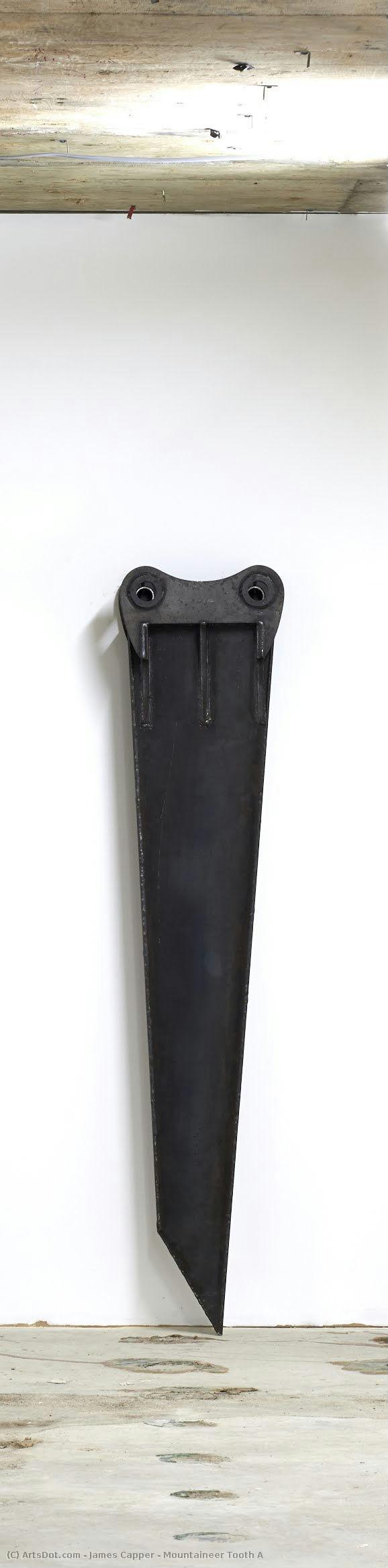
Mountaineer Tooth A
Størrelse på reproduktion


James Capper, born in London in 1987, emerged as a distinctive voice in contemporary sculpture by challenging conventional notions of the medium itself. His path wasn’t forged in traditional art schools focused solely on form and aesthetics; instead, it was deeply rooted in the practical world of agricultural mechanics. This early exposure instilled in him not just an understanding of materials but also a fascination with movement, power, and the inherent capabilities of engineered systems. While formally trained as a welder at Chelsea College of Art and Design, earning a B.A., Capper’s true education began when he started to combine his technical skills with artistic vision. He wasn't content to simply *create* objects; he wanted them to operate, to interact with their environment, to possess a life beyond static display.
Capper’s breakthrough came with the development of his signature mobile sculptures. Rejecting the stillness often associated with sculpture, he conceived of works that actively engage with space—machines designed to traverse varied terrains. This led to the concept of “divisions,” a self-defined categorization of his work based on operational environments: Earth Marking, Aviation, Materials Handling, and Offshore. Each division isn’t merely a thematic grouping but represents an ongoing technical and aesthetic exploration. The initial prototypes within each division serve as both functional tools and sculptural statements. He doesn't simply build sculptures *of* machines; he builds machines that *are* sculptures.
While Capper’s work is strikingly original, it resonates with several historical currents. The kinetic art of Alexander Calder—with its emphasis on movement and balance—is a clear antecedent, though Capper pushes beyond purely aesthetic considerations into the realm of practical application. There's also an echo of early 20th-century Futurist fascination with technology and dynamism, but Capper tempers this enthusiasm with a grounded understanding of engineering limitations and possibilities. His sculptures aren’t utopian visions of technological progress; they are pragmatic explorations of what machines can *do* within the constraints of reality. Furthermore, his interest in biology—particularly the adaptive mechanisms of natural systems—informs the design of his mobile works, seeking to mimic organic efficiency and resilience. He often speaks of creating sculptures that ‘evolve’ through repeated use and modification.
Capper's career trajectory has been marked by rapid ascent. His first solo show in the US at Paul Kasmin Gallery in 2015, featuring the “MOUNTAINEER TEETH” series, garnered significant attention for its ambitious scale and conceptual depth. Since then, he’s exhibited extensively internationally, with solo exhibitions at Albion Barn, Alex Eagle Studio, and MONA (Barriedale), among others. Notable commissions include MUDSKIPPER WALKING WORKBOAT for Battersea Power Station in 2020 and Camellia for Gallery Town in 2023. He received the Royal Society of British Sculptors Bursary Award in 2011, and was nominated for the Jerwood Sculpture Prize in 2009—early recognition that signaled his potential. In 2023, he uniquely stood as the sole artist featured in a Science Museum exhibition dedicated to leading engineers globally, highlighting the intersection of art and technical innovation.
James Capper’s contribution lies in redefining sculpture for the 21st century. He has successfully bridged the gap between art and engineering, creating works that are both conceptually rigorous and materially compelling. His sculptures challenge viewers to reconsider their relationship with technology—not as a detached force but as an extension of human agency.

United Kingdom

Oplev 1920'ernes glamour og kunstneriske innovation! Udforsk 10 ikoniske malerier fra Art Deco, ekspressionisme & mere. Find Tamara de Lempicka prints og Gustav Klimt reproduktioner hos WahooArt.dk – museumskvalitet til din bolig. Se kollektionen online!

Explore the captivating world of industrial aesthetics in modern art. Discover key movements, influential artists & collecting insights at WahooArt.com – your source for museum-quality reproductions and expert art guidance.
Explore the captivating history of marble sculpture from ancient Greece to modern art. Discover renowned artists like Canova & Michelangelo, carving techniques, and investment insights at WahooArt.

Explore the captivating world of Paul Manship, a leading figure in American Art Deco sculpture. Discover his iconic works like Prometheus, influence on modernism, and investment potential. Expert insights for collectors.

Explore the captivating world of geometric abstraction! Discover its origins, key artists like Malevich & Mondrian, and why this movement remains highly valued by art collectors today. Expert insights at WahooArt.


Hold dig opdateret med de seneste kunstnyheder, eksklusive tilbud og indretningsideer.
Fortæl os om dit projekt, og vores kunsteksperter vil give dig 3 personlige kunstforslag.
Vi kuraterer 3 valgmuligheder kun til dig – Gratis!
 Del
Del

 Se mere




































 Glasmulighed er kun tilgængelig i størrelser under 110 cm


