A Window into Genius: Exploring Hans Holbein the Younger's Self Portrait
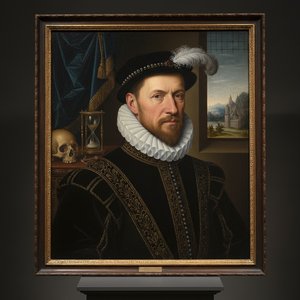
Hans Holbein the Younger’s Self Portrait, executed in 1542, stands as an unparalleled achievement of Northern Renaissance art—a testament to meticulous observation and psychological insight that continues to captivate audiences centuries later. Housed within the Galleria degli Uffizi in Florence, Italy, this deceptively simple painting transcends mere likeness; it embodies Holbein’s artistic philosophy and offers a profound glimpse into the mind of one of history's most celebrated portraitists.
The Artist’s Vision Holbein, renowned for his unwavering commitment to realism and his ability to distill complex emotions onto canvas, was at the zenith of his career during this period. Serving as court painter to King Henry VIII, he skillfully navigated the turbulent political landscape while simultaneously elevating artistic standards. Unlike many of his contemporaries who prioritized idealized representations, Holbein sought to capture not just physical appearance but also inner character—a feat accomplished with breathtaking precision.
Technique and Composition: Pastel Perfection
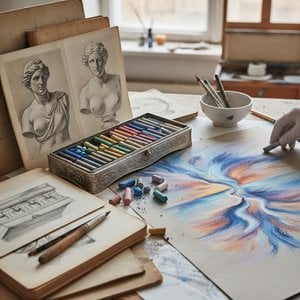
Measuring a modest 23 x 18 cm, the Self Portrait is executed primarily in pastel chalks and pen heightened with gold leaf. This medium choice was revolutionary for its time, allowing Holbein to achieve subtle tonal gradations and luminous highlights—a technique that would become synonymous with his distinctive style. The composition itself is remarkably balanced: Holbein presents himself seated before a mirrored surface, gazing directly at the viewer with an unwavering gaze. This deliberate posture conveys confidence and introspection, inviting contemplation about identity and self-awareness.
Symbolism and Context Beyond its technical brilliance, the Self Portrait resonates deeply with historical context. Created during the Reformation—a period of religious upheaval—Holbein’s depiction reflects the humanist ideals prevalent in intellectual circles. The gold background, added at a later date, symbolizes royal authority and prestige – mirroring Holbein's position as Henry VIII’s court painter. Furthermore, the inclusion of a paintbrush underscores his profession and signifies his dedication to artistic craft.
Influence and Legacy: An Enduring Inspiration
Holbein’s Self Portrait has served as an inspiration for countless artists throughout history. Lucas Horenbout's version—a masterful reproduction capturing Holbein holding a paintbrush—demonstrates the enduring impact of his work on subsequent generations. The painting exemplifies Holbein’s mastery of chiaroscuro, skillfully manipulating light and shadow to sculpt form and convey emotion.
Ultimately, Hans Holbein the Younger's Self Portrait remains an extraordinary achievement of Renaissance art – a captivating portrait that speaks volumes about artistic innovation, psychological depth, and the enduring fascination with capturing the human spirit.



 Se i rummet
 Skift til printversion
 Send
Send Del
Del
 Detaljer
 Guide
Guide

 Download
 Lignende værker
 Røntgenundersøgelse
 Se diasshow
 Statistik


 Læs mere






































 Glasmulighed er kun tilgængelig i størrelser under 110 cm