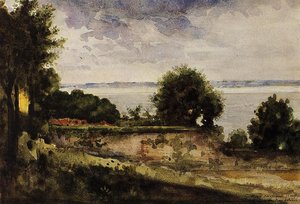
Gustave Moreau’s “Prometheus”: A Titan’s Silent Plea
Gustave Moreau’s “Prometheus” – a monumental canvas depicting the titan chained atop a desolate peak, offering a flickering flame to a shadowed humanity – is far more than just a mythological scene. It's a profound meditation on sacrifice, knowledge, and the enduring struggle against oppressive forces. Completed in 1868, this painting stands as a cornerstone of Symbolism, rejecting the rigid realism of its time and instead delving into the complex realm of subjective emotion and philosophical inquiry. Moreau doesn’t present us with a triumphant hero; rather, he captures the weight of responsibility borne by Prometheus – a solitary figure radiating both defiance and profound sorrow.
The painting's power lies not just in its subject matter but also in Moreau’s masterful technique. He employs a deliberately rough and uneven brushstroke, creating a tactile surface that mirrors the harshness of Prometheus’s fate. The color palette is dominated by muted browns, deep blues, and grays – colors that evoke a sense of vastness, isolation, and melancholic contemplation. Light plays a crucial role, focusing intensely on Prometheus's face and torso, casting dramatic shadows that heighten the feeling of suffering and struggle. This isn’t about photographic accuracy; it’s about conveying atmosphere and emotion through carefully considered color and light – a hallmark of Moreau’s distinctive style.
Decoding the Language of Symbols
“Prometheus” is rich in symbolism, inviting viewers to contemplate fundamental questions about humanity's place in the universe. The chained titan himself embodies resilience, sacrifice, and the enduring human spirit in the face of adversity. The flame he offers isn’t simply a source of warmth or light; it represents knowledge, enlightenment, and progress – but also carries within it the potential for destruction and chaos. Moreau deliberately avoids depicting Prometheus as a glorious victor; instead, he shows him as vulnerable and burdened by his act of defiance. The jagged rocks that imprison him symbolize the constraints imposed by authority, both divine and societal, while the shadowy figure below represents humanity receiving this gift – with all its attendant joys and sorrows.
Recurring motifs further enrich the painting’s symbolic depth. The presence of a bird, often associated with freedom and spirituality, offers a poignant counterpoint to Prometheus's earthly imprisonment. The overall composition—the towering mountain, the desolate landscape, the solitary figure—creates a sense of immense scale and timelessness, suggesting that Prometheus’s struggle is not merely historical but an eternal one. Moreau masterfully uses perspective to flatten the scene, creating a feeling of depth without resorting to traditional realism – a technique that emphasizes mood and atmosphere over precise representation.
A Legacy of Myth and Emotion
Gustave Moreau (1826-1898) was a pivotal figure in the Symbolist movement, rejecting the prevailing artistic trends of his time to explore subjective emotions and mythological themes. Heavily influenced by literary giants like Shakespeare and Byron, he transformed familiar myths into deeply personal statements. “Prometheus” exemplifies this approach, demonstrating Moreau’s fascination with classical narratives and his ability to imbue them with a uniquely emotional charge. His work profoundly impacted later artists such as Henri Matisse and Georges Rouault, paving the way for modern art's exploration of inner worlds and symbolic language.
Moreau’s legacy extends beyond individual paintings; it resides in his pioneering approach to Symbolism. He sought to capture not just what things *looked* like but how they *felt*, creating works that resonate with viewers on a deeply emotional level. “Prometheus” remains a testament to this vision – a powerful and enduring image of defiance, sacrifice, and the eternal quest for knowledge. Today, the Musée Gustave Moreau in Paris stands as a vital repository of his work, preserving his studio and an extensive collection of his paintings, drawings, and watercolors, offering visitors a chance to immerse themselves in the world of this extraordinary artist.
Spørgsmål & svar
Hvilket rum anbefales "Prometheus" af Gustave Moreau til?
En reproduktion af "Prometheus" passer godt ind i et Stue og opholdsrum.
Hvilken type kunstværk er "Prometheus" af Gustave Moreau?
"Prometheus" er et værk i form af Vægkunst.
Hvad er den anbefalede anvendelse af et print af "Prometheus"?
En reproduktion af "Prometheus" af Gustave Moreau anbefales til Statement. Denne anbefaling er baseret på værkets motiv, stemning og farver.



 Se i rummet
 Skift til printversion
 Send
Send Del
Del
 Detaljer
 Studieguide til kunstværker

 Download
 Lignende værker
 Røntgenundersøgelse
 Se diasshow
 Statistik

 Læs mere






































 Glasmulighed er kun tilgængelig i størrelser under 110 cm