


 Oil On CanvasWallArtContemporary Realism
 187119th Century
 18.0 x 37.0 cm
Giclée- eller lærredstryk i museumskvalitet med hurtig produktion og fleksible muligheder for finish. ( Køb håndlavet maleri Køb billede)





























Vælg mellem vores forudindstillede størrelser, der matcher kunstværkets originale proportioner.

Du kan indtaste dine egne mål for at passe til en specifik ramme eller et bestemt område. Hvis den valgte størrelse ikke stemmer overens med det originale billedes proportioner, vil vi enten beskære kunstværket eller udvide billedet med en spejlet eller ensfarvet kant. En digital mockup vil blive sendt til din godkendelse, før produktionen påbegyndes.
Bemærk venligst, at forhåndsvisningen på skærmen ikke afspejler den faktiske beskæring eller udvidelse. Kun mockuppen vil nøjagtigt vise den endelige komposition.
Selvom specialmål er tilgængelige, anbefaler vi at vælge et mål fra den foruddefinerede liste for at bevare de originale proportioner.
Verdensomspændende levering () på 2 uger i stedet for de sædvanlige 4/5 uger. (7 september)


Pomegranates
Størrelse på reproduktion
Gustave Courbet's 1871 painting, ‘Pomegranates,’ is more than just a depiction of fruit; it’s a potent statement of artistic rebellion and a cornerstone of the Realist movement. This intimate still life, measuring a modest 18 x 37 cm, reveals a world stripped bare of romanticism or idealized beauty, offering instead an unflinching observation of everyday objects – in this case, a vibrant collection of apples, oranges, and the intensely symbolic pomegranate itself. Courbet’s dedication to capturing the textures and colors with meticulous detail elevates the seemingly simple subject matter into a profound meditation on life, decay, and the very nature of representation.
Created during a period of immense social and political upheaval in France – specifically, following the brief but impactful Paris Commune – ‘Pomegranates’ embodies Courbet's commitment to depicting the realities of contemporary life. As a leading figure in Realism, he rejected the academic conventions that dominated the Salon system, choosing instead to paint what he saw with uncompromising honesty. This painting reflects his broader engagement with social commentary and political conviction, themes powerfully explored in works like ‘The Stone Breakers.’ Courbet’s influence extended far beyond his immediate circle; artists such as Paul Cézanne, who sought to understand form through a rigorous analysis of structure, were profoundly impacted by Courbet's approach. The deliberate challenge to traditional artistic hierarchies established during this period paved the way for the avant-garde movements that would shape art in the 20th century.
Courbet’s masterful technique is immediately apparent in ‘Pomegranates.’ Executed in oil on canvas, the painting showcases a remarkable sensitivity to light and shadow. The dominant apple in the foreground isn't merely rendered; it glows with an almost luminous quality, achieved through careful manipulation of color and texture. Notice the subtle variations in hue – the deep reds and purples of the fruit contrasted against the pale blue slip lining the earthenware bowl. The artist’s attention to detail extends beyond mere representation; he captures the very essence of the objects, conveying their weight, their coolness, and their tactile qualities. The slightly bruised or imperfect forms of the fruit contribute to a sense of realism that was revolutionary for its time.
The inclusion of the pomegranate itself is particularly significant. Historically, pomegranates have been laden with symbolism – representing fertility, abundance, and even death in ancient cultures. The painting’s composition subtly alludes to this rich tradition, reminding us of the transient nature of beauty and life. Courbet's choice to depict rotting fruit, a common motif within seventeenth-century Dutch still lifes, elevates his work beyond a simple depiction of produce; it becomes a poignant meditation on mortality and the inevitable cycle of decay. The painting’s emotional impact is heightened by its intimate scale – inviting viewers to contemplate this small yet powerful scene with quiet intensity. This piece resonates deeply with the NMWA's mission to celebrate women artists, highlighting Courbet's lasting legacy as a pioneer in artistic honesty and observation.


1819 - 1877 , Frankrig

Explore the profound beauty of fruit arrangement masterpieces. From Dutch Golden Age opulence to Baroque chiaroscuro, discover the art history, symbolism, and timeless elegance of classical still life paintings for the discerning collector.
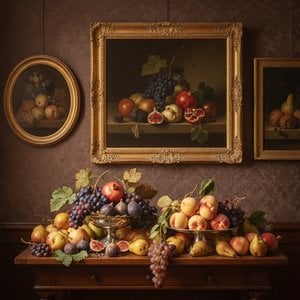
Discover the profound beauty of fruit still life paintings. Explore the rich symbolism, Baroque mastery, and timeless allure of nature's bounty through an art-historical lens, perfect for collectors and enthusiasts of classical fine art.

 Se i fuld skala
 Del
Del Del
Del
 Detaljer

 Download
 Lignende værker
 Røntgenundersøgelse
 Diasshow
 Se mere







 Glasmulighed er kun tilgængelig i størrelser under 110 cm


