Håndmalet olie på lærred i din valgte størrelse og ramme, udført efter bestilling af vores kunstnere. ( Køb print Køb billede)





























Vælg mellem vores forudindstillede størrelser, der matcher kunstværkets originale proportioner.

Du kan indtaste dine egne mål for at passe til en bestemt ramme eller plads. Hvis den valgte størrelse ikke stemmer overens med det originale billedes proportioner, vil vi enten beskære kunstværket eller udvide maleriet med yderligere håndmalede elementer. En digital skitse sendes til din godkendelse, før produktionen påbegyndes.
Bemærk venligst, at forhåndsvisningen på skærmen ikke afspejler den faktiske beskæring eller udvidelse. Kun skitsen vil nøjagtigt vise den endelige komposition.
Selvom specialmål er mulige, anbefaler vi at vælge en dimension fra den foruddefinerede liste for at bevare de originale proportioner.
Levering i hele verden () på 3/4 uger i stedet for de standard 5 uger. (7 september). Ingen kompromiser med kvaliteten.


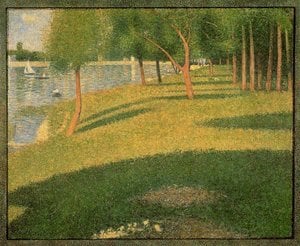
The Riverside
Størrelse på reproduktion
Georges Pierre Seurat (1859-1891) stands as a singular figure in the artistic landscape of late 19th century France, marking a decisive break from the prevailing Impressionist movement and establishing himself as one of the foremost innovators of Neo-Impressionism. His brief but extraordinarily productive career wasn’t merely about capturing fleeting moments of beauty; it was driven by an intellectual curiosity that sought to fundamentally reshape how artists understood and represented light and color—a quest that resulted in a revolutionary technique known as Pointillism.
Born in Paris amidst the burgeoning artistic fervor of his time, Seurat’s upbringing fostered a passion for art from a young age. His father, Antoine Chrysostome Seurat, possessed considerable means and encouraged Georges's education, exposing him to influential artists and fostering an appreciation for scientific observation. This meticulous approach would become the cornerstone of Seurat’s artistic vision.
Unlike Impressionists who blended colors on the canvas to create a unified impression of light, Seurat championed a radically different methodology. Inspired by Eugène Chevreuil and Henri Edmond Cros—fellow proponents of optical blending—he meticulously applied tiny dots of pure pigment onto the surface of the painting. This seemingly simple technique concealed a profound understanding of color theory derived from Helmholtz’s experiments on perception. Seurat believed that by stimulating the eye with individual colored dots, he could achieve greater luminosity and vibrancy than conventional brushstrokes alone.
"A Sunday Afternoon on La Grande Jatte," arguably Seurat's most celebrated masterpiece, exemplifies this groundbreaking approach. The painting depicts Parisians enjoying a leisurely afternoon picnic in Grenouillère Park—a scene brimming with activity and bathed in dappled sunlight. However, it’s not merely the depiction of a picturesque landscape that captivates viewers; it’s the astonishing precision of Seurat's Pointillist technique.
Beyond its technical brilliance, “La Grande Jatte” carries significant symbolic weight. The figures represent a microcosm of Parisian society—bourgeois families, artists, and intellectuals—engaged in social interaction amidst the tranquility of nature. Seurat’s deliberate composition aims to convey a sense of calm contemplation and intellectual curiosity, reflecting his own philosophical leanings.
Furthermore, the painting's muted color palette contributes to its emotional impact. Rather than striving for dramatic contrasts, Seurat employs subtle hues that evoke feelings of serenity and understated beauty. The luminous dots create an ethereal glow, enhancing the atmosphere and inviting viewers into a meditative state.
Georges Pierre Seurat’s untimely death at the age of 31 tragically curtailed his artistic career, yet his legacy endured—inspiring generations of artists who embraced Pointillism and Neo-Impressionism. Today, reproductions of “La Grande Jatte” continue to resonate with audiences worldwide, serving as a testament to Seurat's unwavering commitment to scientific rigor and his profound ability to transform visual perception. His work remains an enduring symbol of artistic innovation and the pursuit of beauty through meticulous observation.


1859 - 1891 , Frankrig

Explore the scientific brilliance of Seurat and Signac. Discover how Pointillism revolutionized color through optical mixing and light, offering a profound look into the Neo-Impressionist movement for true art connoisseurs and collectors.
Discover the mesmerizing world of Pointillism. Explore the revolutionary techniques of Georges Seurat, the science of optical color mixing, and the enduring legacy of Neo-Impressionism in this expert guide for classical art enthusiasts.
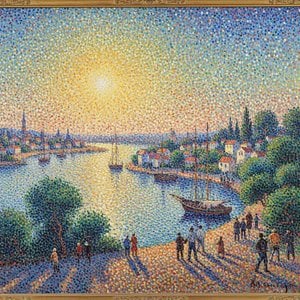
Embark on a sophisticated journey into the luminous world of Neo-Impressionism. Uncover the scientific brilliance of Pointillism, from Georges Seurat’s revolutionary color theory to the mesmerizing magic of the dot. An expert exploration for true art history enthusiasts.

 Se i fuld skala
 Del
Del Del
Del
 Detaljer

 Download
 Lignende værker
 Røntgenundersøgelse
 Diasshow

 Se mere







 Glasmulighed er kun tilgængelig i størrelser under 110 cm