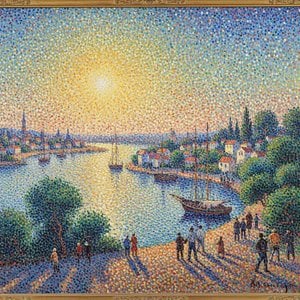
Georges Seurat’s ‘Study for Le Chahut’: A Glimpse into Parisian Frenzy
Georges Seurat's “Study for Le Chahut” offers a captivating, almost hallucinatory glimpse into the vibrant heart of late 19th-century Paris. Completed in 1890, this preparatory sketch isn’t merely a preliminary study; it’s a fully realized miniature world brimming with energy and meticulously constructed observation. It anticipates the grandeur of his final painting, “Le Chahut,” which depicted a lively dance hall scene, but here, we are granted an intimate preview – a concentrated distillation of the composition and its underlying scientific principles.
The image itself is dominated by a central female figure, poised mid-movement, her body angled towards the viewer with a captivating directness. Around her swirl other figures: musicians playing instruments—a violin prominent on the left, a guitar to the right—and onlookers absorbed in the performance. The scene isn’t chaotic; rather, it possesses an almost geometric order, reflecting Seurat's dedication to scientific rigor. He wasn’t simply capturing a moment of spontaneous joy; he was analyzing and reconstructing it through the lens of color theory and optical perception.
The Pointillist Technique: Science Meets Art
Seurat’s revolutionary approach, known as Pointillism or Neo-Impressionism, fundamentally altered the course of painting. Rejecting the blending of colors traditionally employed by Impressionists, Seurat advocated for applying tiny, distinct dots of pure color to a canvas. The viewer's eye, he believed, would then optically blend these colors together, creating a richer and more luminous effect than could be achieved through direct brushstrokes. “Study for Le Chahut” vividly demonstrates this technique; observe how the individual dots coalesce into broader areas of tone and hue – the warm reds and oranges of the stage lights, the cool blues and greens of the surrounding figures.
This wasn’t a random exercise in color manipulation. Seurat meticulously calculated the precise hues needed to achieve specific effects of light and shadow, drawing upon his studies of optics and color perception. He essentially treated painting as a scientific experiment, documenting his process with detailed notes and preparatory sketches like this one. The meticulousness is astonishing; each tiny dot represents hours of careful consideration.
Symbolism and the Parisian Scene
“Le Chahut” itself depicted a dance hall, a popular entertainment venue in late 19th-century Paris – a space where social hierarchies blurred and pleasure was openly celebrated. The figures within “Study for Le Chahut” represent this dynamic environment. While the central dancer commands attention, the musicians and onlookers contribute to a sense of collective experience. The instruments—the violin and guitar—are not merely decorative elements; they are integral to the scene’s musicality and atmosphere.
Furthermore, the composition subtly hints at the social stratification of the time. The figures in the foreground are more sharply defined, while those further back fade into a hazy abstraction. This creates a sense of depth and perspective, mirroring the tiered seating arrangements common in dance halls. The overall effect is both visually arresting and psychologically complex – a snapshot of Parisian life filtered through Seurat’s unique artistic vision.
A Reproduction for Your Space: Bringing ‘Le Chahut’ Home
WahooArt offers meticulously hand-painted reproductions of “Study for Le Chahut,” capturing the luminosity and precision of Seurat's original technique. Our artists recreate the delicate pointillist dots with exceptional skill, ensuring that every nuance of color and texture is faithfully reproduced. This artwork isn’t just a print; it’s an authentic representation of a pivotal moment in art history – a vibrant testament to Georges Seurat’s revolutionary approach to painting. Whether you're an art enthusiast, a collector seeking a significant addition to your collection, or simply someone looking for a captivating piece to enhance your interior space, our reproduction offers a beautiful and enduring connection to this extraordinary work.



 Se i fuld skala
 Køb håndlavet maleri
 Del
Del Del
Del
 Detaljer

 Download
 Lignende værker
 Røntgenundersøgelse
 Diasshow
 Stats
Stats

 Se mere






































 Glasmulighed er kun tilgængelig i størrelser under 110 cm