x
Se i fuld skalaSe i fuld skala AR-forhåndsvisningAR-forhåndsvisning Køb print Køb printKøb billede Køb billede DelDel
DetaljerDetaljer Tilføj til favoritter Tilføj til favoritter DownloadDownload Lignende værkerLignende værker RøntgenundersøgelseRøntgenundersøgelse DiasshowDiasshow

Angel

Discover Georg Pencz’s ‘Angel’ (1525) – a stunning Northern Renaissance masterpiece! Explore intricate details, gold leaf & symbolism in this 50x17cm wood panel painting from Cologne.

Explore the intricate engravings & portraits of Georg Pencz, a German artist influenced by Venetian art. Known as a 'Little Master,' his works depict biblical scenes & humanist subjects.

Håndlavet oliereproduktion

Håndmalet olie på lærred i din valgte størrelse og ramme, udført efter bestilling af vores kunstnere. (Køb print Køb printKøb billede Køb billede)

P118B $10
P118H $10
P118W $10
P438Z $10
P508JH $12
P508YH $12
P805H $10
P805Z $10
P919BZ $10
P919G $10
P919XJ $10
P959ZH $10
P968JZ $12
W106C $8
W218G $10
W218JH $8
W218Y $10
W307PJ $10
W316G $10
W316PJ $8
W316Y $10
W398PJ $8
W4111J $10
W500HY $15
W500JH $15
W692G $12
W849H $8
W940BG $15
W953PJ $8

Standard
custom
CM
INCH

Vælg mellem vores forudindstillede størrelser, der matcher kunstværkets originale proportioner.

bredde
højde

Du kan indtaste dine egne mål for at passe til en bestemt ramme eller plads. Hvis den valgte størrelse ikke stemmer overens med det originale billedes proportioner, vil vi enten beskære kunstværket eller udvide maleriet med yderligere håndmalede elementer. En digital skitse sendes til din godkendelse, før produktionen påbegyndes.
Bemærk venligst, at forhåndsvisningen på skærmen ikke afspejler den faktiske beskæring eller udvidelse. Kun skitsen vil nøjagtigt vise den endelige komposition.
Selvom specialmål er mulige, anbefaler vi at vælge en dimension fra den foruddefinerede liste for at bevare de originale proportioner.

Eksempler på hvad der kan ændres: Udskift ansigt med kundens eget foto; Tilføj kæledyr (f.eks. udskift kat med hund); Inkluder en skjult besked i baggrunden; Ændr baggrundslandskab eller elementer.
Efter bestilling vil WahooArt.com team sende en e-mail til kunden for at få instruktioner og levere et udkast til en skitse.

Levering i hele verden () på 3/4 uger i stedet for de standard 5 uger. (25 august). Ingen kompromiser med kvaliteten.

why_choose_icon
Gratis ekspresforsendelse til hele verden
why_choose_icon
Lærred af linned i høj kvalitet
why_choose_icon
Fuld transportforsikring
why_choose_icon
Garanti for refusion af told og importafgifter
why_choose_icon
Garanti for præcis farvegengivelse
why_choose_icon
60 dages returret (kun ved fabrikationsfejl)
why_choose_icon
100% Tilfredshedsgaranti
why_choose_icon
Mængderabat tilgængelig

Samlet pris

$ 272

reproduction

Angel

Reproduktionsmetode

Størrelse på reproduktion

-

Samlet pris

$ 272

Hurtige fakta

  • Movement: Northern Renaissance
  • Notable elements or techniques: Gold leaf, intricate detail, light and shadow
  • Influences: Italian Renaissance, Venetian art
  • Year: 1525
  • Medium: Oil on wood panel
  • Subject or theme: Purity, innocence, and divine grace
  • Location: Wallraf-Richartz-Museum, Cologne

Beskrivelse af kunstværket

A Celestial Vision in Gold: The Divine Grace of Georg Pencz

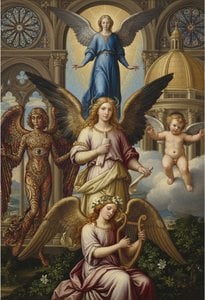
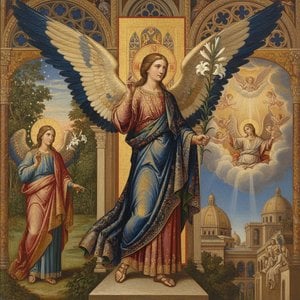
In the quiet corridors of the Wallraf-Richartz-Museum in Cologne, there exists a window into the spiritual fervor of the sixteenth century. Georg Pencz’s Angel, painted in 1525, is not merely a depiction of a celestial being; it is an intimate encounter with the divine. This slender, vertical masterpiece, measuring a delicate 50 x 17 cm, captures a moment of profound stillness and devotion. The composition centers on a kneeling angel, whose hands are clasped in eternal prayer, embodying a sense of humility that transcends the centuries. As the viewer’s eye travels across the wood panel, they are met with a breathtaking display of Northern Renaissance mastery, where every brushstroke serves to bridge the gap between the earthly and the heavenly.

The technical brilliance of Pencz is most evident in his sophisticated use of light and texture. Influenced by the vibrant energy of the Italian Renaissance and the meticulous precision of Nuremberg’s artistic circles, Pencz employs a technique that breathes life into the inanimate. The angel’s drapery falls in heavy, rhythmic folds, rendered with such care that one can almost feel the weight of the fabric. Most striking is the artist's use of gold leaf, which illuminates the halo and the expansive, feathered wings. This luminous element does more than provide opulence; it creates a celestial glow that seems to radiate from within the painting itself, casting soft highlights and deep shadows that lend a remarkable three-dimensional quality to the figure.

Symbolism and the Language of the Renaissance

Beyond its aesthetic splendor, the Angel is a profound tapestry of symbolic meaning. In the iconographic language of the 1500s, the angel serves as a messenger of purity and innocence, a sentinel of the divine realm. The inclusion of a delicate bouquet of flowers held by the figure introduces themes of hope, renewal, and the fleeting beauty of life. This interplay between the eternal (the angel) and the ephemeral (the flowers) invites a contemplative state in the observer, encouraging a reflection on one's own values and spiritual journey. The background, a swirling sky of blues and golds, provides an atmospheric perspective that suggests an infinite, heavenly expanse, further isolating the angel in a moment of sacred solitude.

For the discerning collector or interior designer, this artwork offers much more than visual decoration; it offers an atmosphere of serenity and historical depth. A high-quality oil reproduction of this piece brings with it the prestige of the Northern Renaissance, acting as a sophisticated focal point in any curated space. Whether placed in a quiet study to inspire meditation or within a grand gallery setting to showcase classical elegance, the Angel commands attention through its subtle complexity and emotional resonance. It remains a testament to Georg Pencz’s ability to capture the sublime, making it an enduring treasure for those who seek to surround themselves with art that speaks to the soul.


Kunstnerens biografi

A Life Etched in Renaissance Germany: The World of Georg Pencz

Georg Pencz, born around 1500 in the Franconian town of Bad Windheim, stands as a compelling figure within the German Renaissance—a master engraver, painter, and printmaker whose career unfolded against a backdrop of religious upheaval and artistic innovation. While precise details of his early life remain elusive, we know he embarked on a journey to Nuremberg around 1523, a city then pulsating with creative energy under the influence of Albrecht Dürer. Joining Dürer’s workshop proved pivotal; it was here that Pencz honed his skills and absorbed the technical brilliance that would define his own artistic path. However, Pencz wasn't merely an imitator. He possessed a unique sensibility, one deeply attuned to the changing currents of thought and expression sweeping across Europe. His travels extended beyond Nuremberg, notably including visits to Italy where he encountered the vibrant art of Venice—an experience that profoundly shaped his aesthetic vision.

The ‘Little Master’ and the Power of Printmaking

Pencz quickly established himself as a formidable talent in the burgeoning field of printmaking. In 1525, a dramatic turn of events saw him imprisoned alongside Barthel Beham and Hans Sebald Beham for their association with the radical religious reformer Thomas Müntzer. This shared experience forged a bond between the three artists, leading to their collective designation as the “Little Masters.” Despite their relatively small scale—their prints were often diminutive in size—these works exerted an enormous influence on subsequent generations of printmakers. Pencz’s engravings are characterized by their intricate detail, refined draftsmanship, and a keen observation of human character. He moved beyond traditional religious iconography, exploring secular themes and humanist subjects with a fresh perspective. His series *Six Triumphs of Petrarch* exemplifies this shift, showcasing scenes inspired by the Italian poet's sonnets—a testament to his engagement with classical literature and Renaissance ideals. The *Life of Christ*, comprising 26 plates, demonstrates his ability to narrate complex biblical stories with clarity and emotional depth.

Beyond the Engraving: Painting and Trompe-l’œil Illusion

While celebrated primarily as an engraver, Pencz was also a skilled painter. He became particularly renowned for his *trompe-l'œil* ceiling paintings in Nuremberg—optical illusions designed to deceive the eye into perceiving three-dimensional space where none existed. One surviving drawing depicts a scene of workmen raising building materials on a hoist against an open sky, creating the impression that the room was still under construction. These works reveal Pencz’s mastery of perspective and his playful engagement with illusionism—a technique favored by Renaissance artists seeking to blur the boundaries between art and reality. His portraits, executed with meticulous detail and psychological insight, further demonstrate his versatility as a painter. Works like *Portrait of a Young Man*, *Portrait of Marshal Schirmer*, and *Portrait of Erhard Schwetzer and his wife* capture the individuality and social standing of their sitters with remarkable sensitivity.

A Courtly Appointment and Lasting Legacy

In 1539, Pencz briefly returned to Italy, visiting Rome for the first time before returning to Nuremberg in 1540. This period marked a turning point in his career; he was appointed city painter and achieved significant success as a portraitist. His reputation continued to grow, culminating in his appointment as court painter by Albert, Duke of Prussia, in 1550. Sadly, Pencz died in Leipzig the same year, before he could take up his new position. Despite his relatively short life, Georg Pencz left an indelible mark on German art. He bridged the gap between the late Gothic tradition and the emerging styles of the High Renaissance, blending technical precision with humanist ideals and a keen understanding of human psychology. His prints continue to captivate viewers with their intricate detail and expressive power, while his paintings offer a glimpse into the lives and sensibilities of 16th-century Germany.

Historical Significance and Rediscovery

The story of Georg Pencz is not without its shadows. In March 1939, during the Nazi regime, his painting *Young Couple in a Landscape* was seized from the Jewish collector Arthur Feldmann, who tragically perished in the Holocaust. The artwork resurfaced at Sotheby’s in 1946 and eventually found its way into the collection of Rosi Schilling, who generously donated it to the British Museum. In 2013, after years of research and advocacy, the museum settled a claim for Nazi spoliation from Feldmann's grandson, returning the painting to his rightful heirs—a poignant reminder of the enduring importance of restitution and the preservation of cultural heritage. Today, Georg Pencz is recognized as one of the most important German artists of the Renaissance, his works held in major museums and collections worldwide. His legacy continues to inspire artists and scholars alike, ensuring that his name will be etched forever in the annals of art history.
Georg Pencz

Georg Pencz

1500 - 1550 , Germany

Kort om kunstneren

  • Artistic Movement Or Style: High Renaissance
  • Artists Or Movements Influenced By This Artist: ['Da Vinci family']
  • Artists Who Influenced This Artist: ['Andrea del Verrocchio']
  • Date Of Birth: April 15, 1452
  • Date Of Death: May 2, 1519
  • Full Name: Leonardo di ser Piero da Vinci
  • Nationality: Italian
  • Notable Artworks:
    • Mona Lisa
    • The Last Supper
    • Vitruvian Man
  • Place Of Birth: Vinci, Italy