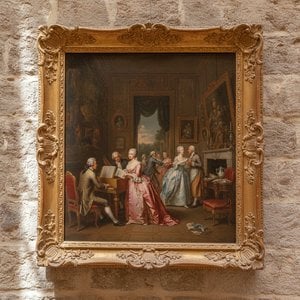
A Moment of Domestic Harmony: Franz Ludwig Catel’s “First Steps”
Franz Ludwig Catel's "First Steps," painted around 1820-25, is more than just a charming depiction of a young child taking its first tentative steps; it’s a poignant meditation on continuity and the enduring promise of family within the evolving landscape of post-revolutionary Europe. This idyllic scene, rendered in rich oil paints, transports us to a sun-drenched courtyard in rural Italy – a setting deliberately chosen by Catel to evoke the classical ideals of harmony and balance, subtly contrasting with the turbulent social shifts occurring across the continent.
The painting’s subject matter—a young girl supported by her mother as she embarks on this momentous occasion—resonates deeply with a popular genre theme of the early 19th century. Following the upheaval of the French Revolution, there was a widespread desire for stability and a return to traditional values. Families, representing the bedrock of society, became potent symbols of reassurance and continuity. Catel masterfully captures this sentiment, presenting a scene that feels both timeless and remarkably contemporary. The peasant family depicted isn’t idealized in an overly romanticized way; rather, they are presented with a quiet dignity and warmth, embodying a sense of groundedness and connection to the land.
A Neoclassical Composition: Light, Space, and Detail
Catel's technical skill is immediately apparent in his masterful use of light and shadow. The scene is bathed in a warm, golden glow, suggesting an idyllic afternoon. He employs a carefully orchestrated interplay of light to highlight the central figures – the mother and child – while subtly receding into the background, creating a sense of depth and spatial awareness. The architectural details—the simple yet sturdy walls of the courtyard, the arched doorway hinting at a larger space beyond—are rendered with meticulous precision, reflecting Catel’s training in the École des Beaux-Arts in Paris.
Notice also the attention to detail in the depiction of everyday objects: the two chairs positioned invitingly, the bowl containing fruit or vegetables – these elements ground the scene in a tangible reality. The artist's brushwork is smooth and refined, contributing to the overall sense of serenity and order. The color palette is restrained yet vibrant, dominated by earthy tones—ochres, browns, and greens—that evoke the warmth of the Italian countryside.
Symbolism and Historical Context
The choice of an Italian setting is significant. Italy, with its ancient ruins and enduring traditions, represented a romanticized vision of antiquity for many European artists and intellectuals during this period. Catel’s work subtly references this fascination with the classical past, suggesting a connection between the present family and the timeless values embodied by the ancients. The inclusion of a contemporary peasant family within this idyllic setting serves as a deliberate contrast to the aristocratic ideals that had been challenged by the revolution. It suggests a belief in the inherent goodness and stability of the common people.
Furthermore, Catel’s work aligns with François Gérard's “Ages of Man,” a monumental Salon painting from 1808 at the Louvre Museum. While sharing the Italian setting, "First Steps" updates Gérard’s antique dress by depicting a contemporary peasant family, offering a more immediate and relatable portrayal of human experience. This subtle shift in perspective reflects a broader trend in art during this period—a move away from purely mythological subjects towards scenes of everyday life.
A Legacy of Italian Influence
"First Steps" is a testament to Franz Ludwig Catel’s artistic journey, beginning with his training in Berlin and culminating in his embrace of the Neoclassical style while living in Rome. The painting embodies the spirit of the era—a desire for stability, harmony, and connection to both tradition and nature. It's a beautiful reminder that even the smallest moments – a child’s first steps – can hold profound significance, representing not only personal growth but also the enduring promise of family and continuity within a changing world. Reproductions of this evocative work capture its warmth and timeless appeal, making it a cherished addition to any collection or interior space.
Spørgsmål & svar
Hvor bør en reproduktion af "First Steps" af Franz Ludwig Catel hænges op?
Formatet Portrait til "First Steps" af Franz Ludwig Catel anbefales til en Living Room. Format og rumstørrelse er tilsammen vejledende for placeringen af en reproduktion.
Fra hvilket land stammer Neoclassicism-værket "First Steps"?
"First Steps" blev skabt af Franz Ludwig Catel, født i Germany, inden for Neoclassicism-bevægelsen. Kunstnerens oprindelse forbinder værket med Neoclassicism, som det praktiseres af kunstnere fra Germany.
Hvilken anvendelse og hvilket rum anbefales til "First Steps" af Franz Ludwig Catel?
Anvendelse (Harmony) og placering (Living Room) er de to anbefalinger, der er angivet for "First Steps" af Franz Ludwig Catel.



 Se i rummet
 Skift til printversion
 Send
Send Del
Del
 Detaljer
 Studieguide til kunstværker

 Download
 Lignende værker
 Røntgenundersøgelse
 Se diasshow
 Statistik


 Læs mere






































 Glasmulighed er kun tilgængelig i størrelser under 110 cm