x
Giclée- eller lærredstryk i museumskvalitet med hurtig produktion og fleksible muligheder for finish.
Vælg mellem vores forudindstillede størrelser, der matcher kunstværkets originale proportioner.
Du kan indtaste dine egne mål for at passe til en specifik ramme eller et bestemt område. Hvis den valgte størrelse ikke stemmer overens med det originale billedes proportioner, vil vi enten beskære kunstværket eller udvide billedet med en spejlet eller ensfarvet kant. En digital mockup vil blive sendt til din godkendelse, før produktionen påbegyndes.
Bemærk venligst, at forhåndsvisningen på skærmen ikke afspejler den faktiske beskæring eller udvidelse. Kun mockuppen vil nøjagtigt vise den endelige komposition.
Selvom specialmål er tilgængelige, anbefaler vi at vælge et mål fra den foruddefinerede liste for at bevare de originale proportioner.

Verdensomspændende levering () på 2 uger i stedet for de sædvanlige 4/5 uger. (2 juli)
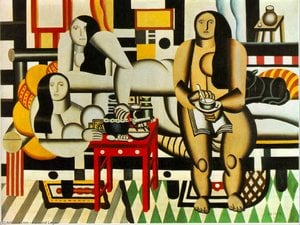
Study for the two lovers
Størrelse på reproduktion
Fernand Léger's "Study for the Two Lovers," created in 1955, offers a captivating window into the artist’s evolving vision of modern life and human connection. This deceptively simple drawing, rendered primarily in bold black ink on white paper, transcends its modest scale to reveal a complex interplay of geometric abstraction, psychological observation, and a subtle yearning for intimacy – hallmarks of Léger's distinctive artistic language. Born amidst the rural landscapes of Argentan, Normandy, Léger’s journey from agricultural labor to Parisian avant-garde circles shaped his unique approach to art, one that sought not to replicate reality but to distill its essence into fundamental forms and expressive lines.
The composition itself is remarkably restrained. Two figures – a man and a woman – occupy the central space, their bodies subtly overlapping in a pose suggesting both closeness and separation. Léger deliberately eschews traditional perspective, flattening the scene and prioritizing the interplay of shapes and lines. The man, distinguished by a hat that hints at urbanity, leans slightly towards the woman, while she holds a single flower—a potent symbol of beauty, fragility, and perhaps even lost innocence. Behind them, an abstract landscape unfolds, composed of undulating curves and geometric blocks, reminiscent of both rolling hills and the mechanized forms that increasingly dominated Léger’s artistic vision. This juxtaposition – the organic and the machine-made – is a recurring motif in his work, reflecting his fascination with the changing relationship between humanity and technology.
What immediately strikes the viewer is Léger's masterful use of line. Bold, thick black lines delineate every contour—the figures’ bodies, the landscape’s forms, even the implied edges of the paper itself. These lines aren’t used to create realistic shading or detail; instead, they function as graphic building blocks, defining shapes and creating a sense of immediacy and dynamism. The angularity of these lines contributes to the overall feeling of modernity—a deliberate rejection of the rounded curves favored by earlier Impressionists in favor of the sharp edges of the industrial age. The simplification of forms, bordering on abstraction, mirrors Léger’s broader exploration of essential shapes and their inherent expressive power.
Beyond its formal qualities, “Study for the Two Lovers” resonates with a quiet emotional depth. The stark contrast between black and white amplifies the sense of isolation and introspection, while the single flower—a delicate counterpoint to the geometric forms—suggests a longing for connection and beauty in an increasingly mechanized world. Léger’s work from this period reflects a broader cultural shift – a move away from romanticized notions of love towards a more pragmatic and perhaps even detached observation of human relationships. The figures, rendered with a certain anonymity, invite viewers to project their own interpretations onto the scene, making it a powerful meditation on intimacy, loss, and the search for meaning in modern life.
Created in 1955, this drawing exemplifies Léger’s evolution from his early “tubist” period to a more mature style characterized by geometric simplification and bold lines. Influenced by Cubism but distinct in its emphasis on form over representation, Léger's work anticipated the rise of Pop Art, demonstrating a willingness to engage with modern subject matter—from machines and factories to everyday objects—and to explore their aesthetic potential. This “Study for the Two Lovers” offers a rare glimpse into the mind of a visionary artist who profoundly shaped the course of 20th-century art.
WahooArt is proud to offer meticulously crafted hand-painted reproductions of Fernand Léger’s "Study for the Two Lovers." These reproductions capture not only the artwork's striking visual impact but also its underlying emotional resonance, allowing you to bring this iconic piece into your home or office. Explore our range of sizes and canvas options to find the perfect representation for your space – a testament to Léger’s enduring legacy and a celebration of modern art’s timeless appeal.
1881 - 1955 , Frankrig
Fortæl os om dit projekt, og vores kunsteksperter vil give dig 3 personlige kunstforslag.
Vi kuraterer 3 valgmuligheder kun til dig – Gratis!