x
Se i fuld skalaSe i fuld skala AR-forhåndsvisningAR-forhåndsvisning Køb print Køb printKøb billede Køb billede DelDel
DetaljerDetaljer Tilføj til favoritter Tilføj til favoritter DownloadDownload Lignende værkerLignende værker RøntgenundersøgelseRøntgenundersøgelse DiasshowDiasshow

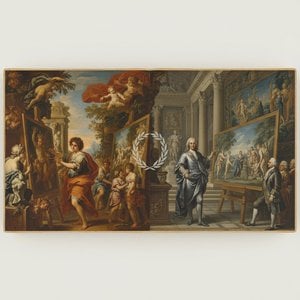
The Two Coaches

Explore Claude Gillot’s dramatic Baroque masterpiece ‘The Two Coaches,’ depicting a public execution with masterful technique and emotion—a poignant scene captured in the Louvre.

Explore Claude Gillot (1673-1722), master of Watteau & Lancret! French painter, printmaker, & theater designer known for fêtes champêtres & commedia dell’arte scenes.

Håndlavet oliereproduktion

Håndmalet olie på lærred i din valgte størrelse og ramme, udført efter bestilling af vores kunstnere. (Køb print Køb printKøb billede Køb billede)

P118B $10
P118H $10
P118W $10
P438Z $10
P508JH $12
P508YH $12
P805H $10
P805Z $10
P919BZ $10
P919G $10
P919XJ $10
P959ZH $10
P968JZ $12
W106C $8
W218G $10
W218JH $8
W218Y $10
W307PJ $10
W316G $10
W316PJ $8
W316Y $10
W398PJ $8
W4111J $10
W500HY $15
W500JH $15
W692G $12
W849H $8
W940BG $15
W953PJ $8

Standard
custom
CM
INCH

Vælg mellem vores forudindstillede størrelser, der matcher kunstværkets originale proportioner.

bredde
højde

Du kan indtaste dine egne mål for at passe til en bestemt ramme eller plads. Hvis den valgte størrelse ikke stemmer overens med det originale billedes proportioner, vil vi enten beskære kunstværket eller udvide maleriet med yderligere håndmalede elementer. En digital skitse sendes til din godkendelse, før produktionen påbegyndes.
Bemærk venligst, at forhåndsvisningen på skærmen ikke afspejler den faktiske beskæring eller udvidelse. Kun skitsen vil nøjagtigt vise den endelige komposition.
Selvom specialmål er mulige, anbefaler vi at vælge en dimension fra den foruddefinerede liste for at bevare de originale proportioner.

Eksempler på hvad der kan ændres: Udskift ansigt med kundens eget foto; Tilføj kæledyr (f.eks. udskift kat med hund); Inkluder en skjult besked i baggrunden; Ændr baggrundslandskab eller elementer.
Efter bestilling vil WahooArt.com team sende en e-mail til kunden for at få instruktioner og levere et udkast til en skitse.

Levering i hele verden () på 3/4 uger i stedet for de standard 5 uger. (26 august). Ingen kompromiser med kvaliteten.

why_choose_icon
Gratis ekspresforsendelse til hele verden
why_choose_icon
Lærred af linned i høj kvalitet
why_choose_icon
Fuld transportforsikring
why_choose_icon
Garanti for refusion af told og importafgifter
why_choose_icon
Garanti for præcis farvegengivelse
why_choose_icon
60 dages returret (kun ved fabrikationsfejl)
why_choose_icon
100% Tilfredshedsgaranti
why_choose_icon
Mængderabat tilgængelig

Samlet pris

$ 272

reproduction

The Two Coaches

Reproduktionsmetode

Størrelse på reproduktion

-

Samlet pris

$ 272

Hurtige fakta

  • Medium: Oil on canvas
  • Location: Louvre Museum
  • Title: The Two Coaches
  • Notable elements or techniques: Dramatic execution; Stage-like realism.
  • Artist: Claude Gillot
  • Subject or theme: Public execution
  • Dimensions: 127 x 160 cm

Kunstquiz

Der er kun ét korrekt svar på hvert spørgsmål.

Spørgsmål 1:
What is the primary subject matter depicted in Claude Gillot’s ‘The Two Coaches’?
Spørgsmål 2:
The painting utilizes what artistic style, characterized by delicate pastel hues and idealized forms?
Spørgsmål 3:
Approximately when was Claude Gillot’s ‘The Two Coaches’ created?
Spørgsmål 4:
Where is ‘The Two Coaches’ currently housed?
Spørgsmål 5:
What artistic technique did Gillot employ to convey intense emotion and drama in this painting?

Beskrivelse af kunstværket

Claude Gillot’s ‘The Two Coaches’: A Baroque Tableau of Justice and Spectacle

Claude Gillot’s “The Two Coaches” (1707), housed in the Louvre Museum, stands as a masterful exemplar of late Baroque painting—a genre characterized by dramatic lighting, opulent costumes, and an intense focus on theatrical presentation. More than just a depiction of a public execution, it's a carefully constructed visual narrative that speaks volumes about the anxieties and aspirations of Louis XIV’s court.

The scene unfolds in a bustling Parisian street, rendered with Gillot’s signature pastel technique—a hallmark of his collaboration with Watteau and Lancret. The artist eschews the idealized landscapes favored by his contemporaries, opting instead for gritty realism to heighten the emotional impact. Observe how Gillot captures the palpable tension surrounding the impending demise of Jean-Baptiste Colbert, Louis XIV's influential minister of finance.

Gillot’s meticulous attention to detail is evident in every brushstroke. The figures are sculpted with remarkable precision, conveying a sense of movement and immediacy. Note the masterful use of chiaroscuro—the dramatic interplay between light and shadow—which sculpts the faces of the onlookers and emphasizes the solemnity of the event. This technique wasn’t merely decorative; it served to heighten the psychological drama, mirroring the internal turmoil experienced by those witnessing the spectacle.

  • Subject Matter: The painting portrays Jean-Baptiste Colbert's execution following a trial for treason—a controversial decision that ignited considerable debate within Parisian society.
  • Style: Gillot’s style aligns perfectly with Watteau and Lancret’s “fête champêtre,” prioritizing psychological realism over idealized beauty.
  • Technique: Pastel technique combined with chiaroscuro creates a visually arresting image, emphasizing emotional intensity and dramatic lighting.
  • Historical Context: The painting reflects the turbulent political climate of Louis XIV's reign—a period marked by religious persecution and royal absolutism.
  • Symbolism: The execution serves as a potent symbol of justice and authority—demonstrating the king’s unwavering commitment to upholding his power, even in matters of conscience.

“The Two Coaches” transcends mere representation; it invites contemplation on themes of morality, governance, and the human condition. Gillot's ability to convey profound emotion through subtle visual cues cements its place as a cornerstone of Baroque art—a testament to his artistic genius and enduring legacy.

Consider how this artwork might inspire interior designers seeking to evoke grandeur and drama within their spaces. Its muted palette, combined with the dramatic lighting effects captured by Gillot, creates an atmosphere of restrained elegance that speaks to the sensibilities of discerning tastes.


Kunstnerens biografi

The Architect of Baroque Splendor

Claude Gillot (1673–1722) remains a luminous figure in the tapestry of late Baroque France, an artist whose versatile hand touched nearly every facet of the visual culture of his era. Born in the historic town of Langres, north of Dijon, Gillot’s early creative impulses were nurtured by his father before he ventured to Paris to refine his craft. His artistic journey was far from linear; he was a true polymath of the arts, moving with ease between the delicate precision of printmaking, the structural demands of metalworking, and the grand-scale imagination required for theatrical design. This multidisciplinary foundation allowed him to approach the canvas not merely as a surface for pigment, and but as a stage where light, movement, and drama could converge.

The trajectory of Gillot’s career was profoundly shaped by his apprenticeship under the legendary Jean Watteau around 1703. From Watteau, he absorbed the ethereal qualities of the emerging fête champêtre style—a genre characterized by pastoral elegance and aristocratic leisure. Yet, while he inherited this delicate sensibility, Gillot infused it with a unique vigor derived from his work in the Parisian theater. His extensive collaborations with playwrights and composers to design elaborate sets and costumes for operas and comedies instilled in him a mastery of visual storytelling. He understood how to direct the viewer's eye through composition, using the theatricality of costume and scenery to breathe life into mythological and contemporary narratives alike.

A Mastery of Myth and Motion

Gillot’s ascent within the prestigious Académie Royale de peinture et de sculpture in 1715 marked a definitive moment in his professional life, signaling his recognition as a master of monumental composition. His breakthrough was anchored by works that celebrated the grandeur of classical antiquity through a contemporary lens. In masterpieces such as “Feast of Pan” and “Feast of Bacchus,” Gillot demonstrated an extraordinary ability to blend the divine with the terrestrial. These canvases were not merely depictions of myth; they were sensory experiences, where the lushness of the landscape met the exuberant energy of mythological revelry.

His technique was characterized by a sophisticated use of color and form that could shift from the soft, dreamlike textures reminiscent of his mentor to a more robust, dramatic Baroque intensity. This versatility allowed him to capture the very essence of the commedia dell’arte, bringing the wit and character of masked performers to life with a sense of spontaneous motion. Through his engravings and paintings, he documented the social graces and theatrical whimsies of the French court, creating a visual record that was as much about the spirit of the age as it was about the subjects themselves.

Legacy of the Rococo Prelude

As the art world began to transition from the heavy grandeur of the Baroque toward the lighter, more intimate aesthetics of the Rococo, Gillot’s influence remained foundational. He served as a vital bridge between generations, influencing later masters such as Lancret by refining the vocabulary of pastoral scenes and theatrical character studies. His ability to marry the structural discipline of classical painting with the whimsical charm of the stage helped define the aesthetic sensibilities of the early 18th century.

Today, the significance of Claude Gillot lies in his role as a creator of atmosphere. Whether through the intricate lines of a print or the sweeping vistas of a mythological feast, his work continues to evoke the vibrant, theatrical pulse of pre-revolutionary France. He remains an artist whose legacy is found not just in individual masterpieces, but in the very way we perceive the intersection of art, theater, and the beautiful artifice of life.

Claude Gillot

Claude Gillot

1673 - 1722 , France

Kort om kunstneren

  • Artistic Movement Or Style: Baroque
  • Artists Who Influenced This Artist:
    • Jean Watteau
    • Nicolas Lancret
  • Date Of Birth: 1673
  • Date Of Death: 1722
  • Full Name: Claude Gillot
  • Nationality: French
  • Notable Artworks:
    • The Two Coaches
    • Garment time of night
    • Italian Comedians
  • Place Of Birth: Langres, France
Udforsk kunstværker organiseret efter temaer, stilarter og karakteristika.