


x

 Bestil tryk Køb højopløseligt billede
 Del
Del
 Detaljer
 Tilføj til favoritter
 Download
 Lignende værker
 Røntgen
 Diasshow
 148.0 x 33.0 cm
 Horim Museum
Håndmalet olie på lærred i din valgte størrelse og ramme, udført efter bestilling af vores kunstnere.
Vælg mellem vores forudindstillede størrelser, der matcher kunstværkets originale proportioner.

Du kan indtaste dine egne mål for at passe til en bestemt ramme eller plads. Hvis den valgte størrelse ikke stemmer overens med det originale billedes proportioner, vil vi enten beskære kunstværket eller udvide maleriet med yderligere håndmalede elementer. En digital skitse sendes til din godkendelse, før produktionen påbegyndes.
Bemærk venligst, at forhåndsvisningen på skærmen ikke afspejler den faktiske beskæring eller udvidelse. Kun skitsen vil nøjagtigt vise den endelige komposition.
Selvom specialmål er mulige, anbefaler vi at vælge en dimension fra den foruddefinerede liste for at bevare de originale proportioner.
Levering i hele verden () på 3/4 uger i stedet for de standard 5 uger. (6 juli). Ingen kompromiser med kvaliteten.


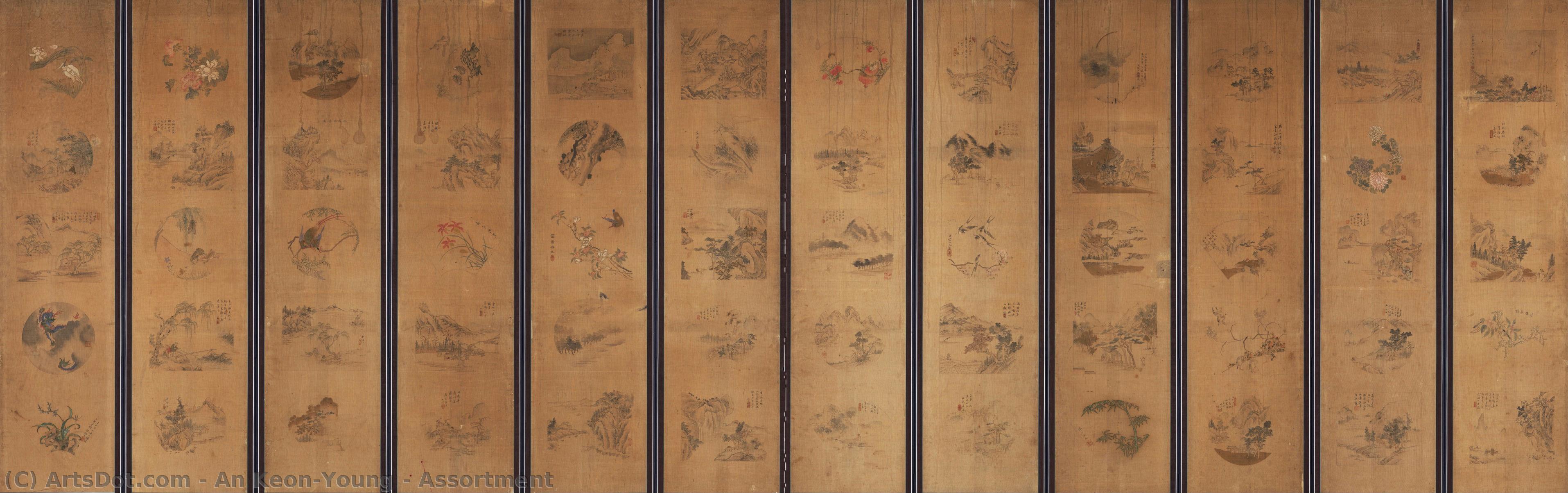
Assortment
Størrelse på reproduktion
An Keon-Young (1841-1876) emerged from the vibrant tapestry of late Joseon Dynasty Korea, a period marked by both artistic flourishing and increasing Western influence. Born into a family deeply rooted in traditional Korean art practices – particularly court painting and textile design – his early life was shaped by a confluence of cultural heritage and nascent artistic curiosity. While biographical details remain somewhat fragmented, historical records suggest he began his artistic journey as a student under the tutelage of prominent figures within the Korean art establishment. His initial training focused on mastering the intricate techniques of traditional Korean painting styles, absorbing the meticulous detail and symbolic language inherent in these established forms. Simultaneously, he demonstrated an early aptitude for textile arts, specifically embroidery and silk weaving – skills that would become central to his distinctive artistic style.
Keon-Young’s most celebrated work, "Assortment," represents a pivotal moment in his artistic development – a bold departure from traditional Korean painting while retaining its core aesthetic values. Created around 1870, this large-scale folding screen embodies a remarkable synthesis of Eastern and Western influences. Unlike the static, formalized compositions typical of court paintings, “Assortment” is characterized by dynamic movement, vibrant color palettes, and an innovative use of space. The screen’s design incorporates a diverse array of motifs – landscapes, flowers, birds, plants, and even aquatic creatures – each rendered in miniature vignettes framed within meticulously crafted borders. This deliberate juxtaposition of subjects creates a sense of visual abundance and playful exploration.
Crucially, Keon-Young's technique involved directly painting onto the silk screen itself, rather than adhering separate panels afterward—a revolutionary approach at the time. This method allowed for an unprecedented level of integration between design and execution, resulting in a seamless and unified visual experience. The use of light colors on silk is also notable, creating a luminous quality that contrasts sharply with the darker tones often associated with traditional Korean painting.
Despite his deep roots in Korean artistic tradition, Keon-Young’s work reveals a clear engagement with Western art movements, particularly Impressionism and Japonisme. The influence of these styles is evident in the loose brushwork, emphasis on capturing fleeting moments of light, and incorporation of Western compositional techniques. Notably, there are parallels between “Assortment” and the works of European landscape painters like Claude Monet, who similarly sought to capture the ephemeral qualities of nature through vibrant color and atmospheric effects. Furthermore, the decorative elements within the screen—the intricate borders and miniature vignettes—echo the aesthetic sensibilities of Japanese woodblock prints (Japonisme), which were gaining popularity in Europe during this period.
An Keon-Young’s “Assortment” stands as a testament to the dynamism and creativity of Korean art during a period of profound cultural change. His innovative approach to silk painting, blending traditional techniques with Western influences, challenged established artistic conventions and paved the way for future generations of Korean artists. While his life was tragically cut short at the age of 35, his work continues to be celebrated as a masterpiece of Korean art—a vibrant expression of both cultural heritage and artistic vision. His legacy is preserved through exhibitions at institutions like the Young Gallery in Salisbury, England, where “Assortment” remains a centerpiece of its collection, offering visitors a glimpse into the remarkable artistry of this often-overlooked figure.

United States of America


Hold dig opdateret med de seneste kunstnyheder, eksklusive tilbud og indretningsideer.
Fortæl os om dit projekt, og vores kunsteksperter vil give dig 3 personlige kunstforslag.
Vi kuraterer 3 valgmuligheder kun til dig – Gratis!
 Del
Del

 Se mere




































 Glasmulighed er kun tilgængelig i størrelser under 110 cm


