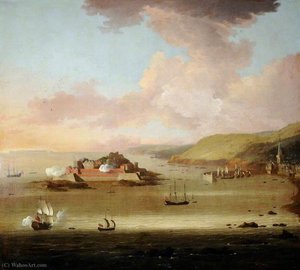
Peter Monamy, 1681 – 1749

Peter Monamy: De 71 mest berømte malerier

The Opening of the First Eddystone Lighthouse in 1698 (1703) er det mest berømte maleri af Peter Monamy, som er i Yale Center for British Arts samling i New Haven. Shipping in a Calm (1712) og Royal Yacht Becalmed at Anchor (1720) er de næste to værker, som verden kender bedst. Udvalgt fra de 72 værker af Peter Monamy i vores katalog er her de 71, som samlere og museumsgæster oftest opsøger, inklusiv årstal, museum og historien bag hvert værk.

Rangordnet efter vores popularitetsscore, som kombinerer søgninger, besøg og ordrer for hvert værk. Opdateret oktober 2026. Hvert mesterværk på denne side kan bestilles som en håndmalet oliereproduktion i museumskvalitet eller som et kunsttryk i den størrelse, du vælger.

Portræt af Peter Monamy
Peter Monamy · 1681 – 1749
Født · død
1681 – 1749, London
Bevægelse
Neoclassicism
Værker i vores katalog
72
Mest kendte
The Opening of the First Eddystone Lighthouse in 1698 (1703)
Flest værker hos
National Maritime Museum

Top 10: Peter Monamys mest kendte malerier

Resten af Peter Monamy-ranglisten, fra 11 til 71

Peter Monamys malerier efter periode

De motiver Peter Monamy malede mest

De fire motiver, der optræder hyppigst blandt disse mesterværker, med det fineste eksempel på hvert enkelt.

Hvor kan man se Peter Monamy's malerier

De 8 museer, der rummer flest af malerierne på denne side.

Museum By Værker af Peter Monamy Malerier fra denne liste
National Maritime Museum, LondonNational Maritime Museum London 19 Three English Flagships Becalmed, The Capture of Louisburg, 28 June 1745, The Burning of HMS Royal James at the Battle of Solebay, 28 May 1672
Yale Center for British Art, New HavenYale Center for British Art New Haven 6 The Opening of the First Eddystone Lighthouse in 1698, Shipping in a Calm, Royal Yacht Becalmed at Anchor
Felbrigg Hall, NorwichFelbrigg Hall Norwich 1 Four British Warships and a Fishing-smack in a Strong Wind
Ardress HouseArdress House 1 Stormy Seascape
Royal Collection, LondonRoyal Collection London 1 A Calm with a Royal Yacht Firing a Salute
Antony HouseAntony House 1 A Naval Engagement between an English Ship and Barbary Ships
Nationalmuseet i Warszawa, WarszawaNationalmuseet i Warszawa Warszawa 1 Ships on the sea
Metropolitan Museum of Art, New YorkMetropolitan Museum of Art New York 1 Harbor Scene: An English Ship with Sails Loosened Firing a Gun

Peter Monamy gennem årtierne: et mesterværk for hvert årti

  1. 1700s
  2. 1710s
  3. 1720s
  4. 1730s

Peter Monamys malerier: ofte stillede spørgsmål

Hvad er det mest berømte maleri af Peter Monamy?Vis svaret

The Opening of the First Eddystone Lighthouse in 1698 (1703), Yale Center for British Art, New Haven. Derefter følger Shipping in a Calm (1712) og Royal Yacht Becalmed at Anchor (1720).

Hvilken alder havde Peter Monamy, da The Opening of the First Eddystone Lighthouse in 1698 blev malet?Vis svaret

22 år gammel: The Opening of the First Eddystone Lighthouse in 1698 er fra 1703, og Peter Monamy blev født i 1681.

Hvilke er de 10 mest berømte Peter Monamy malerier?Vis svaret

The Opening of the First Eddystone Lighthouse in 1698, Shipping in a Calm, Royal Yacht Becalmed at Anchor, An Evening Calm, Four British Warships and a Fishing-smack in a Strong Wind, Stormy Seascape, Three English Flagships Becalmed, A Calm with a Royal Yacht Firing a Salute, An English Royal Yacht Standing Offshore in a Calm og British Men-of-War and a Sloop. Ranglisten ovenfor angiver årstallet og museet for hver af dem.

Hvor mange malerier af Peter Monamy er der?Vis svaret

Vores katalog indeholder 72 værker af Peter Monamy, dateret fra 1703 til 1730.

Hvor kan jeg se de mest berømte Peter Monamy malerier?Vis svaret

De fleste af dem findes i National Maritime Museum (London), Yale Center for British Art (New Haven) og Felbrigg Hall (Norwich). Tabellen ovenfor lister museerne enkeltvis.

I hvilken periode malede Peter Monamy sine mest kendte værker?Vis svaret

I 1720s: 7 af de 71 værker på denne side stammer fra denne periode, herunder Royal Yacht Becalmed at Anchor.

Hvad er det tidligste berømte maleri af Peter Monamy, og hvad er det nyeste?Vis svaret

Det tidligste på denne side er The Opening of the First Eddystone Lighthouse in 1698 (1703), det seneste An English Royal Yacht Standing Offshore in a Calm (1730).

Hvilke motiver malede Peter Monamy?Vis svaret

Wars (15), Men (13) og 18th century (9), blandt de 71 værker på denne side.

Hvilken stilart tilhører Peter Monamys kunst?Vis svaret

Neoclassicism, som malerierne på denne side viser.

Hvilke malerier af Peter Monamy har National Maritime Museum i sin samling?Vis svaret

Three English Flagships Becalmed, The Capture of Louisburg, 28 June 1745 og The Burning of HMS Royal James at the Battle of Solebay, 28 May 1672 er blandt de 19 værker på denne side, som er i National Maritime Museum, London's samling.

Hvor kan jeg købe en Peter Monamy reproduktion?Vis svaret

Ja. Hvert maleri på denne side kan bestilles som en håndmalet oliereproduktion i museums kvalitet eller som et kunstprint i den størrelse, du ønsker, direkte fra maleriets egen side.

Peter Monamy: biografi

A Life Immersed in the Maritime World

Peter Monamy, born in London in 1681, occupies a pivotal position in the development of English marine painting. He wasn’t merely a recorder of ships and seascapes; he was a chronicler of an era—an age defined by Britain's burgeoning naval power and its expanding global reach. His life, deeply intertwined with the maritime world through familial connections to Guernsey in the Channel Islands, instilled within him a lifelong fascination with all things nautical. This wasn’t simply aesthetic appreciation; it was an intimate understanding born from heritage and observation. Monamy didn’t just paint ships, he understood them—their construction, their function, and the lives of those who sailed upon them.

From Decorative Arts to Masterful Seascapes

Monamy's artistic journey began with a solid grounding in the decorative arts. At fifteen years old, he was apprenticed to William Clark, a master painter-stainer specializing in interior decoration and ornamental painting. This apprenticeship wasn’t confined to narrow specialization; it encompassed overdoor paintings, overmantels, and even large-scale house murals—a broad education that honed his technical skills and exposed him to diverse artistic challenges. Significantly, he shared this workshop with James Thornhill, who would later achieve renown as a historical painter, indicating the high caliber of Clark’s tutelage. This early experience in decorative painting likely informed Monamy's meticulous attention to detail and his ability to create visually compelling compositions. It provided him with a foundation upon which he could build his unique style, moving beyond mere ornamentation towards capturing the dynamism and drama of life at sea. The influence of earlier Dutch masters, particularly the Van de Veldes—renowned for their realistic maritime depictions—is evident in Monamy’s work, but he wasn't simply an imitator; he synthesized these influences with his own keen observation and artistic sensibilities.

Capturing the Essence of Naval Life

Monamy’s style is characterized by a remarkable realism and an unwavering focus on detail, particularly in his renderings of ships. He possessed an exceptional ability to depict rigging, sails, and hull construction with accuracy, demonstrating a profound understanding of shipbuilding techniques. However, his paintings weren’t merely technical exercises; they were imbued with a sense of movement and atmosphere. He frequently depicted scenes of action—naval battles, turbulent storms, and the everyday bustle of port life—conveying a palpable sense of drama and excitement. Sovereign of the Seas, for example, stands as a testament to his skill in portraying large warships with meticulous precision, while **The Capture of Porto Bello by Admiral Edward Vernon** showcases his ability to document significant historical events with both artistic flair and factual accuracy. These weren’t just paintings; they were visual records of Britain's naval triumphs and its growing maritime dominance. His works resonated deeply with a public eager for depictions of national pride and military prowess, securing commissions from both private collectors and government officials.

Notable Achievements & Influences

Monamy’s dedication to portraying the sea resulted in numerous celebrated paintings that solidified his reputation as one of Britain's foremost marine artists. Among his most iconic works are *St Peter Consacrates St Lawrence as Deacon*, a fresco commissioned for the Cappella Niccolina in Vatican City, demonstrating his mastery of monumental painting and capturing the solemn grandeur of religious iconography. Alongside this masterpiece, Monamy produced breathtaking depictions of naval engagements, notably *The Capture of Porto Bello*, commemorating Admiral Vernon’s triumphant victory over Spanish forces—a scene brimming with energy and conveying the thrill of battle. His artistic vision was profoundly shaped by the legacy of Dutch marine painters like Rembrandt and Johannes Vermeer, whose meticulous realism and atmospheric perspective served as inspiration for Monamy's own approach to composition. Furthermore, he benefited from the tutelage of William Clark and James Thornhill, fostering a collaborative environment that nurtured his technical skills and broadened his artistic horizons.

A Lasting Legacy

Peter Monamy’s contribution to English art extends beyond his individual paintings. He played a crucial role in establishing a distinct British tradition within marine painting, bridging the gap between earlier Dutch influences and a uniquely English style. His detailed and realistic depictions of ships and naval life helped define the genre for generations to come. He wasn’t simply copying what had been done before; he was adapting it, refining it, and imbuing it with a distinctly British sensibility. He died in 1749, leaving behind a body of work that continues to be appreciated by art historians and enthusiasts alike. His legacy isn’t just about technical skill—it's about his ability to capture the spirit of an era, to convey the power and majesty of the sea, and to immortalize the ships and sailors who navigated its treacherous waters. His paintings remain invaluable historical documents as well as enduring artistic achievements, offering a glimpse into a pivotal period in British history and the lives of those who shaped it.