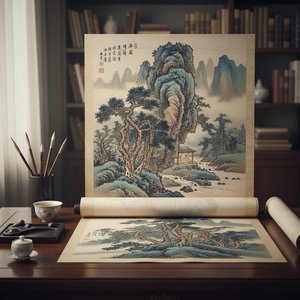
Yuan Chiang (Yuán Jiāng): A Master of Qing Dynasty Landscape Painting
Yuan Chiang (Yuán Jiāng), born around 1671 in Yangzhou, China, was a pivotal figure in Qing Dynasty landscape painting—a genre that flourished during the reign of emperors Kangxi, Yongzheng and Qianlong. Despite his humble origins within an artistic family – his nephew Yuan Yao also excelled as a painter – Yuan Chiang ascended to prominence through service at the imperial palace during the Yongzheng era (1722–1735), marking him as one of the most respected artists of his time. His legacy continues to inspire admiration for its meticulous detail and profound understanding of nature’s harmonies.
- Early Life & Artistic Training: Yuan Chiang's formative years were spent in Yangzhou, a coastal city renowned for its artistic traditions. Evidence suggests he received instruction from Li Yin, another prominent Yangzhou painter, establishing a stylistic connection that would characterize his later work. This early exposure undoubtedly instilled within him the foundational principles of literati painting—a tradition emphasizing philosophical contemplation alongside skillful execution.
- Imperial Service & The Yongzheng Era: Yuan Chiang’s career took a decisive turn when he was appointed as an assistant to Gao Qipei, a celebrated painter at the imperial court. This association solidified his position within the artistic elite and afforded him access to the highest levels of patronage. During the Yongzheng reign, he served as a painter-in-waiting, diligently documenting the grandeur of the imperial gardens and contributing significantly to the stylistic developments of the period.
- Style & Technique: Yuan Chiang’s distinctive style is characterized by an unwavering commitment to accuracy and subtlety. He meticulously rendered landscapes with astonishing detail—capturing not merely visual appearances but also atmospheric conditions, geological formations, and seasonal changes. His paintings frequently depict garrets (屋舎), elevated dwellings perched atop hillsides, which served as focal points for contemplation and artistic expression. Yuan Chiang’s technique involved layering thin washes of ink to achieve luminous effects and creating textures that conveyed the tactile qualities of stone and foliage.
- Notable Works: Among his most celebrated paintings are “The Palace of Nine Perfections” (九正宮圖) and “Landscapes of the Four Seasons” (四季山水畫), both masterpieces embodying the ideals of Qing Dynasty landscape art. These works exemplify Yuan Chiang’s mastery of composition, perspective, and tonal gradation—elements that elevate them beyond mere depictions of scenery to profound meditations on beauty and harmony.
- Legacy & Influence: Yuan Chiang's influence extended far beyond his own lifetime. He established a workshop where he trained numerous disciples who carried forward his artistic vision. His meticulous approach to painting served as an exemplar for subsequent generations of artists, shaping the trajectory of landscape art in China for decades to come. Today, Yuan Chiang’s paintings are treasured possessions within museums and private collections worldwide—testaments to his enduring contribution to Chinese cultural heritage.
Further Resources: