Early Life, Family and Training
Born on March 7, 1899, in Memphis, Tennessee, Sarah Baker entered a world where art was already a family language. She was the daughter of Thomas Henry and Bealle Jennings Baker. Her very name was a tribute, drawn from her paternal grandmother, a woman who had also pursued a life in painting. This early connection to the craft provided a quiet, foundational understanding of the life she would eventually lead.
Her formal education began in Baltimore at the Maryland Institute College of Art. It was here that her technical skills began to take shape, moving from the foundational studies of a student to the focused intent of a professional. Her training was shaped by a series of significant mentors, including Hugh Breckenridge and Arthur Charles. Through these instructors, she began to refine her approach to composition and color.
The pursuit of her craft eventually took her to Europe, where the influences of modernism became more direct. She sought instruction from André Lhote and Pierre Bonnard, absorbing their distinct perspectives on form and light. In 1925, she returned to Paris for a year to study painting under André Lhote, a period that deepened her understanding of the discipline before she returned to the American art scene.
Teaching Career and Academic Roles
Baker’s commitment to art education was a central pillar of her professional life, spanning several decades and various institutions. Her tenure as an educator began in earnest in Baltimore, where she taught at the Bryn Mawr School for Girls from 1929 to 1937. During this same period, she expanded her reach into Catonsville, serving as a teacher at St. Timothy's School between 1931 and 1945. These early years established her reputation as a steady presence in the regional academic landscape.
In 1945, her career shifted toward a more permanent academic setting when she joined the faculty at American University in Washington, D.C. This move coincided with a significant entrepreneurial endeavor; alongside sculptor William Calfee, she founded the American University Art School in Washington, D.C. Her influence at the university was profound and enduring. She served as a full-time faculty member from 1945 until 1964, remaining an active part of the institution's academic community until her death in 1983.
Awards and Professional Recognition
The early years of her career were marked by significant validation from the institutions that shaped her. In 1926, she was awarded a fellowship gold medal from the Pennsylvania Academy of the Fine Arts, a distinction earned through a self-portrait. This recognition arrived during a formative period of her development, signaling her technical proficiency to the broader American art community.
As her presence in the Mid-Atlantic art scene solidified, she continued to garner formal accolades. She received a prize from the Washington Society of Independent Artists in 1935, followed by another prize from the Baltimore Museum of Art in 1945. These honors reflected a steady professional standing within the regional circles of Baltimore and Washington, D.C.
Her standing among her peers was further cemented through her involvement with professional organizations. On July 3, 1946, she was elected to AAN membership. This election marked her integration into a community of artists who were actively defining the contemporary landscape of the era.
Artistic Technique and Style
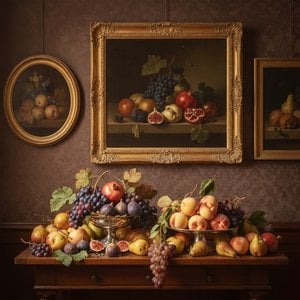
Baker’s approach to the canvas was defined by an Impressionistic sensibility, particularly in her treatment of color, composition, and the deliberate application of the brushstroke. She possessed a particular affinity for the quietude of still lifes and the nuances of portraiture. Her compositions often centered on the intimate details of domestic life, utilizing emotive stagings of household vignettes to capture a sense of private, everyday moments. These scenes frequently featured ripe fruits or the shifting light of summertime.
The natural world provided a steady source of inspiration, especially during her summers on North Haven. She drew heavily from her coastal surroundings, finding a specific palette in the various hues of Penobscot Bay. This connection to the maritime environment informed the way she observed light and atmosphere. Her work sought to translate these environmental qualities into a structured, painterly language.
- Black Teapot (about 1970)
- Eggplants (1950)
- Summer Vegetables (1938)
Where to See the Works Today
The physical remnants of Baker’s creative life are distributed across several significant institutions. The Brooklyn Museum and the Phillips Collection both hold examples of her paintings, offering a glimpse into her visual language. At the Phillips Collection, specific works such as Summer Vegetables (1938), Eggplants (1950), and Black Teapot (about 1970) remain part of the permanent collection.
Beyond her canvases, the more personal dimensions of her career are preserved through her documentation. The Archives of American Art at the Smithsonian Institution houses her papers, providing a record of her professional and personal correspondence. These archives offer a way to trace the intellectual development of an artist who moved between the academic rigor of her teaching roles and the quiet observations of her studio practice.
Otázky a odpovědi
Mohu si prohlédnout díla umělce Sarah Baker podle barevného spektra?
Stránka Sestavení podle barev umožňuje prohlížet díla umělce Sarah Baker rozdělená podle barvy.
Mohu si prohlédnout díla umělce Sarah Baker podle klíčových slov?
Díla umělce Sarah Baker můžete prozkoumat podle klíčových slov na jeho stránce Podle klíčových slov. Každé klíčové slovo seskupuje související umělecká díla.
V jakém městě a z jaké země pochází Sarah Baker?
Sarah Baker se narodil(a) ve městě Memphis v zemi United States.
Kde najdu díla umělce Sarah Baker seskupená podle barevné palety?
Stránka Podle palet seskupuje díla umělce Sarah Baker podle jejich barevných palet.