Early Life, Training and Education
Michael Upton was born in Birmingham in 1938. His early years were spent in the Midlands, where he began his formal training at the Birmingham College of Art. He remained there from 1954 until 1958, developing the foundational skills that would lead him toward the center of the British art scene. This period provided the technical grounding necessary for the more experimental paths he would later take.
By 1958, his focus shifted to London, where he entered the Royal Academy Schools. He studied there until 1962, a time when the atmosphere of the schools was shaped by the presence of peers like David Hockney. During these years, Upton’s education moved beyond simple instruction, placing him in the middle of a shifting landscape of contemporary practice. His time in London was marked by significant recognition; in 1962, he was awarded both a Leverhulme Scholarship and an Abbey Scholarship. These awards allowed him to travel to Rome, an experience that expanded his perspective beyond the confines of the London art schools.
Technique and Artistic Style
Upton’s hand moved between extremes. In his early years at the Royal Academy Schools, he engaged in brief flirtations with Abstract Expressionism and Pop Art, testing the boundaries of the prevailing trends. However, he often found himself returning to a much smaller scale. He produced small, quiet, beautiful gouaches that favored precision over the messy, large-scale gestures favored by many of his contemporaries. These works often focused on still life groups, arranging specific objects in compositions that felt carefully considered. He sometimes repeated these subjects across multiple images, using the repetition to heighten the sense of change and the passage of time.
His approach to the landscape was marked by a unique, abstracted representational quality. Rather than literal depictions, his views of the coast were filtered through a lens of abstraction. He frequently worked with muted tones, placing colors one against another with a painstaking, deliberate touch. This careful application of pigment allowed for a subtle tension within the frame. Whether working in oils or gouache, his focus remained on the quiet details of a scene, often using the same props in his paintings that he would later utilize in his performance work.
Performance Art and Collaborations
Upton’s practice often moved beyond the canvas into the realm of conceptual work. He worked with mixed media installations, videos, and performances that explored the mechanics of time and change. Much of this experimental output was developed alongside Peter Lloyd Jones. Together, they co-founded the performance art group London Calling, based at the Institute of Contemporary Arts in London. These collaborative efforts were not confined to small studios; they found space in significant venues such as the Whitechapel, the Serpentine, and the ICA Galleries in London.
His interests frequently crossed into music and the avant-garde. He was an original member of The Flying Lizards, appearing on the group's first single, 'Summertime Blues'. This involvement reflected a life lived at the intersection of different creative disciplines. His work often involved a sense of quiet subversion, sometimes manifesting in unusual settings, such as a performance involving a four-poster bed in Central Park.
Notable Works and Collections
Upton's presence in major institutional collections reflects a career that moved between the quietude of small-scale painting and more experimental ventures. His works are held within the Government Art Collection and the British Council collection, finding a place in the Arts Council Collection at the Southbank Centre in London. These holdings suggest a reach that extends beyond the local landscapes of Cornwall into the broader fabric of British art history.
His reach also crossed the Atlantic, with pieces held in New York at the Yale Centre for British Art and the Anthony Ralph Gallery. These international placements sit alongside his more personal output, much of which is represented by Messum's of London. His paintings often focus on specific, localized subjects, such as the harbor at Mousehole or the cliffs of Land's End, capturing the light and movement of the coast through thick, textured layers of oil.
- Bridport, Dorset, Looking West (about 1994)
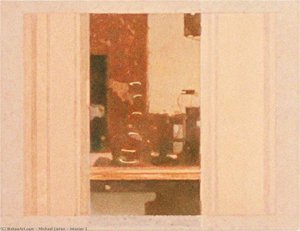
- Interior 2
Later Years and Death
The later years of Michael Upton's life were spent in Mousehole, Cornwall. He lived there for many years, remaining connected to the rugged landscape that had long informed his practice. His presence in the region was steady, a quiet fixture amidst the shifting light and tides of the coast.
He passed away in 2002. He died in Truro at the age of 64. His death marked the end of a life spent navigating the boundaries between painting, teaching, and performance.
Otázky a odpovědi
Mohu navštívit virtuální muzeum děl umělce Michael Upton?
3D galerie umělce Michael Upton je stránka, která v rámci virtuální trojrozměrné galerie prezentuje umělecká díla tohoto tvůrce.
Kde mohu si prohlédnout všechná umělecká díla autora Michael Upton?
Veškerá díla umělce Michael Upton na tato webová stránka si můžete prohlédnout na jeho stránce Všechná umělecká díla.
Jak je kariéra umělce Michael Upton rozdělena do období?
Chronologický přehled tvorby umělce Michael Upton naleznete na jeho stránce Kronika umělce, kde jsou díla uspořádána podle jejich vzniku v jednotlivých kapitolách.
Mohu si u Michael Upton prozkoumat používání barev napříč všemi jeho díly?
Barevný profil děl umělce Michael Upton naleznete na jeho stránce Genom palety.