Li Yin: The Silent Bloom of Ming Dynasty Landscape Painting
Li Yin (李因; c. 1610 – 1685), also known by her courtesy name jinsheng (今生) and her art names shi'an (是庵) and kanshan nüshi, stands as a singular figure in Ming Dynasty art—a woman who defied convention and achieved renown for her exquisite flower and bird paintings. Unlike many artists of her era whose identities remained shrouded in obscurity, Li Yin’s legacy persists through the meticulous documentation of her life and work by contemporaries like Huang Zongxi, cementing her place as one of the most celebrated female painters of the period. Her art, characterized by serene compositions and masterful brushwork, continues to inspire admiration for its beauty and subtlety.
- Early Life & Influences: Born in Shaoxing (くアイジ), Zhejiang Province during the waning years of the Ming Dynasty, Li Yin’s origins remain somewhat elusive. Accounts suggest her birth year varied between 1610, 1611, and 1616—a testament to the challenges faced by recording biographical details during a time when meticulous record-keeping was uncommon. Raised in a family of modest means, Li Yin received an education focused on poetry and painting from a young age – a privilege afforded to few women of her era. Legend recounts that she repurposed liver mosses as paper and persimmon sticks for writing, highlighting the resourceful spirit characteristic of her upbringing. Her artistic training was overseen by Ye Danian (叶大年), a master whose style—influenced by Chen Chun (陳淳) and Xu Wei (徐魏)—provided Li Yin with foundational techniques that would define her distinctive aesthetic.
- Marriage & Artistic Flourishing: At seventeen, Li Yin married Ge Zhengqi (葛正祺), a scholar-official who captivated her imagination with his poetic sensibilities. Their union fostered a profound artistic partnership, during which they traveled extensively documenting the landscapes of China. Notably, Li’s husband served as an official in Beijing and she accompanied him on numerous expeditions—a rare circumstance for women artists at that time. Her devotion to Ge Zhengqi was recognized by Lu Chuan (陸傳), who penned prefaces praising her loyalty and comparing her to Xi Shi (Ξῖ Σὶ)—the legendary beauty of ancient China—demonstrating the admiration surrounding Li Yin’s character.
- The Qing Dynasty & Legacy: Following the fall of the Ming Dynasty in 1644, Li Yin relocated to Nanjing with Ge Zhengqi, enduring hardship and danger amidst the turbulent political landscape. Despite facing adversity, she persevered in her artistic pursuits, continuing to paint and compose poetry—a testament to her unwavering spirit. Her final years were spent quietly at Laughing Bamboo Studio (笑竹庵) in Haining, where she honored her husband’s memory and maintained her passion for art until her death in 1685.
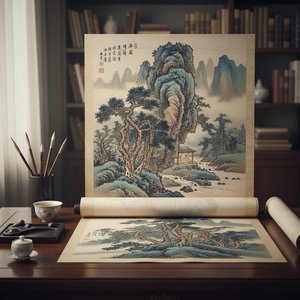
- Style & Technique: Li Yin's flower and bird paintings are renowned for their tranquil beauty and meticulous detail. Her compositions often depict scenes of mountains bathed in moonlight, capturing the ethereal glow of dawn or dusk—a hallmark of Ming landscape painting. She employed a distinctive brushwork style characterized by subtle gradations of color and delicate linework—techniques that conveyed both visual splendor and profound emotional resonance. Unlike many male artists of her time who sought grand spectacle, Li Yin prioritized conveying inner harmony and contemplation—reflecting the humanist sensibilities prevalent during the Ming Dynasty.
- Influence & Recognition: Li Yin’s work garnered considerable acclaim during her lifetime, inspiring as many as forty imitators in her region. This widespread admiration underscores her artistic significance and confirms her place among the most accomplished female painters of the Ming Dynasty. Her paintings continue to be studied by art historians today, who recognize her contribution to the development of flower and bird painting—a genre that flourished during the Ming period and remains celebrated for its aesthetic qualities.
Her enduring fame stems not only from her artistic prowess but also from the fact that she defied societal expectations—a woman achieving renown in a male-dominated field. Li Yin’s story serves as an inspiring reminder of the transformative power of art and the remarkable achievements possible when creativity transcends conventional boundaries. Her legacy continues to resonate within the annals of Ming Dynasty art, securing her place as a beacon of feminine artistry and intellectual curiosity.