Early Life, Family and Training
Leili Muuga was born on November 14, 1922, in the Altai region of the USSR. Her early years involved a series of moves, beginning with her family's relocation to Pyatigorsk, Russia, in 1925. By 1940, she had completed her secondary education, graduating from high school with a gold medal. Her path toward a formal education initially led her toward the sciences; from 1940 to 1941, she spent time studying chemistry at the Moscow Institute of Technology.
The direction of her life shifted toward the visual arts as she moved through different stages of study. Between 1947 and 1951, she studied painting under Alfred Kongo at the Tartu State Art Institute. This period of training helped shape her technical foundation before she moved toward the final stage of her formal education. She completed her studies in 1953 at the Estonian SSR State Art Institute in Tallinn.
Professional Career and Teaching
After moving to Tartu in 1946, her professional life began in the architectural design department of the Government Office, where she worked as a draftsman-designer. This period of technical precision preceded her formal recognition within the local art community. In 1953, she became a member of the Estonian Artists Union, a step that coincided with the completion of her studies in Tallinn.
A significant portion of her life was spent within the classroom. From 1962 to 1977, she held a teaching position at the school in Muuga. This long tenure in education provided a steady rhythm to her years before she transitioned into a different way of working. After 1977, she moved into a period of freelance artistry, focusing on her own practice without the structure of a formal teaching role.
Technique and Artistic Style
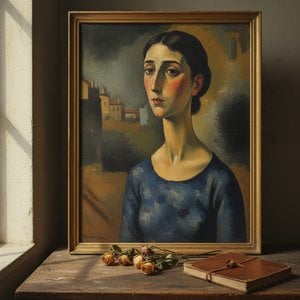
Her work often settles into the quiet rhythms of genre paintings, portraits, and still lifes. There is a certain weight to these images, a sense of pathos that emerges through a concise approach to composition. She relies on the decorative effect of her color choices to define the space, avoiding unnecessary clutter to keep the focus on the essential form. In her portraits, she seeks to capture the subtle shifts in a subject's mood, looking for the unchanging features that define a person's character.
The light in her paintings has a specific quality, often characterized by bright effects that interact with a beautiful northern color palette. This light helps shape the atmosphere of her scenes, whether she is working with the solid presence of a figure or the delicate petals of a flower. Her visual language shifted over the decades, moving from a rugged modernist realism toward more abstract compositions. This evolution shows a changing way of seeing the world, where the subject matter sometimes dissolves into pure form and color.
- Protest against war (1959)
- Orchestra (1962)
- Festive flowers (1972)
Key Works and Notable Pieces
Muuga’s brushwork often settles on the quiet presence of a person or the stillness of a subject. In her 1952 oil on canvas, Portrait of Olga Lund, she captures the Estonian singer and mezzo-soprano in a work measuring 49.5 x 35 cm. This focus on the individual continues in her 1967 Anna Ekston's Portrait, an oil on canvas measuring 65.0 x 51.0 cm. These portraits seek to find the unchanging features of the model, looking past the surface to the moods and feelings held within.
Her larger compositions often move toward the social or the natural. The 1968 Nude is a significant oil on canvas, measuring 100.0 x 82.0 cm, depicting a dark-haired young woman sitting in a pose that turns toward the left. In other years, her work shifted toward the landscape and the botanical. She spent much of her later life focused on the juniper trees of the Lohusalu summer house and the nature of Saaremaa, creating works like Kadaka hing and Kadaka perekond. These pieces often lean toward abstract compositions, reflecting a green worldview through a specific, northern light.
Several of her significant paintings are held in the Art Museum of the Estonian SSR, Tallinn, including:
- Protest against war (1959)
- Orchestra (1962)
- Festive flowers (1972)
Where to See the Works Today
Finding her paintings requires looking through several significant collections across different regions. In Estonia, her work is held within the Art Museum of Estonia and the Tartu Art Museum. These institutions house pieces that reflect her long engagement with the local landscape and the people she observed. The Tallinn Art Hall Foundation also maintains works from her practice.
Beyond the borders of Estonia, her presence is felt in major Russian collections. Her paintings are part of the holdings at the Tretyakov Gallery and the Russian Art Museum. These locations preserve her contributions to the visual history of the era, keeping her compositions accessible to those studying the development of mid-century painting.
Otázky a odpovědi
Jaké nálady vyjadřují umělecká díla umělce Leili Muuga?
Díla umělce Leili Muuga si můžete prohlédnout podle nálady na jeho stránce Galerie nálad, kde jsou umělecká díla uspořádána podle jejich vyvolané nálady.
Kde mohu vidět díla umělce Leili Muuga v chronologickém pořadí?
Díla umělce Leili Muuga můžete prohlédnout v chronologickém pořadí na stránce Chronologie děl.
Kde najdu díla umělce Leili Muuga seskupená podle uměleckých směrů?
Díla umělce Leili Muuga si můžete prohlédnout rozdělená podle uměleckých směrů na jeho stránce Všechna umělecká hnutí.
Kde mohu si prohlédnout všechná umělecká díla autora Leili Muuga?
Veškerá díla umělce Leili Muuga na tato webová stránka si můžete prohlédnout na jeho stránce Všechná umělecká díla.