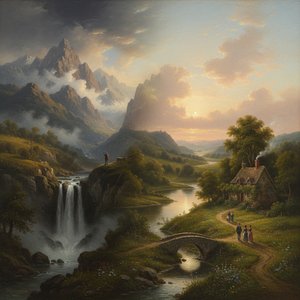
Lazzaro Pasini (1861 – 1949): A Tuscan Landscape Painter Embracing Naturalism
- Early Life and Training
- Florence and Fattori’s Studio
- The Macchiaioli Style: Light and Atmosphere
- Milan and Lombard Naturalism
- Mature Works and Recognition
Early Life and Training
Lazzaro Pasini was born in Reggio Emilia, Italy, in 1861. His formative years were marked by a profound connection to the artistic traditions of his region, particularly influenced by the revival of classical ideals during the Risorgimento era. He began his artistic journey under the tutelage of Romualdo Belloli, a respected engraver who instilled in him a meticulous attention to detail and an appreciation for craftsmanship—skills crucial for mastering the art of etching and printmaking. This early training would prove invaluable as he pursued higher education at the Accademia di Belle Arti di Firenze (Florence Academy), where he encountered Giovanni Fattori’s studio, a pivotal encounter that cemented his fascination with the Macchiaioli movement.
Florence and Fattori’s Studio
Giovanni Fattori's influence was transformative for Pasini. Fattori championed a revolutionary approach to landscape painting—the “macchia” style—characterized by bold brushstrokes and an emphasis on capturing the immediacy of nature. Rejecting academic conventions, Fattori sought to depict scenes as they appeared before the eye, prioritizing atmospheric effects over precise representation. Pasini eagerly absorbed Fattori’s techniques, immersing himself in plein air painting sessions and experimenting with color palettes that aimed to convey the vibrancy and dynamism of Tuscan landscapes.
The Macchiaioli Style: Light and Atmosphere
The macchia style represented a radical departure from prevailing artistic trends. Artists like Fattori prioritized capturing the fleeting qualities of light and shadow, striving to evoke emotion rather than simply documenting visual reality. Pasini embraced this ethos wholeheartedly, meticulously observing how sunlight illuminated hillsides, olive groves, and cypress trees—transforming these observations into canvases brimming with luminous color and expressive brushwork. This stylistic choice reflected a broader intellectual preoccupation with Impressionism and its exploration of sensory experience.
Milan and Lombard Naturalism
In 1886, Pasini relocated to Milan, where he engaged with the burgeoning Lombard Naturalist movement. Led by artists like Giuseppe Cortelloni and Raffaele Buscaroli, Lombard Naturalism sought to depict rural life with uncompromising realism—capturing not idealized beauty but the gritty realities of peasant existence. Pasini’s canvases from this period reflect a similar commitment to portraying the natural world truthfully, albeit tempered by Fattori's influence. He skillfully blended Impressionistic techniques with elements of Tuscan landscape painting, resulting in works that convey both atmospheric grandeur and psychological depth.
Mature Works and Recognition
Pasini’s artistic career culminated in a series of celebrated landscapes—particularly his depictions of Vesuvian landscapes after the eruption of Mount Vesuvius in 1906. These paintings showcased his mastery of color, composition, and tonal modulation—skills honed over decades of dedicated practice. His work was recognized by the Academy of Fine Arts of Milan, earning him the gold medal in 1918—a testament to his artistic talent and unwavering devotion to his craft. Lazzaro Pasini died in Milan in 1949, leaving behind a legacy as one of Italy’s foremost landscape painters—a figure whose canvases continue to inspire admiration for their evocative beauty and profound connection to the Tuscan countryside.