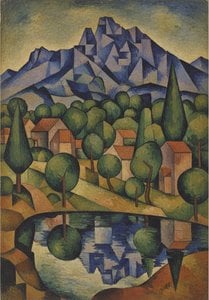
The Light of the Midi
Born in Marseille to a family of Italian immigrants, Joseph Garibaldi’s path toward the canvas was shaped by a quiet, observant upbringing. His father, an employee at the Noilly Prat distillery, recognized a natural aptitude in the young man and secured his enrollment at the École supérieure des beaux-arts de Marseille. It was there that his talent met the guidance of Antoine Vollon, a relationship that would define the trajectory of his career. Under this mentorship, Garibaldi moved beyond mere student exercises to exhibit at the Salon, a presence he maintained from 1884 until 1914.
His brush was drawn repeatedly to the Mediterranean coast, finding a sense of permanence in the shifting tides of the Provençal landscape. He spent years, specifically between 1884 and 1899, frequenting Cassis, and he found a deep affinity for the waters of La Ciotat. Yet, the Old Port of Marseille remained his most enduring subject. He possessed a particular ability to capture the interplay of light upon stone and water, rendering the maritime atmosphere with a balanced, serene quality that many have described as a portrait of a peaceful southern life.
Patronage and Provençal Life
The recognition of his skill brought him into the circles of significant collectors and supporters. Before 1905, he enjoyed the patronage of Baron Alphonse de Rothschild, whose acquisitions helped ensure his work found its way into provincial museums. This period of stability allowed him to explore broader horizons, including a travel grant to Tunisia in 1907 and brief excursions to Venice and Corsica. Despite these travels, his heart remained anchored to his home district, finding beauty in the local rhythm of life.
Garibaldi’s compositions often focused on the intersection of nature and human labor. He was drawn to the geometry of ports and the quietude of village streets, where the rounded forms of fountains and the heavy, repetitive motions of washerwomen provided a sense of grounded reality. He did not seek to paint grand portraits of individuals, but rather used small figures to populate his panoramic views, capturing the essence of traditional craftsmanship and the steady, unhurried pace of the hinterland.
The Fading Vision
The later years of his life were marked by a physical struggle that mirrored the quietude of his subjects. During the 1930s, the onset of glaucoma gradually stripped him of the ability to paint, forcing a premature end to his creative output. He spent his final years in Fos-sur-Mer, a period of stillness following a career defined by the observation of light and movement.
Though his active painting ceased, his influence remained etched in the regional art history of Marseille. His work has been honored in retrospectives, such as those held in Cassis and at the Palais des Arts in Marseille, and his canvases continue to reside in collections including the Musée de Cahors Henri-Martin and the Musée des beaux-arts de Marseille. He remains a painter of the coast, a man who sought to fix the ephemeral light of the Mediterranean onto the canvas.
Otázky a odpovědi
Kde mohu vidět díla umělce Joseph Garibaldi v chronologickém pořadí?
Prohlédněte si časovou osu děl umělce Joseph Garibaldi: na stránce Chronologie děl jsou díla seřazena podle data jejich vzniku.
Mohu si prohlédnout díla umělce Joseph Garibaldi podle klíčových slov?
Díla umělce Joseph Garibaldi můžete prozkoumat podle klíčových slov na jeho stránce Podle klíčových slov. Každé klíčové slovo seskupuje související umělecká díla.
Jak populární jsou umělecká díla umělce Joseph Garibaldi?
Pro umělce Joseph Garibaldi je k dispozici stránka Statistiky, která zobrazuje statistiky o jeho dílech na tato webová stránka.