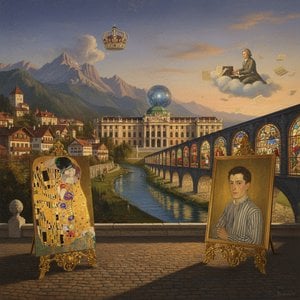
The Viennese Genesis and the Seeds of Symbolism
Born in 1865 amidst the vibrant cultural landscape of Vienna, Josef Maria Auchentaller was destined to become a cornerstone of the Austrian avant-garde. His early years were steeped in an environment that valued visual expression, a passion nurtured by his formal training at the Technical College and later the Academy of Fine Arts Vienna. During this formative period, the shadows of the Symbolist movement began to lengthen over his work, particularly through the evocative influence of Gustav Klimt. This connection was more than mere proximity; it was a shared pursuit of psychological depth and spiritual resonance that would define his aesthetic. Auchentaller’s early mastery of design principles provided the technical foundation upon which he would later layer the intricate, dreamlike motifs that characterize his most celebrated works.The Secessionist Rebellion and Artistic Innovation
The year 1897 marked a seismic shift in Auchentaller’s career as he joined the revolutionary Vienna Secession. Alongside luminaries such as Klimt, Emil Körner, and Wilhelm Moser, he stood at the forefront of a movement dedicated to shattering the stifling constraints of academic tradition. This was an era of profound rebellion, where the pursuit of "pure art" demanded a rejection of historical mimicry in favor of something entirely new. His time spent studying under Paul Hoecker in Munich further enriched this rebellious spirit, infusing his compositions with a modern sensibility that bridged the gap between classical draftsmanship and the burgeoning Art Nouveau style. Through his contributions to the seminal journal Ver Sacrum, Auchentaller helped articulate a new visual language for a changing century.A Tapestry of Ornament and Decorative Grace
Auchentaller’s legacy is perhaps most beautifully realized in his ability to weave the organic with the geometric. His work serves as a breathtaking tapestry of floral motifs, meticulous detail, and structured patterns that embody the very essence of Secessionist elegance. Beyond the canvas, his talent extended into the realm of the decorative arts, where he applied his visionary designs to everything from posters for the Vienna Secession exhibitions to exquisite patterns for the jewelry and silverware company G.A. Scheid. This seamless integration of fine art and functional design allowed his aesthetic to permeate the daily lives of the Viennese public, ensuring that his influence was not merely seen in galleries, but felt in the very atmosphere of the modern city. His life’s work remains a testament to the power of beauty to transform the mundane into the extraordinary.Otázky a odpovědi
Mohu si prohlédnout díla umělce Josef Maria Auchentaller podle nálady?
Stránka umělce Galerie nálad nabízí díla Josef Maria Auchentaller uspořádaná podle jejich atmosféry.
Jak se umění umělce Josef Maria Auchentaller v čase vyvíjelo?
Kariéra umělce Josef Maria Auchentaller se na stránce Kronika umělce odvíjí období po období v podobě horizontální časové osy děl uspořádaných do kapitol podle tvůrčích etap.
Kde najdu díla umělce Josef Maria Auchentaller uspořádaná podle tématu?
Stránka Atlas témat mapuje díla umělce Josef Maria Auchentaller podle tématu.