The Scholar’s Unyielding Spirit
Born in the coastal serenity of Dongshan County around 1585, Huang Daozhou was a man whose life was defined by a profound tension between the delicate precision of the scholar's brush and the turbulent, often violent, realities of imperial politics. A figure of immense intellectual weight during the late Ming Dynasty, Huang’s journey was one of rising brilliance and tragic descent. After attaining the prestigious Jinshi degree in 1622, he entered the heart of the Ming bureaucracy, eventually serving in roles as significant as the Minister for Education. Yet, his career was never merely a matter of administrative duty; it was a battlefield of conscience. Known for his unwavering integrity and a refusal to remain silent in the face of corruption, Huang frequently offered candid, often biting, critiques to the Chongzhen Emperor. This very honesty, while earning him the respect of many intellectuals, alienated the powerful factions within the court, leading to a cycle of demotions and imprisonable offenses that would shadow his entire official life.
The Fluidity of the Cursive Script
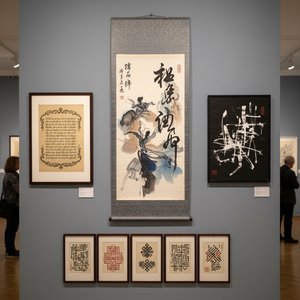
In the realm of calligraphy, Huang Daozhou achieved a level of mastery that mirrored his internal fortitude—a style that was as energetic as it was disciplined. He became one of the preeminent exponents of caoshu, or cursive script, during the twilight of the Ming era. To observe his work is to witness a brush that races across the silk, rarely pausing to lift between characters, creating cascading textures of ink that seem to move with a life of their own. This technique was not merely an aesthetic choice but an expression of a spirit that refused to be constrained by rigid boundaries. In works such as his Poem dedicated to Wen Zhenmeng, the fluidity of the script captures a sense of continuous motion, much like the historical currents that were sweeping through China at the time. His calligraphy serves as a testament to a moment in history where the elegance of tradition met the frantic energy of a changing world.
Nature as an Allegory of Constancy
Beyond the rhythmic dance of ink, Huang’s artistic vision extended into the landscape, where he utilized natural motifs to communicate deep philosophical truths. He is perhaps most admired for his depictions of pines and rocks—elements that, in Chinese iconography, serve as enduring symbols of perseverance, strength, and moral constancy. In his notable scroll, Pines and Rock, created for his disciple Zhang Ruizhong, Huang employs a landscape that is both rugged and contemplative. The towering pines, standing amidst craggy formations, act as metaphors for the scholar who remains upright despite the storms of political upheaval. His deep understanding of the Book of Changes is woven into these works, often accompanied by inscriptions that reflect his stoic resolve. Through these paintings, Huang transformed the natural world into a mirror for the human soul, illustrating the struggle to maintain one's essence in an era of profound instability.
A Legacy Written in Blood and Ink
The tragedy of Huang Daozhou lies in the fact that his commitment to principle could not be contained within the quietude of a studio or the halls of academia. As the Ming Dynasty crumbled under the weight of the Manchurian invasion, the scholar-official transitioned into the role of a military general. His final chapter was written not with a brush, but with the ultimate sacrifice of a man who refused to surrender his values. Captured during the conflict, he chose death over capitulation, ensuring that his historical legacy would be one of martyrdom as much as artistry. Today, we remember him through:
- His calligraphic mastery, which captured the kinetic energy of the late Ming period.
- His landscape paintings, which provided a visual language for Confucian virtue and resilience.
- His political integrity, which remains a poignant study of the cost of intellectual dissent.
Otázky a odpovědi
Kde a kdy se narodil/a Huang Daozhou?
Huang Daozhou se narodil(a) ve městě Dongshan County v roce 1585.
Jak najdu díla umělce Huang Daozhou v určité barevné paletě?
Chcete-li najít díla umělce Huang Daozhou v určité paletě, využijte stránku Podle barevné palety tohoto umělce.
Pod jakými dalšími jmény je Huang Daozhou známý/á?
Huang Daozhou se vystupuje även pod alternativními jmény 黃道周.