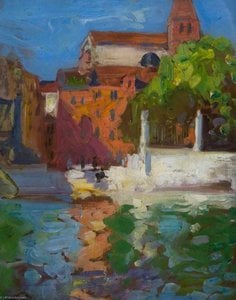
Francis Campbell Cadell: A Scottish Colourist's Vision of Elegance
Francis Campbell Boileau Cadell (pronounced "caddle") was a Scottish Colourist painter born in Edinburgh in 1883, the son of Dr. Francis Cadell FRSE (1844-1909), a prominent surgeon and his wife, Mary Hamilton Boileau (1853-1907). His childhood home resided at 22 Ainslie Place on Edinburgh’s prestigious Moray Estate, fostering an environment steeped in artistic appreciation. Jean Cadell, his sister, achieved renown as a celebrated actress, shaping his formative years with exposure to theatrical artistry. From the age of sixteen, he pursued formal studies at the Académie Julian in Paris, immersing himself within the vibrant currents of French avant-garde thought—a connection that would prove profoundly influential on his artistic trajectory. Cadell’s artistic sensibilities were decisively molded by the burgeoning Fauvist movement, spearheaded by artists like Matisse. The bold use of colour and expressive brushstrokes became hallmarks of his distinctive style, reflecting a rejection of academic conventions in favor of capturing emotional resonance rather than photographic realism. This stylistic choice wasn't merely aesthetic; it represented a fundamental challenge to the prevailing artistic dogma of the time—a desire to prioritize feeling over meticulous observation. Returning to Scotland after Paris, Cadell established himself as a consistent exhibitor in Edinburgh and Glasgow, alongside London, demonstrating unwavering dedication to his craft and engaging actively with the evolving artistic landscape of his era. He tirelessly pursued excellence, constantly refining his technique and experimenting with new approaches to visual representation. A left-handed painter—a fact that garnered considerable attention—Cadell famously countered skepticism regarding unconventional techniques by referencing Michelangelo’s own practice. This anecdote encapsulates his rebellious spirit and intellectual curiosity, highlighting a refusal to conform to societal expectations. His fellow students questioned him about how he knew Michelangelo was left-handed; Cadell responded with wry humor, revealing that the president of the Royal Scottish Academy had departed abruptly after dismissing the inquiry. Such anecdotes underscore Cadell’s astute observation of artistic discourse and his willingness to challenge established norms—a characteristic that distinguished him from many of his contemporaries. He possessed a remarkable ability to provoke thought and debate within the art world. Cadell's oeuvre primarily focused on capturing the refined interiors of Edinburgh’s new town—a subject he revisited repeatedly with meticulous detail and luminous colour palettes. These paintings are characterized by an extraordinary sensitivity to light and shadow, achieved through painstaking layering of translucent washes—a technique known as glazing—that imbues each canvas with a palpable sense of atmosphere. Simultaneously, he undertook significant commissions for Iona Abbey, translating the spiritual serenity of the island into evocative watercolour landscapes imbued with a profound connection to nature. His portraits, particularly those depicting glamorous women adorned in opulent attire, exemplify his masterful ability to convey character and emotion through subtle gestures and expressive shading—capturing not merely likeness but also psychological depth. Cadell’s distinctive style cemented his place as one of Scotland's most celebrated Colourists. His legacy extends beyond his individual artworks; he stands as a pivotal figure in Scottish art history, representing a crucial juncture between Impressionism and Expressionism. The retrospective held at the National Gallery of Modern Art in Edinburgh in 2011-2012 served as a poignant reminder of his enduring artistic vision, ensuring that Cadell's distinctive style continues to inspire admiration and scholarly study for generations to come. He remains an emblem of artistic innovation and unwavering dedication—a testament to the transformative power of pursuing one’s passions with uncompromising conviction.Otázky a odpovědi
Kde najdu díla umělce Francis Campbell Cadell uspořádaná podle barvy?
Stránka Spektrální index organizuje díla umělce Francis Campbell Cadell podle barvy.
V jakém historickém období působil/a Francis Campbell Cadell?
Francis Campbell Cadell působil v období Modernismus. Toto období historicky vymezuje uměleckou činnost tohoto autora.
Kde najdu díla umělce Francis Campbell Cadell seskupená podle klíčových slov?
Stránka Podle klíčových slov umělce Francis Campbell Cadell seskupuje díla tohoto umělce podle jejich klíčových slov.