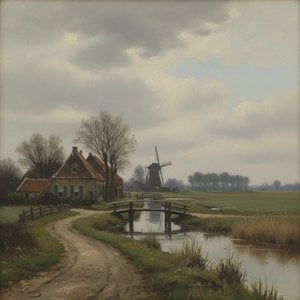
The Romantic Landscape of Cornelis Lieste
To look at a landscape by Cornelis Lieste is to witness the mid-nineteenth century Dutch Romantic school in its most direct form. He did not merely paint scenery; he captured the tension between the smallness of human presence and the overwhelming scale of nature. His work often centers on the concept of the "small man" positioned against a vast, sometimes intimidating environment. Whether it is a shepherd near a stream or figures navigating frozen rivers, Lieste uses these subjects to ground his larger atmospheric studies in a recognizable, albeit dramatic, reality.
His technical foundation was built through rigorous, formal training. After enrolling at the Vocational School in 1835 to study drawing under Jan Reekers, he moved into more specialized landscape instruction with Nicolaas Johannes Roosenboom between 1837 and 1838. This period of academic discipline provided the tools for his later, more expressive works. His ability to manipulate light—specifically through dramatic backlighting and the depiction of evening air—was not accidental but a result of studying the traditions of Dutch realist painting and expanding them through travel.
Travel and Technical Development
Lieste’s development was shaped by movement across Europe. His study trips to Belgium and Germany in the late 1830s and early 1840s brought new perspectives to his palette. In Germany, he likely engaged with the Drawing Academy of B.C. Koekkoek in Kleve, a connection that reinforced his command over the Romantic style. These travels allowed him to move beyond local Dutch scenes to capture more varied terrains, including the Rhine region and the Harz mountains.
The artist’s skill is most evident in his handling of specific environmental conditions:
- Winter Scenes: He utilized wide expanses of ice and bare trees to create high-contrast, dramatic compositions.
- Atmospheric Light: His use of blue and pink evening tones creates a sense of depth and temporal weight.
- Topographical Detail: From the dunes of North Holland to the Schwanenburg in Kleve, his sketches and oils maintain a sharp, observational edge.
Recognition and Legacy
Lieste’s career was marked by specific, measurable successes within the established art circles of his time. He earned a silver medal at an exhibition in ’s-Hertogenbosch in 1839 and later secured a gold medal for landscape work at the Felix Meritis exhibition in Amsterdam in 1842. These were not mere accolades; they signaled his acceptance into the upper echelons of the Dutch art scene, leading to his appointment as a member of the Royal Academy of Art in Amsterdam in 1846.
His influence extended through his role as an educator and collaborator. He worked alongside notable figures such as Charles Rochussen, Hendrikus van de Sande Bakhuyzen, and Eugène Verboeckhoven. Furthermore, his pedagogical impact is seen in the work of his students, including Hendrik Dirk Kruseman van Elten and Paul Gabriël. While his life ended prematurely in 1861, his presence remains anchored in major collections, including the Rijksmuseum and the Amsterdam Museum, where his specific approach to the Romantic landscape continues to be studied.
Otázky a odpovědi
V jakém historickém období působil/a Cornelis Lieste?
Cornelis Lieste působil v období 19th Century. Toto období historicky vymezuje uměleckou činnost tohoto autora.
Existuje časová osa děl umělce Cornelis Lieste?
Stránka Chronologie děl představuje díla umělce Cornelis Lieste seřazená chronologicky, rok po roce.
Kde najdu díla umělce Cornelis Lieste seskupená podle uměleckých směrů?
Umělecká směry, ve kterých Cornelis Lieste působil/a, si můžete prohlédnout na stránce Všechna umělecká hnutí, která seskupuje díla podle jednotlivých směrů.
Kde najdu díla umělce Cornelis Lieste seskupená podle klíčových slov?
Chcete-li najít díla umělce Cornelis Lieste na konkrétní téma, navštivte jeho stránku Podle klíčových slov, kde jsou umělecká díla seskupena podle klíčových slov.