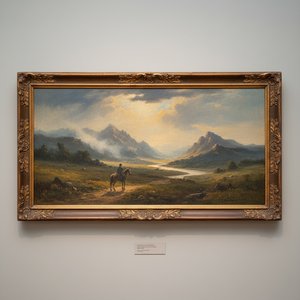
A Life Captured in Landscape
The story of Bernard Walter Evans is one deeply rooted in the very landscapes he sought to immortalize. Born in Wolverhampton, United Kingdom, Evans emerged from an environment where art was woven into the fabric of family life. As the son of a master engraver and church furniture maker, his early years were steeped in the meticulous craftsmanship of his father, Walter Swift Evans. This lineage of creativity extended through his many siblings, several of whom also pursued artistic paths, creating a domestic atmosphere where the pursuit of beauty was a shared vocation. Even his famous cousin, the author George Eliot, reminds us of the profound intellectual and creative currents that flowed through his family tree.
His artistic journey began with an almost precocious dedication, starting his apprenticeship at the tender age of seven under the guidance of Samuel Lines. This early training in Birmingham laid the foundation for a career defined by a relentless pursuit of atmospheric truth. As he matured, Evans refined his skills under the tutelage of masters such as George Wallis and Edward Watson, eventually finding his voice as a painter capable of capturing the delicate nuances of light and weather. His development was not merely academic but experiential; he was an artist who truly lived within his subjects, often venturing into the most challenging environments to find his inspiration.
The Wanderer of the North and Beyond
To many in the North Riding of Yorkshire, he was known by a more colorful moniker: Van Evans. This nickname arose from his habit of traversing remote, rugged terrains in a heavy, horse-drawn van, a vessel that carried his tools and his ambitions to the far reaches of the countryside. There is a certain romanticism in the image of Evans navigating the harsh Yorkshire winters, painting amidst frozen water pots and the meager warmth of a paraffin stove. This grit and determination allowed him to capture the profound stillness and the biting chill of the landscape, imbuing his works with a sense of lived reality that few could replicate.
His travels were as varied as they were extensive. While his heart often resided in the hills of Yorkshire and the beauty of the Midlands, Evans’s eye wandered far beyond the British Isles. He sought out the lush scenery of North Wales and the serene vistas of the French Riviera. During the 1890s, he and his wife, Mary Ann Eliza Hollyer, spent winters in Cannes and Grasse, where the soft light of the Mediterranean offered a new palette for his watercolours. Whether depicting the ancient abbeys of Yorkshire or the sun-drenched landscapes of France, Evans possessed a unique ability to achieve a synthesis of atmosphere and distance, making the viewer feel the very air of the locations he visited.
Legacy and Artistic Recognition
The professional stature of Bernard Walter Evans was marked by significant achievements within the prestigious art circles of his time. His dedication to the craft earned him election to several esteemed institutions, including the Royal Society of British Artists and the Royal Institute of Painters in Water Colours. He was also a driving force behind the creation of the City of London Society of Artists, demonstrating a leadership spirit that extended beyond the easel. His works were frequently showcased at the Royal Academy, bringing his vision of the natural world to the widest possible audience.
Today, the significance of Evans lies in his role as a master of the Romantic and Realist styles, particularly within the tradition of English landscapists. His ability to communicate the true feeling of a subject—the weight of a cloud, the texture of a frozen field, or the hazy distance of a coastal view—ensures his place in the annals of British art. Through his prolific output in both oil and watercolour, he left behind a visual record of landscapes that continue to resonate with an emotional depth, inviting us to see the world through the eyes of a man who truly understood the soul of the earth.
Otázky a odpovědi
V jakém historickém období působil/a Bernard Walter Evans?
Bernard Walter Evans působil v období 19th Century. Toto období historicky vymezuje uměleckou činnost tohoto autora.
Kde mohu vidět barevný profil děl umělce Bernard Walter Evans?
Stránka Genom palety umělce Bernard Walter Evans představuje barevný profil celkového díla tohoto tvůrce.
Kde si mohu prohlédnout díla umělce Bernard Walter Evans uspořádaná podle atmosféry?
Stránka Galerie nálad umělce Bernard Walter Evans nabízí prohlížení jeho děl rozřazených podle nálady.
Mohu si prohlédnout díla umělce Bernard Walter Evans podle tématu?
Díla umělce Bernard Walter Evans si můžete prohlédnout podle tématu na stránce Atlas témat.