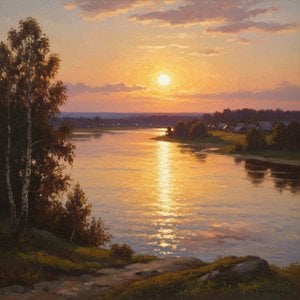
The Formative Years in Beirut
Born in Beirut, Lebanon, on November 21, 1931, Arshak Garnikyan began his creative life in a city defined by its complex, layered identity. His early inclinations toward art and music emerged during his youth, long before he would find his footing in the formal academies of Europe. Before he was a painter of canvas, he was a designer of spaces, finding his initial professional rhythm in the theater. His work as a set designer for various productions in Beirut, including those by the Gaspar İpekian Theater Group, required a keen understanding of how light and shadow define a narrative.
This theatrical background instilled in him a sense of drama and spatial arrangement that would later inform his visual language. He worked on sets for productions such as "Ancient Gods" and "The Chained," learning how to build worlds within the confines of a stage. By 1958, he moved to Paris, a transition that would fundamentally shift the trajectory of his career and expose his developing technique to the rigorous traditions of the French capital.
Academic Discipline and Parisian Life
In Paris, Garnikyan sought to refine his raw talent through formal study. His education was marked by a commitment to the fundamentals of classical training and the freedom of the studio. His development was shaped by several key institutional influences:
- The Grand École des Beaux-Arts, where he pursued advanced studies.
- The Louvre free workshops, where he spent three years honing his technical skills.
These years in France provided the structural foundation necessary to transition from the ephemeral nature of stage design to the permanence of painting. He moved through the Parisian art scene with a quiet, disciplined focus, absorbing the atmosphere of a city that had long been a crossroads for international movements.
A Legacy in Color and Form
Garnikyan’s later years were defined by a settled presence in Paris, where he continued to work until his death on April 14, 2014. His output during the mid-to-late 20th century reflects a matured sensibility, moving away from the temporary requirements of the stage toward a more personal, singular expression. His presence in the art world was marked by a steady, professional evolution that bridged the gap between his Lebanese roots and his French training.
His works have found their way into significant collections, most notably within the National Gallery of Armenia in Yerevan. Among his recognized contributions is his 1973 work, titled Untitled, which remains a part of the Armenian national collection. Through his paintings, the French-Armenian artist left a record of a life spent translating the visual complexities of the world onto the surface of the canvas.
Otázky a odpovědi
Pod jakými dalšími jmény nebo pseudony je Arshak Garnikyan známý/á?
Arshak Garnikyan se vystupuje även pod alternativními jmény Arshak Harutyun Garnikyan, Arshak Garni.
Mohu si prohlédnout díla umělce Arshak Garnikyan podle nálady?
Stránka Galerie nálad umělce Arshak Garnikyan nabízí prohlížení jeho děl rozřazených podle nálady.
Kde mohu si prohlédnout všechná umělecká díla autora Arshak Garnikyan?
Veškerá díla umělce Arshak Garnikyan na tato webová stránka si můžete prohlédnout na jeho stránce Všechná umělecká díla.
Mohu si u Arshak Garnikyan prozkoumat používání barev napříč všemi jeho díly?
Barevný profil děl umělce Arshak Garnikyan naleznete na jeho stránce Genom palety.