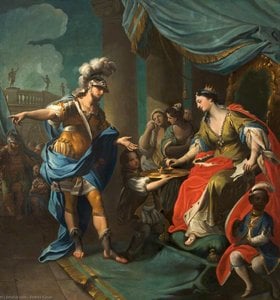
The Grandeur of the Chevalier: The Life and Art of Andrea Casali
In the luminous tapestry of the eighteenth century, few figures embody the stylistic transition from the dramatic intensity of the Baroque to the delicate grace of the Rococo as elegantly as Andrea Casali. Born in 1705 in the coastal town of Civitavecchia, within the Papal States, Casali’s early years were steeped in the rich traditions of Italian masterworks. His artistic foundation was forged under the guidance of esteemed maestros such as Sebastiano Conca and Francesco Trevisani, mentors who instilled in him a profound command over light, shadow, and classical composition. Before his name became synonymous with English high society, Casali established himself as a formidable decorative painter, adorning the sacred spaces of Roman churches with frescoes that breathed life into divine narratives through meticulous detail and a burgeoning sense of movement.
The year 1729 marked a pivotal moment in his personal and professional ascent when he was invested as a Knight of the Golden Spur. This prestigious knighthood did more than just elevate his social standing; it provided him with a title that would follow him across borders, earning him the affectionate and respectful moniker “the Chevalier Casali” once he reached the shores of Great Britain. His journey from the ecclesiastical grandeur of Rome to the sophisticated salons of London represents a fascinating cultural bridge, as he carried the warmth and theatricality of Italian painting into the heart of the English Enlightenment.
A Transnational Legacy: From Roman Frescoes to English Salons
Casali’s relocation to England in 1741 initiated a prolific era that would redefine his career. For twenty-five years, he navigated the vibrant cultural landscape of Britain, becoming a sought-after figure among the landed gentry and intellectual elite. His presence in London was not merely that of a visiting painter but that of an influential cultural agent. He cultivated deep connections with prominent patrons, most notably Thomas Coke, Earl of Leicester, and the influential Alderman William Beckford, whose commissions allowed him to translate his Italian training into works that resonated with English tastes for classical mythology and historical drama.
Beyond the canvas, Casali demonstrated a remarkable versatility and business acumen that set him apart from many of his contemporaries. He was not only a creator of beauty but also an active participant in the burgeoning art market of London, organizing notable auction sales that showcased his keen eye for value and quality. This dual identity as both an artist and an astute art dealer allowed him to shape the aesthetic preferences of his era. His influence even extended to the next generation of painters; through his mentorship of James Durno, Casali’s technical mastery and stylistic nuances were passed down, ensuring that the echoes of his Roman training would resonate in English art for years to come.
Mastery of Myth and Motion
The true essence of Casali’s genius lies in his ability to blend the heavy, emotive textures of the Baroque with the airy, ornamental lightness of the Rococo. His repertoire is a breathtaking exploration of classical themes, where gods and mortals interact within landscapes of extraordinary beauty. To observe his work is to witness a masterclass in compositional dynamism and chromatic richness:
- Mythological Narratives: In works such as Bacchus and Ariadne and the Rape of Ariadne, Casali utilizes dramatic chiaroscuro to heighten the emotional stakes of the myth, using rich, saturated colors to bring the legendary figures to life.
- Allegorical Depth: His ability to imbue subjects with symbolic meaning is evident in pieces like Mercury and Minerva Presiding Over The Arts, where classical deities serve as vessels for Enlightenment ideals regarding knowledge and creativity.
- Technical Precision: Whether executing large-scale religious frescoes or intimate mythological scenes, his brushwork maintains a consistent level of exquisite detail, from the soft glow of celestial light to the intricate textures of drapery and skin.
As Casali eventually returned to Rome in 1766, he left behind a legacy that spanned two nations and multiple artistic movements. Though he passed away in 1784, his contribution to the European art historical canon remains indelible. He stands as a testament to the era of the traveling master—an artist whose life was a continuous dialogue between the sacred traditions of Italy and the evolving elegance of the English Rococo.
Otázky a odpovědi
Kde najdu díla umělce Andrea Casali seskupená podle techniky?
Stránka Podle techniky seskupuje díla umělce Andrea Casali podle použité techniky.
Kde si mohu prohlédnout díla umělce Andrea Casali uspořádaná podle atmosféry?
Stránka umělce Galerie nálad nabízí díla Andrea Casali uspořádaná podle jejich atmosféry.
Jak najdu díla umělce Andrea Casali v určité barevné paletě?
Stránka Podle palet seskupuje díla umělce Andrea Casali podle jejich barevných palet.